






Written by: Professor Geek (The Geek Educator)
Edited by: Greg Kowalczyk, CEO & Co-Founder, TapeGeeks Inc.
Kinesiology Tape for IT Band Syndrome in Runners: Application and Recovery Guide
Outer knee pain that shows up 2 to 4 kilometres into a run is the classic warning sign runners associate with IT band syndrome. Kinesiology tape can help some runners keep irritation down by changing skin tension, improving body awareness around the lateral knee and hip, and giving a mild unloading cue during stride mechanics. It is not a fix by itself. The runners who get the best result use tape as one part of a plan: reduce the pain trigger, strengthen the hip, manage weekly mileage, rotate shoes before they are dead, and return to running in controlled steps.
This guide shows you exactly how to apply kinesiology tape for IT band-related outer knee pain, how much stretch to use, where to anchor the strips, when to tape before a run, and how to build a recovery plan that does not depend on tape forever. If you are training for a 5K, half marathon, trail race, or your next waterfront tempo run, the goal is the same: calm the lateral knee enough to train smart while fixing the workload and strength gaps that made it flare up.
Quick Answer: How do you use kinesiology tape for IT band syndrome in runners?
Apply one long strip from the outer knee up the lateral thigh with 10–25% stretch, then add a shorter decompression strip across the most tender outer-knee point with 50–75% stretch in the middle only. Tape should support running comfort, not replace hip strength work, mileage control, or medical assessment when pain is sharp or worsening.
If you need tape for training, race prep, or your running kit, start with the TapeGeeks kinesiology tape collection.
Shop KT Tape →Why Runners Get IT Band Pain on the Outside of the Knee
The iliotibial band is a thick fascial structure that runs along the outside of the thigh from the pelvis down toward the outside of the knee. Runners usually feel symptoms near the lateral femoral epicondyle, the bony area on the outside of the knee. The pain often appears at a predictable point in a run, fades when you stop, then returns earlier and sharper if you keep pushing the same training load.
The old explanation was simple friction: the IT band rubbing back and forth over bone. Modern running rehab usually looks at it more as a compression and load problem. When the knee repeatedly moves through roughly 20 to 30 degrees of flexion during stance phase, the tissue around the lateral knee can become irritated, especially if the hip is not controlling femur position well. Add a rapid mileage jump, cambered roads, too many downhill repeats, old shoes, or weak hip abductors, and the outside knee becomes the place where the bill gets paid.
Common runner triggers
- A weekly mileage jump of more than 10–20% after a low-volume block.
- Too much downhill running, especially long descents where braking forces rise.
- Running the same side of a crowned road, which changes pelvis and knee angles.
- Shoes that are well past their useful mileage or a sudden shoe model change.
- Weakness or poor endurance in glute medius, glute max, and lateral hip stabilizers.
- Overstriding, low cadence, or excessive crossover gait under fatigue.
Kinesiology tape does not make these causes disappear. What it can do is give a mechanical and sensory nudge. The tape lifts and tensions the skin, changes how the brain receives input from the taped region, and may reduce the feeling of strain at the lateral knee during a run. Some runners also use it as a reminder to keep stride short, cadence steady, and hip control active.
How Kinesiology Tape Helps IT Band Symptoms
Kinesiology tape is elastic. That matters because it moves with the skin during running instead of locking the joint down like rigid athletic tape. For IT band symptoms, the goal is not to “hold the IT band in place.” You cannot realistically reposition a dense fascial structure with a strip of elastic tape. The better goal is to change local skin tension, create a decompression effect over the sore lateral knee area, and improve sensory feedback from the hip-to-knee line.
The 3 useful mechanisms for runners
- Local decompression: A short strip placed across the sore area with stretch in the middle can slightly wrinkle and lift the skin when the knee moves. Many runners describe this as reducing sharpness at the outside of the knee.
- Proprioceptive feedback: Tape gives the nervous system more information from the lateral thigh and knee. That feedback can help a runner notice collapsing inward, crossover steps, or late-run hip drop.
- Load awareness: Tape can act like a speed governor. If discomfort rises from 2/10 to 5/10, it tells you the workload is still too high, even if the tape made the first few kilometres feel better.
The honest answer: tape works better for mild to moderate symptoms than for severe pain. If you cannot run 5 minutes without limping, tape is not the right first move. If pain is dull, predictable, and calms quickly when you stop, taping may help you stay active while you adjust training and add targeted strength work.
See a physiotherapist, sports medicine physician, chiropractor, or athletic therapist if pain is sharp, swelling is present, the knee gives way, symptoms follow trauma, or pain changes your walking pattern. This article is educational and is not a diagnosis.
| Feature | KT Tape Pro | RockTape H2O | Best for |
|---|---|---|---|
| Typical price | About $19.99 for 20 precut strips | About $22.99-$24.99 for one 2 in x 16.4 ft roll | KT Tape Pro for predictable per-run cost; RockTape H2O for custom cuts |
| Material and stretch | Synthetic fibers; elastic support; latex-free | Cotton/nylon blend; up to 180% stretch; latex-free | RockTape H2O for high-mobility hip, TFL, and lateral thigh taping |
| Format and sizing | 20 precut strips, each 10 in x 2 in | Continuous roll, 2 in wide x 16.4 ft long | Precut strips for fast race-day application; roll for tailored IT band length |
| Wear time and water resistance | Designed to last 4-7 days; water-resistant | Designed for wet conditions; commonly worn up to 5 days | RockTape H2O for sweaty long runs, rain, or triathlon training |
| IT band application use | Easy I-strip from outer knee toward hip plus optional cross-strip over tender spot | Custom long I-strip or Y-strip for lateral knee, IT band, TFL, and glute support | KT Tape Pro for beginners; RockTape H2O for clinician-guided taping patterns |
| Runner recovery use case | Short to moderate runs while reducing lateral knee irritation during return-to-run | Long runs, humid climates, heavy sweating, and multi-day training blocks | Use tape as support alongside hip strengthening, load reduction, and mobility work |
Step-by-Step KT Tape Application for IT Band Pain
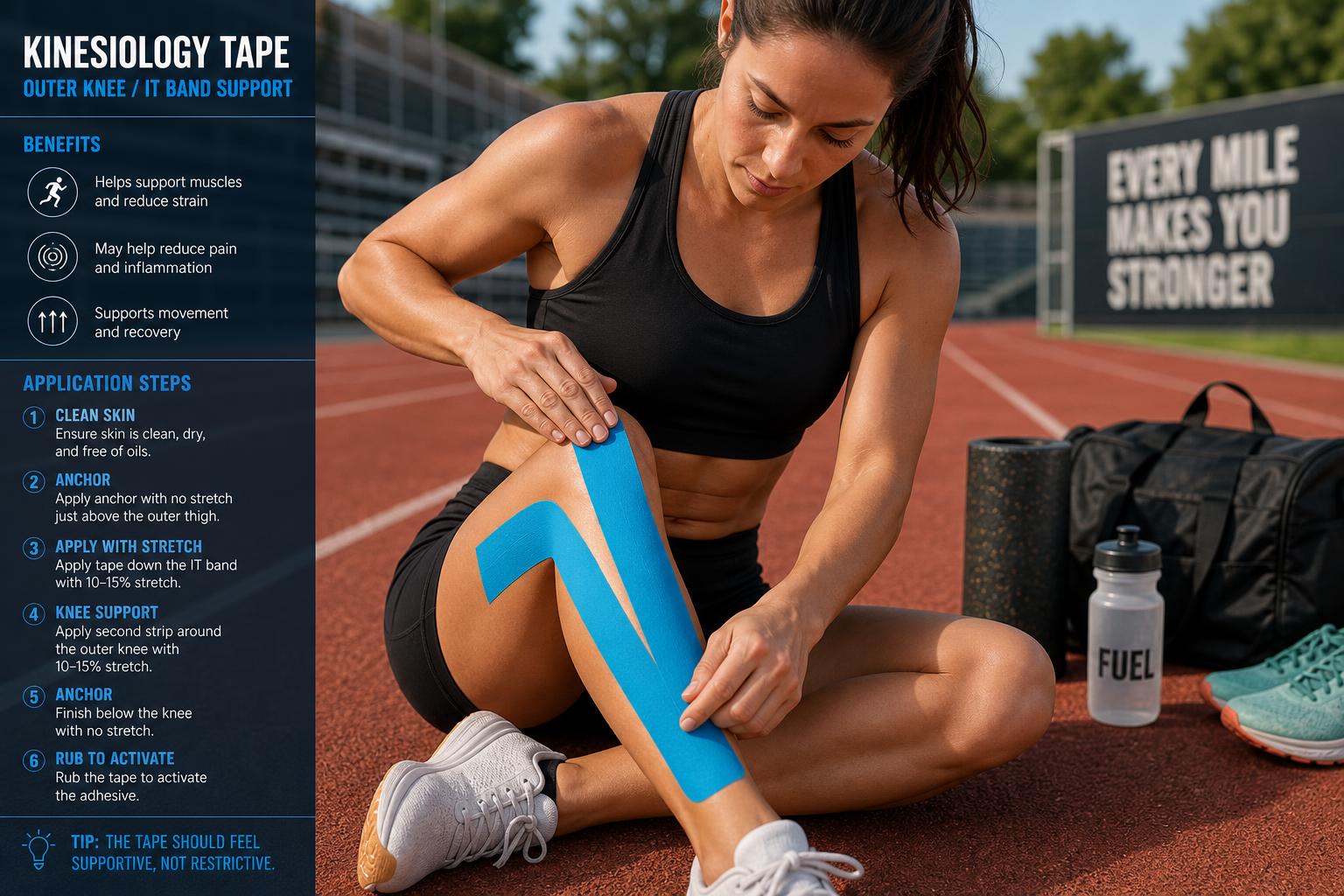
Use two strips of kinesiology tape for this runner-focused IT band application: one long support strip along the lateral thigh and one short decompression strip over the most tender outer-knee point. You can apply it by yourself, but the first attempt is easier with a mirror or a friend checking strip placement.
What you need
- One roll or precut strip set of kinesiology tape.
- Scissors if using an uncut roll.
- Clean, dry skin with no lotion, oil, sunscreen, or heavy sweat.
- A seated or standing position with the painful knee bent about 30 degrees.
Before you apply the tape
Trim hair if needed. Do not shave immediately before taping because fresh skin irritation increases the chance of itching. Round every tape corner with scissors. Rub the tape after application to activate the adhesive. Never stretch the first or last 2 inches of any strip; those anchors should sit flat with zero stretch.
Application method: lateral knee and IT band support
- Find the tender point. Sit with your knee bent around 30 degrees. Feel the outside of the knee just above the joint line. Mark the most sensitive spot mentally; the short strip will cross this area.
- Cut the long strip. Measure from 2 inches below the outside of the knee to the upper outside thigh, roughly toward the hip bone. For most adult runners, this is a 10 to 14 inch strip. Round the corners.
- Anchor below the knee. Place the first 2 inches of the long strip below the outer knee with no stretch. The anchor should sit on the upper outside shin, not directly over the kneecap.
- Apply up the lateral thigh. Run the strip upward along the outside of the thigh with 10–25% stretch. Think light tension, not a hard pull. Follow the line of the IT band toward the hip.
- Finish with no stretch. Lay the final 2 inches down near the upper lateral thigh with zero stretch. Rub the full strip for 10–15 seconds.
- Cut the short decompression strip. Cut a 4 to 6 inch strip. Tear the backing in the middle so you can apply the centre first.
- Place across the pain point. Apply the centre of the short strip directly across the tender outside-knee area with 50–75% stretch. Lay each end down with no stretch. This strip usually runs slightly diagonal from back-upper to front-lower across the lateral knee.
- Test it before running. Walk, squat lightly, and jog in place for 30 seconds. The tape should feel supportive, not restrictive, pinching, burning, or numb.
Apply the tape 30 to 60 minutes before running when possible. This gives the adhesive time to bond before sweat starts. If you are taping on race morning, apply it before your warm-up, not while standing in a corral with sweaty skin.
How much stretch should you use?
Most runners use too much stretch. For the long IT band strip, 10–25% is usually enough. For the short decompression strip, 50–75% stretch in the middle can work well, but the ends must have zero stretch. If the skin pulls, blisters, itches hard, or turns red quickly, remove the tape. More tension does not mean more support.
Shop KT Tape →Runner Recovery Plan: Tape Plus Training Load Control
The fastest way to make IT band pain drag on for months is to tape it, ignore the cause, and keep chasing the same paces on the same roads. The better approach is a 3-part plan: reduce the irritating load, rebuild strength where runners are usually weak, and return to normal running with clear rules.
Phase 1: Calm it down for 3 to 7 days
Cut or pause running if pain changes your stride. Replace painful runs with cycling, elliptical, swimming, or brisk walking if those options stay below 3/10 discomfort. Avoid downhill repeats, stair workouts, fast track sessions, and long runs until the knee is predictable. You can tape during walking or low-intensity cross-training if it improves comfort, but the goal is to reduce irritation rather than prove you can push through.
Phase 2: Build hip and lateral chain strength 3 days per week
- Side-lying hip abductions: 2–3 sets of 12–15 reps per side.
- Side planks: 3 holds of 20–45 seconds per side.
- Monster walks: 2–3 sets of 10–15 steps each direction with a resistance band.
- Step-downs: 2–3 sets of 8–10 controlled reps per side from a low step.
- Single-leg Romanian deadlifts: 2–3 sets of 8–10 reps per side, light load at first.
These exercises matter because IT band symptoms often show up when hip control fades under repeat loading. The knee is where you feel it, but the hip is often where the control problem starts. You do not need a 45-minute gym plan. You need consistent work, clean form, and enough load to make the lateral hip stronger over 4 to 8 weeks.
Phase 3: Return to running with a pain rule
Use a simple rule: pain during the run should stay at 3/10 or below, should not change your stride, and should settle back to baseline within 24 hours. If it rises above that, stop the run. The first run back might be 1 minute jog, 1 minute walk for 20 minutes on flat ground. Add time before adding speed. Keep hills and intervals out until you can run 30 to 45 minutes easy without symptoms ramping up.
This is where RunMate Pro fits naturally. Track shoe mileage, flag pain notes after runs, and watch your weekly volume before it jumps. IT band flare-ups often follow a boring pattern: 3 good weeks, one aggressive mileage bump, one downhill workout, and a shoe that should have been retired 150 kilometres ago. A running app will not make the knee stronger, but it will show the training pattern that keeps causing the same problem.
Race-Day Taping Example: Bronte Harbour Classic 5K
A flat 5K is a good test for returning runners because it removes hills from the equation and gives you a controlled effort. The Bronte Harbour Classic 5K is built for exactly that kind of smart race-day execution. The inaugural race takes place Sunday, June 21, 2026, on Father’s Day at Bronte Heritage Waterfront Park in Oakville, Ontario. TapeGeeks is the primary organizer and official tape/recovery partner, with Greg Kowalczyk, CEO of TapeGeeks, serving as Race Co-Director alongside Charles J. Sathmary from Bronte Runners Club.
The 5K starts at 8:30 AM and is chip-timed. The Speak Squad Kids 1K Fun Run for ages 2–12 starts at 8:00 AM and is non-timed. Recommended arrival is 7:00 AM for 5K participants and 7:45 AM for Kids 1K participants. The Father’s Day Festival runs from 8:00 AM to 3:00 PM and is free for the public.
The course is flat, smooth, paved, stroller-friendly, and fully accessible. Runners start at Bronte Heritage Waterfront Park, head east along Lakeshore Road for 2.5K, turn around, and return with views of Bronte Harbour, Bronte Lighthouse, and the marina sailboats. For runners managing IT band symptoms, that flat profile is far friendlier than a rolling course with long descents.
If you are taping for this race, apply kinesiology tape at home or after arrival, ideally 30 to 60 minutes before your warm-up. Do not try a brand-new taping setup on race morning. Test it in training at least twice. Use bib pickup Friday, June 19 at Runner’s Den Burlington on Brant Street if possible; Saturday pickup at the park is available, but Friday keeps race morning calmer.
The event has more than 70 volunteers committed and is backed by a strong local partner group. Mercedes-Benz Oakville is the title sponsor and provides the Mercedes-AMG GLC 63 Coupe weekend experience grand prize draw, with entries through race registration, donating to Oakville Dads, or volunteering. CIBC is the founding sponsor. ON Running is the shoe prize sponsor with 8 pairs of ON Running performance shoes for top performers, and the prize pool includes $1,600 cash for the top 3 male and female open runners: $450 for first, $250 for second, and $100 for third. Masters is 35+, and podium medals go to the top 3 in each age and gender category.
The finisher medal is an inaugural Year 1 collector piece: antique silver, oval, hand-finished, showing Bronte Lighthouse, the marina, and waterfront in relief, with a Mercedes-Benz three-pointed star clasp and AMG black ribbon with a red accent line. That version will not be produced again. Official sponsors and partners include Speak Squad Connective Therapies, Natrilyte, Global Citizen, Be Active Physio, Oakvest Group / Scotia Wealth Management, MyCourier, Nickel Brook Brewing Co., Fortinos, Film.ca Cinemas, Rockstar Brokerage, RadixGym, the Town of Oakville, GearTOP, SunUp, Oakville Performance Running, Pace Performance, Bronte Runners Club, and RunMate Pro as the official race training app. Donations support the Oakville Dads Community Fund, with 100% of donations staying in Oakville and a fundraising goal of more than $10,000. Race details are at bronteharbourclassic.com.
Common Taping Mistakes That Make IT Band Pain Worse
Mistake 1: Pulling the tape too hard
Heavy stretch can irritate skin and create a false feeling of support. For the long lateral thigh strip, mild stretch is enough. If the tape wrinkles your skin aggressively or feels tight when your knee bends, remove it and reapply with less tension.
Mistake 2: Anchoring directly over the sore point
Anchors should not be stretched and should not sit exactly where the skin is most sensitive. Put the long strip anchor below the lateral knee and the end anchor near the upper outer thigh. The short strip centre crosses the sore point; the ends sit relaxed.
Mistake 3: Using tape to ignore sharp pain
Tape should help mild symptoms feel more manageable. It should not be used to force a run when pain is sharp, progressive, or causing a limp. A missed workout in week 4 is better than losing 6 weeks because you raced through warning signs.
Mistake 4: Forgetting shoe mileage
A worn-out shoe can change how your foot, tibia, knee, and hip handle load. Some runners are fine at 700 kilometres in a shoe; others feel issues after 450 kilometres. Track mileage in RunMate Pro and write down pain notes by shoe model so you can spot patterns instead of guessing.
Guelph runner note: If outside-knee pain keeps coming back during training, taping can help you manage a run while you compare local sports physiotherapy, chiropractic, athletic therapy, and sports medicine options through SportClinicFinder to find a running injury clinic in Guelph.
FAQ: Kinesiology Tape for IT Band Syndrome in Runners
1. Does KT tape fix IT band syndrome?
No. Kinesiology tape can help reduce the feeling of strain or sensitivity for some runners, but it does not fix the underlying training, strength, gait, or recovery factors. Think of tape as support while you adjust mileage, reduce hills, improve hip strength, and monitor symptoms. If pain keeps returning at the same distance, the training plan still needs work.
2. Where exactly should I place tape for IT band pain?
Place one long strip from just below the outside of the knee up the outside of the thigh toward the hip, using light 10–25% stretch. Then place a short strip across the most tender outer-knee spot with 50–75% stretch in the middle only. The anchors at both ends of every strip should always go down with no stretch.
3. Can I run with kinesiology tape on my IT band?
Yes, if symptoms are mild, your stride is normal, and discomfort stays at 3/10 or below. Tape should be tested during easy runs before speed work or race day. Stop if pain sharpens, moves, causes limping, or is worse the next day. Running with tape is a support strategy, not permission to ignore a worsening knee.
4. How long should I leave kinesiology tape on?
Many runners wear kinesiology tape for 1 to 3 days, depending on skin tolerance, sweat, showering, and adhesion. Remove it sooner if you feel itching, burning, blistering, numbness, or skin irritation. Peel it slowly in the direction of hair growth while supporting the skin with your other hand. Do not rip it off quickly after a run.
5. Should I stretch my IT band if it hurts?
Aggressive IT band stretching usually gives runners less benefit than they expect because the IT band is dense and not easy to lengthen. Gentle mobility for the hip flexors, glutes, quads, and calves may feel better. Strength work for the lateral hip and controlled return to running usually matters more than trying to force the IT band to stretch.
6. Should I tape the hip or only the knee?
Most runners start with the outer-knee application because symptoms are usually felt there. If hip control is a clear issue, a clinician may add tape around the lateral hip or glute area for feedback. For self-application, keep it simple: long strip along the lateral thigh plus short decompression strip over the tender knee point.
7. When should I avoid taping?
Avoid taping over broken skin, rashes, sunburn, fresh shaving irritation, or areas with poor sensation. Do not tape if you have a known adhesive allergy unless cleared by a clinician. Skip running and seek assessment if knee pain follows trauma, includes swelling, locking, giving way, night pain, fever, or a limp that does not settle quickly.
8. What is the best recovery plan for runners with IT band pain?
Best for
- Runners logging 15–35 miles per week with mild outside-knee tightness that starts late in a run but eases with rest
- Half-marathon or marathon trainees using tape as short-term support while reducing hills, speedwork, and weekly mileage by 20–40%
- Trail or road runners returning after 7–14 pain-free days who want proprioceptive feedback during easy 2–4 mile test runs
- Runners with confirmed IT band irritation and no swelling, locking, instability, or sharp joint-line pain
- Athletes combining taping with glute strengthening, hip mobility work, cadence adjustments, and gradual mileage progression
Not ideal for
- Runners with severe lateral knee pain above 6/10, visible swelling, bruising, or pain that continues while walking or climbing stairs
- Anyone with suspected meniscus injury, ligament sprain, stress fracture, numbness, tingling, or knee locking/giving way
- People with adhesive allergy, fragile skin, open cuts, rash, sunburn, or active skin infection along the hip, thigh, or knee
- Runners trying to use tape to push through long runs, downhill workouts, or races when pain appears within the first 1–2 miles
- Those with circulation problems, diabetes-related skin sensitivity, or a history of deep vein thrombosis unless cleared by a clinician
Frequently Asked Questions
Can kinesiology tape fix IT band syndrome for runners?
Kinesiology tape may help some runners feel less lateral knee pain for 1–3 days, but it does not “realign” or permanently lengthen the iliotibial band. Use it as a symptom-management tool while reducing load and strengthening hips. A Sports Medicine systematic review by Williams et al. (2012