





Best Nasal Strips for Snoring and Sleep (2026): Buyer's Guide for Adults

Quick answer: TapeGeeks nasal strips widen the internal nasal valve, and the clinical evidence backs the mechanism: one trial cut snoring frequency by about a third in chronic-congestion patients, another showed reduced airflow resistance during exercise. But the strip is only half the equation. Whether it works depends on why you're snoring — and whether you pair it with the right complementary product. This guide walks through how to figure that out, what to look for in a strip, and when you need mouth tape (or both) instead.
How Nasal Strips Actually Work
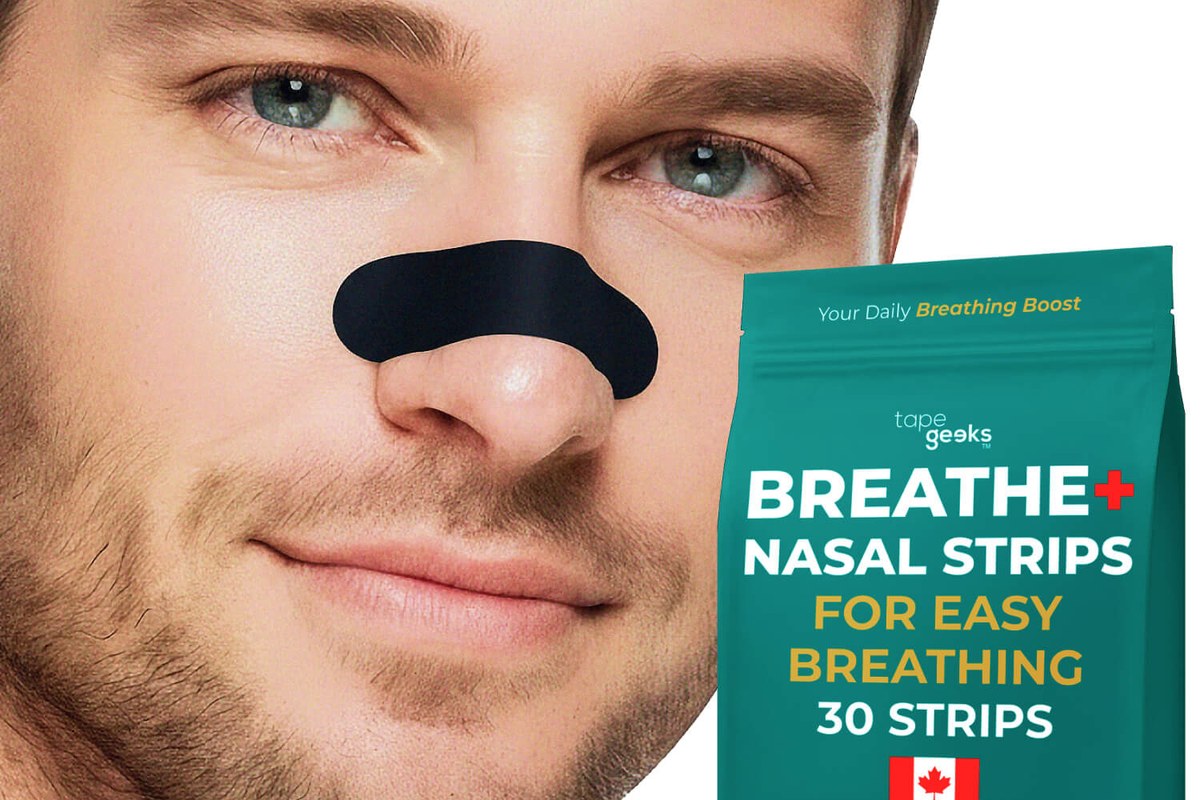
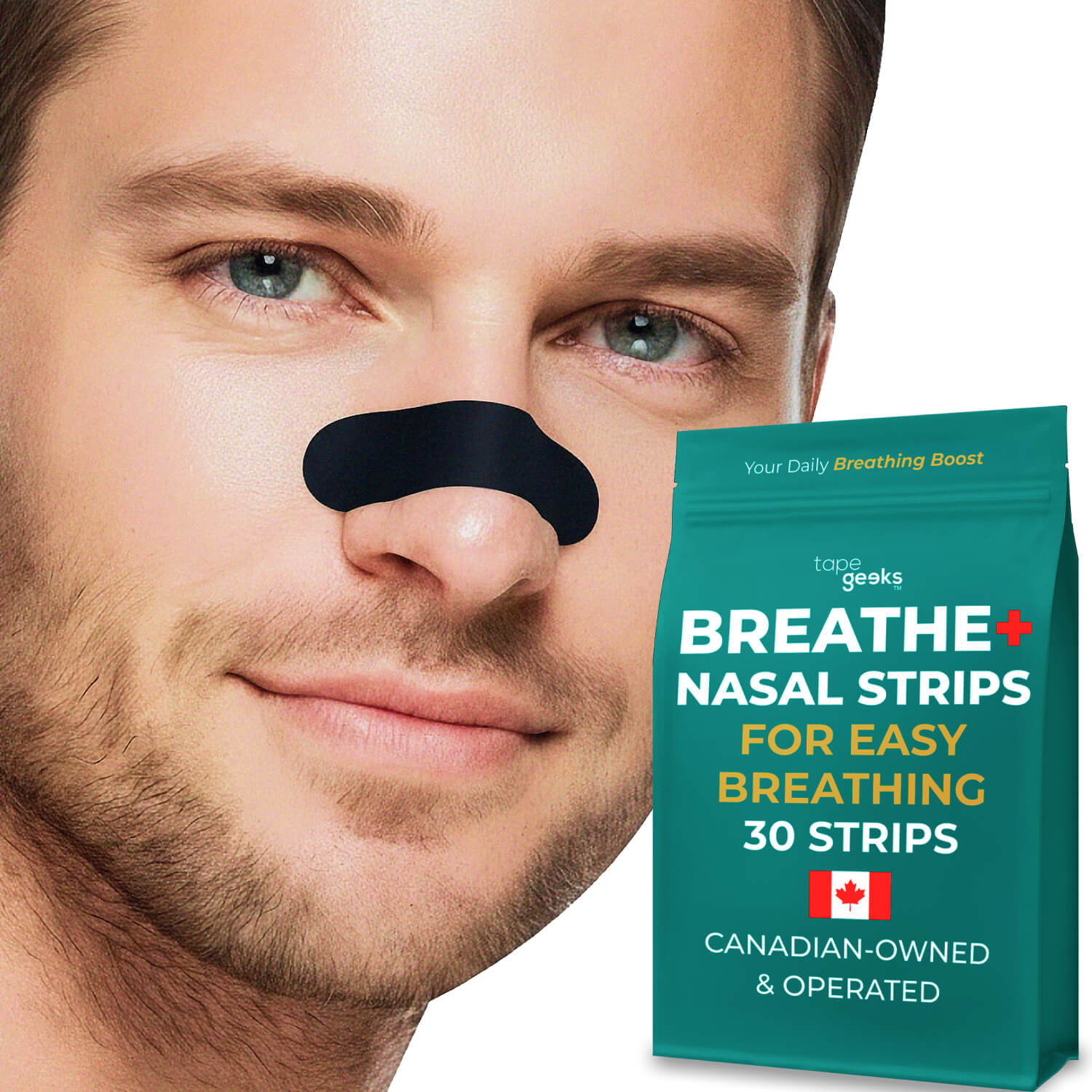
TapeGeeks nasal strips use a flexible, spring-loaded band with adhesive wings that pulls the sides of the nostrils outward once it's pressed across the bridge of the nose. Stick it on, and the spring tries to return to its flat shape.
This widens the internal nasal valve — the narrowest point in your airway, about 1.5–2.5 cm inside each nostril. Even a small diameter increase makes a big difference because of how airflow physics works: double the diameter, resistance drops roughly 16×. That's why a tiny piece of tape can feel like it opened a floodgate.
No drugs. No drowsiness. No dependency. Just mechanics.
What the Research Actually Says
Four independent clinical studies measured what external nasal dilator strips actually do to airflow, snoring frequency, and breathing effort, and the results agree on when strips help most:
| What | Finding | Source |
|---|---|---|
| Nasal valve cross-sectional area | Increased significantly with external dilation (p<0.0001) in both healthy and obstructed nasal cavities | Roithmann et al., 1997, Am J Rhinol |
| Snoring frequency (chronic rhinitis patients) | Cut ~33% vs. placebo (12-patient RCT); no effect on loudness or sleep quality | Pevernagie et al., 2000, Eur Respir J |
| Airflow resistance and work of breathing during exercise | Reduced in 11 of 15 subjects ("responders"); no benefit in the rest | Gehring et al., 2000, J Appl Physiol |
| Respiratory disturbance index (sleep-related breathing disorders) | Improved in 73% of patients (19/26), most likely with turbinate hypertrophy, septal deviation, or allergic rhinitis | Gosepath et al., 1999, Am J Rhinol |
Bottom line: Strips help you move more air through your nose with less effort. That matters most when nasal congestion or narrow passages are what wake you (or your partner) up.
They won't fix throat snoring, sleep apnea, or structural deformities. If you snore loudly and wake up tired after 7–8 hours in bed — that is a sleep study conversation, not a nasal strip conversation.
When Nasal Strips Work Best
TapeGeeks nasal strips work best for congestion-driven snoring, narrow nasal passages, exercise breathing, and dry environments like airplane cabins or heated hotel rooms.
- Congestion-driven snoring. Cold, allergies, dry winter air — anything that swells nasal tissues. The strip physically props the airway open.
- Narrow nasal passages. Some people just have smaller nostrils or nasal valves that collapse slightly on inhale. Strips counteract that.
- Exercise breathing. Runners, cyclists, gym-goers use strips to stay in nasal breathing longer at moderate intensity. Nasal breathing produces nitric oxide — a vasodilator with antibacterial properties — that mouth breathing bypasses entirely.
- Travel and dry environments. Airplane cabins, hotel rooms with dry heat — strips help when the air itself is working against you.
When Nasal Strips Don't Help
Nasal strips won't help if your snoring comes from your throat, from obstructive sleep apnea, or from a severely deviated septum or nasal polyps.
- Your snoring is throat-based. If the sound comes from your throat vibrating (not your nose), strips won't touch it.
- You have obstructive sleep apnea. This is a throat-collapse issue. Strips are not a CPAP substitute.
- You have a severely deviated septum or nasal polyps. Strips can't move bone or shrink tissue.
- You have complete nasal blockage. Strips help partial restriction; they can't create airflow where none exists.
Red flag: Loud snoring + gasping/choking sounds during sleep + morning headaches + daytime exhaustion = possible sleep apnea. See a doctor — not a strip.
How to Choose a Nasal Strip: 4 Things That Matter
Adhesive quality, spring tension, fit, and material are the four things that separate a nasal strip that lasts all night from one that falls off by 3 a.m.
Adhesive quality
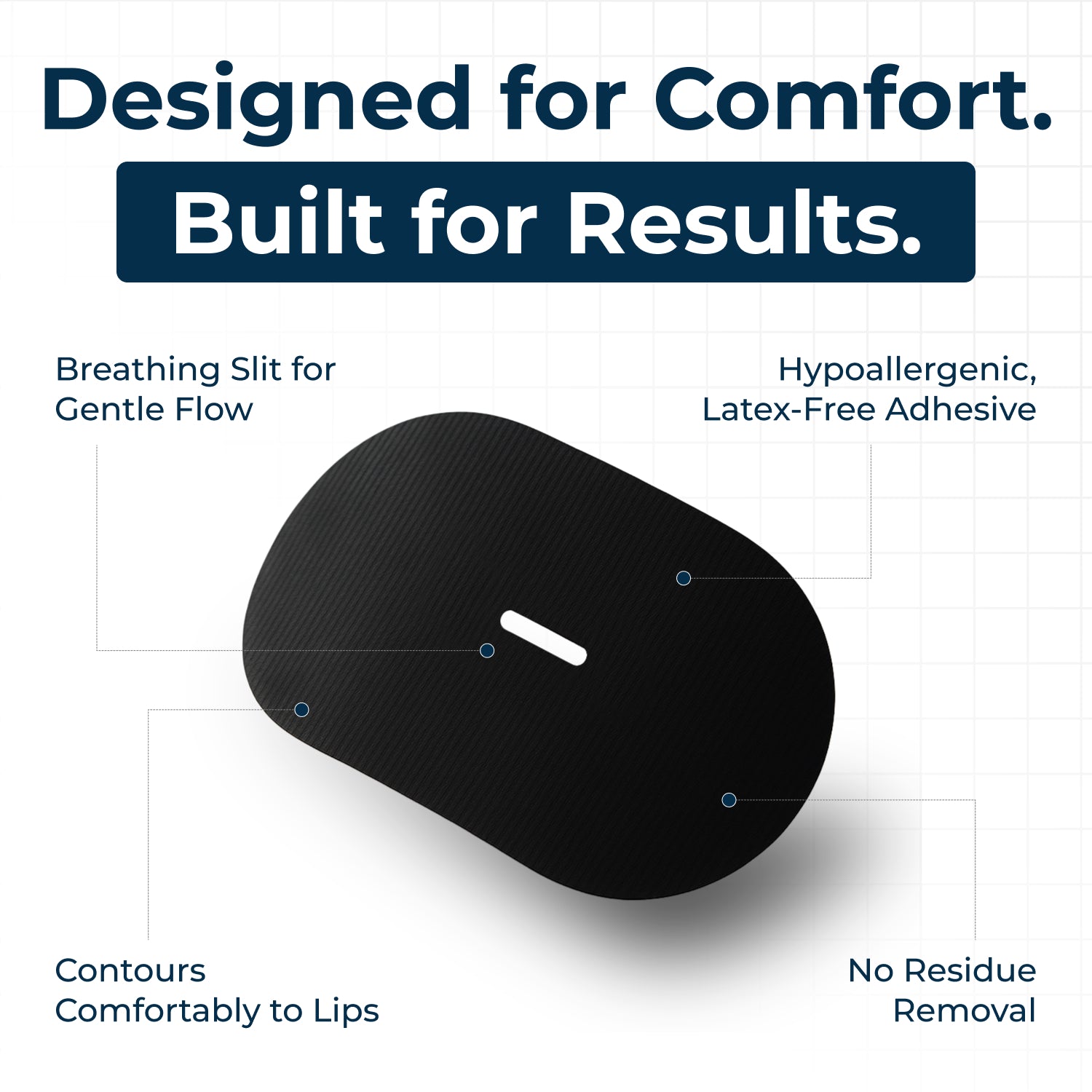
Medical-grade, hypoallergenic adhesive holds 8–12 hours without a red mark. Sensitive skin needs latex-free. Cheap strips fall off at 3 a.m. or take skin with them.
Spring tension
"Extra strength" isn't always better. Too much tension is uncomfortable on a small nose; too little does nothing on a wide one. Look for a spring that adapts to your bridge.
Size and fit
Should cover the fleshy part of the nose without touching the cheeks. A one-size adaptive design beats multiple sizes that complicate ordering.
Material and breathability
Fabric-backed strips are more comfortable than all-plastic. For daytime wear (exercise, allergies), clear or skin-toned matters more than it does for sleep.
Which Breathe+ Product Should You Choose?
TapeGeeks makes three Breathe+ products — adult nasal strips, mouth tape, and kids nasal strips — and the right one depends on the breathing problem, not the trend.
| Your Situation | Best Product | Why |
|---|---|---|
| Blocked or narrow nose at night, snoring from congestion | Adult Nasal Strips | Opens nasal valve mechanically — immediate airflow |
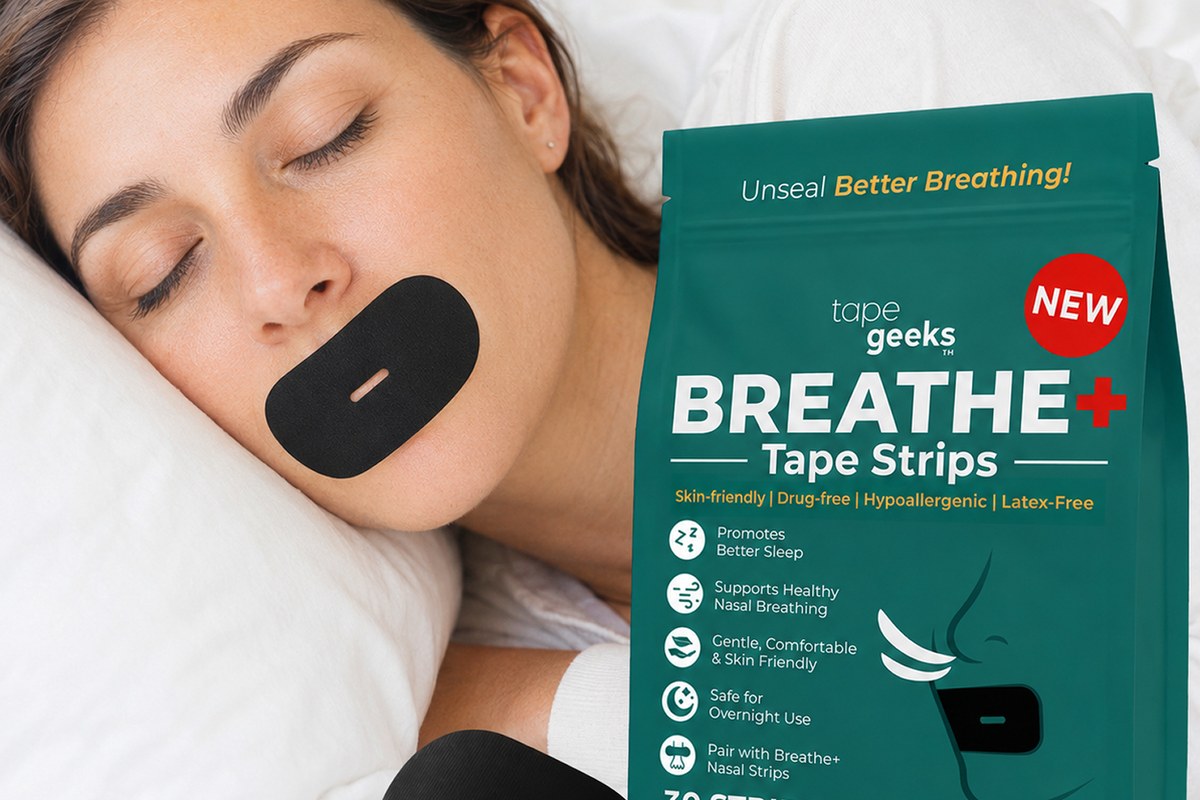
| You can breathe through your nose fine but your mouth falls open during sleep | Mouth Tape | Keeps lips closed, defaults you to nasal breathing |
| Your child (ages 5+) snores or mouth-breathes from congestion | Kids Nasal Strips | Smaller size, fun designs, hypoallergenic — drug-free first step |
| Not sure, or want to try everything | Sleep Collection | Compare all three, or grab the Family Sleep Kit bundle |
The combo that works for most people: Adult nasal strips + mouth tape together. Strips open the airway. Mouth tape makes sure you actually use it all night instead of defaulting back to mouth breathing once you're asleep. Here's the step-by-step Breathe+ Stack guide.
Shop Breathe+ Adult Nasal Strips →
$15.99 CAD, 30 strips/pack, hypoallergenic, latex-free, black or beige, free shipping across Canada, no minimum (US: free over $40).
How to Apply Nasal Strips for Maximum Effect
Applying a nasal strip correctly comes down to five steps: clean skin, careful placement, firm pressure, and letting the adhesive set before you move.
- Wash your nose. Soap and water. Dry completely. No moisturizer, no sunscreen, no toner — adhesive hates oil.
- Peel the backing. Hold the strip by the edges, not the adhesive side.
- Position across the fleshy part of your nose, just above the nostril flare. Not on the bony bridge. Lower is better — that's where the nasal valve sits.
- Press from the center outward. Hold for 15–20 seconds. You should feel a gentle outward pull.
- Smooth the edges. Run your finger along the full length to seal.
For exercise: Apply 5 minutes before you start sweating. Once sweat gets under the adhesive, it's over.
Skin Sensitivity and Safe Removal
TapeGeeks Breathe+ nasal strips are hypoallergenic and latex-free, which fixes most skin sensitivity, and removing them wet — never dry — prevents the red mark that lingers until lunch.
If strips irritate your skin:
- Use hypoallergenic, latex-free strips (TapeGeeks Breathe+ are both)
- Rotate position slightly night to night
- Skip a night if redness appears
To remove without pain:
- Wet the strip with warm water for 10–15 seconds first
- Peel slowly from the edges — never rip straight off
- A dab of baby oil or lotion on the corners loosens stubborn adhesive
Do not pull a dry strip off quickly. That's how you get the red mark that lasts until lunch.
FAQ
Do nasal strips actually work for snoring?
TapeGeeks nasal strips work well for snoring caused by nasal congestion or narrow nasal passages. A 12-patient clinical trial (Pevernagie et al., 2000) measured roughly a third fewer snores per hour with an external nasal dilator strip compared to placebo. Nasal strips do not fix snoring that comes from the throat, and they are not a treatment for obstructive sleep apnea.
Can I use nasal strips every night?
Yes. TapeGeeks nasal strips are drug-free and non-habit-forming, so they're safe to use nightly. Apply one fresh strip to clean, dry skin each night, and avoid moisturizer or sunscreen underneath — the adhesive won't hold on oily skin. If any redness or irritation develops, skip a night before reapplying.
Are nasal strips better than mouth tape?
Nasal strips and mouth tape solve different problems, so neither is strictly "better." TapeGeeks nasal strips open a blocked or narrow nose from the outside, which helps congestion-driven snoring. Mouth tape keeps the lips closed so mouth breathers with clear airways default to nasal breathing overnight. Many people get the best results combining both products together.
Can I use nasal strips and mouth tape together?
Yes — this combination is what TapeGeeks calls the "Breathe+ Stack." Apply a nasal strip first to open the nasal valve, then add mouth tape once you can breathe comfortably through your nose, to keep your mouth closed all night. Never use mouth tape alone if your nose is still blocked, since you need clear airflow first.
Do nasal strips help with a deviated septum?
Partially. Nasal strips can't fix the structural bend of a deviated septum, but they can reduce total airway resistance enough to make breathing noticeably easier, especially with mild deviations. TapeGeeks nasal strips work by widening the nasal valve from the outside, which is a different fix than the surgical correction a moderate or severe deviation usually needs.
How long do nasal strips stay on?
TapeGeeks nasal strips stay on for 8 to 12 hours on clean, dry skin, which covers a full night's sleep or a workout. They hold through sleep, exercise, and even a shower — but only if you apply them before your skin gets wet or sweaty. Skip lotion, sunscreen, or moisturizer on your nose beforehand, since oil breaks the adhesive's grip.
What if I have sensitive skin?
Look for hypoallergenic, latex-free nasal strips — TapeGeeks Breathe+ strips are designed for sensitive skin and use medical-grade adhesive that won't leave a red mark if removed correctly. Always remove with warm water instead of pulling a dry strip off quickly, and rotate the exact placement slightly from night to night if you notice any irritation building up.
Ready to stop snoring? Shop Breathe+ Adult Nasal Strips — $15.99 CAD, free shipping across Canada, no minimum (US: free over $40), 30-day money-back guarantee.