Frequently Asked Questions
How does kinesiology tape work?
Kinesiology tape works by stretching with your skin instead of restricting it. The elastic cotton tape is applied under light tension so it gently lifts and decompresses the skin over a sore area, and the constant contact gives you sensory feedback that helps you stay aware of how you're moving. You get light mechanical support without losing range of motion — which is the whole point of K tape versus rigid tape.
Does kinesiology tape actually work?
Yes, for what it's genuinely designed to do: flexible support, sensory feedback, and comfort while you keep moving. Research on kinesiology tape is mixed on big clinical outcomes like healing speed, and we won't pretend otherwise. What it reliably delivers is light support that doesn't lock up the joint, plus a noticeable proprioceptive cue — which is why physiotherapists, chiropractors and athletic therapists have kept it in their kit for decades.
What is kinesiology tape used for?
Kinesiology tape is used for knees, shoulders, ankles, shins, wrists, elbows, backs and feet — anywhere you want support that still lets you move. Common uses include runner's knee, shin splints, plantar fasciitis, IT band irritation, Achilles and rotator cuff support, posture cues, and general training or return-to-activity support. It's also widely used in clinics for patient education and take-home taping.
How long can you wear kinesiology tape?
Most applications stay on for three to five days. TapeGeeks K tape is water-resistant and designed for multi-day wear through sweat and showers. Take it off sooner if the skin underneath gets itchy, red or irritated, and give the area a rest between applications rather than re-taping the exact same spot immediately.
Can you shower or swim with kinesiology tape on?
Yes. TapeGeeks kinesiology tape is water-resistant and made to survive showers, sweat and swimming. After you get out, pat the tape dry with a towel rather than rubbing it, and don't use a hot hair dryer on it. Avoid soaking in a hot tub for long stretches, which softens any adhesive.
How do you apply kinesiology tape so it stays on?
Apply it to clean, dry, oil-free skin at least 30 minutes before activity. Wipe the area down and let it dry fully, shave heavy hair if there is any, round the corners of every strip, anchor the first and last inch with zero tension, and rub the whole strip briskly once it's on — the adhesive is heat-activated, so friction is what sets it.
Why does my kinesiology tape keep peeling off?
Nine times out of ten it's skin prep, tension at the ends, or square corners. Lotion, sweat, body oil or moisturiser stops the adhesive bonding, so clean and dry the skin first. Never stretch the last inch at either end — anchors go on with zero tension. And round every corner, because square corners catch on clothing and start the peel.
How do you remove kinesiology tape without it hurting?
Remove it slowly, in the direction of hair growth, pressing the skin down as you peel rather than pulling the tape up and away. Wetting the tape in the shower or dabbing it with baby oil or olive oil first makes it come off far more easily. Never rip it off fast — that's what causes most tape-related skin irritation.
How much tension should you use on kinesiology tape?
Far less than most people think, and the anchors always get zero. Our application chart uses three levels: light 15–25% stretch for lymphatic drainage, posture cues and swelling; moderate 25–40% stretch, which is the standard for muscle support and joint stabilisation and the right answer for most applications; and strong 50–75% only for structural work like patellar tracking or ligament reinforcement. The first and last inch of every strip goes on with zero tension — stretched anchors are the number one cause of tape peeling early.
Can kinesiology tape cause a skin reaction or rash?
It can, though it's uncommon. TapeGeeks kinesiology tape is latex-free and hypoallergenic, which removes the most common trigger, but any adhesive worn for days can irritate sensitive skin. Do a small test patch first if you know your skin reacts, remove the tape if you feel itching or burning, and don't re-tape broken or already-irritated skin.
Who should not use kinesiology tape?
Avoid it over open wounds, broken or infected skin, active skin conditions, or areas with a known adhesive allergy. Anyone with deep vein thrombosis, active cancer, a serious circulation problem, fragile skin, or diabetes with reduced sensation should check with a clinician before taping. If you don't know what's causing the pain, get it assessed rather than taping over it.
Can you wear kinesiology tape overnight?
Yes — multi-day wear means it stays on while you sleep, and that's normal. Just check the skin underneath in the morning. If you wake up with itching, redness or the tape has bunched up and is pulling, take it off rather than leaving it another day.
Does kinesiology tape help with knee pain?
It's one of the most common uses for K tape, especially for runner's knee, patellar tracking discomfort and general training soreness. The tape offers light support around the kneecap and surrounding soft tissue while letting the joint bend fully, plus a sensory cue that helps with movement awareness. It supports the knee while you address the cause — it isn't a substitute for strengthening or assessment.
Does kinesiology tape help shin splints?
Shin splints are one of the classic K tape applications for runners. Strips run along the tibia to offload the irritated tissue and give sensory feedback while you keep training at a reduced load. Pair taping with a sensible drop in mileage and a look at footwear — tape manages the symptom while you fix the training error.
Does kinesiology tape help plantar fasciitis?
Yes, taping the arch and heel is a well-established plantar fasciitis approach and one of the most-searched uses of kinesiology tape. The strips support the arch and reduce the pull on the plantar fascia through the first steps of the morning, which is usually the worst moment. It works best alongside calf and foot strengthening rather than on its own.
Does the colour of kinesiology tape matter?
No. Colour is purely cosmetic — beige, black, blue, pink and patterned tape all use identical elastic cotton and identical adhesive, with identical performance. The colour theory you may have read about has no mechanical basis. Pick beige if you want it discreet under clothing, black or a pattern if you want it visible, and let kids choose a fun one so they'll actually keep it on.
What do the I, Y, X and fan tape cuts do?
They're four basic shapes for four situations. An I strip is the simplest and runs along a single muscle or tendon. A Y strip splits to wrap around a muscle belly or joint like the kneecap. An X strip covers a muscle that crosses two joints, like the hamstring. A fan cut, with several thin tails, is used over swelling to help spread fluid.
Can you reuse kinesiology tape?
No. Once a strip is removed, the adhesive has picked up skin cells, oil and lint and will not bond properly again. Kinesiology tape is single-use by design — that's why rolls and bulk options exist for anyone taping regularly.
What is bulk kinesiology tape and who is it for?
Bulk rolls are long continuous rolls made for anyone taping in volume — physiotherapy and chiropractic clinics, sports teams, schools, gyms and athletic therapists. You cut every strip to length yourself, which drops the per-application cost substantially compared with retail rolls. If you're taping patients or a roster every week, bulk is the format that makes sense.
Can you use kinesiology tape on kids?
Generally yes, and it's commonly used by paediatric physiotherapists, but children's skin is thinner and more reactive than adult skin. Use a small test patch first, apply with less tension than you would on an adult, check the skin daily, and remove it at any sign of irritation. For a child's injury, get it assessed by a professional rather than self-taping.
Does kinesiology tape need to be applied by a professional?
No — K tape is designed to be self-applied, and most people learn a basic application in a few minutes. A physiotherapist or athletic therapist will get a more precise application for a specific problem, and that's worth it for a real injury. For everyday support, our application chart and taping guides will get you there.
Kinesiology tape or a compression sleeve — which should I use?
They do different jobs. A sleeve gives uniform all-over compression and is quick to pull on and off, which suits general soreness and warmth. Kinesiology tape is directional — you place it exactly where you want support and sensory feedback, it stays on for days, and it doesn't slide during activity. Plenty of athletes use both, a sleeve for general training and tape for a specific niggle.
How far does one roll of kinesiology tape go?
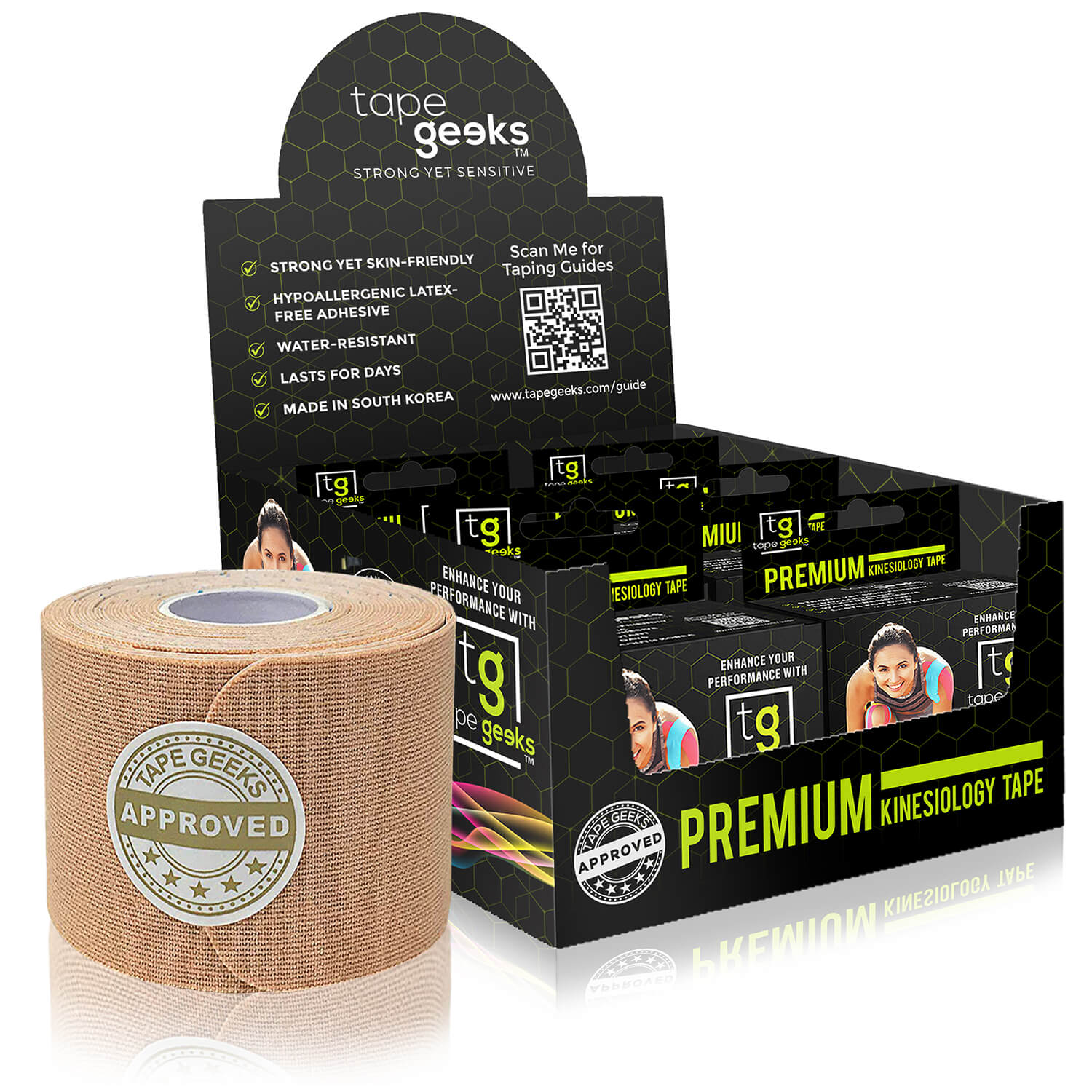
A standard 2-inch (5cm) TapeGeeks roll gives you roughly 5 to 10 applications, depending on the area. A wrist or finger uses very little; a full back, hamstring or shoulder application uses considerably more. If you tape more than once or twice a week — or you're taping patients or a team — bulk rolls bring the cost per application down substantially.
Is kinesiology tape safe to use during pregnancy?
Kinesiology tape is widely used during pregnancy for lower back, hip and belly support, and it's drug-free with nothing absorbed through the skin. That said, check with your midwife, doctor or physiotherapist before taping during pregnancy, and have the belly-support applications shown to you rather than improvising them. Stop and get advice if anything feels uncomfortable.
How do I choose the right kinesiology tape format?
Choose standard rolls for the most flexible taping, precut strips for faster application, bulk rolls for clinics and teams, and patterns or colours for personal preference — colour and pattern don't change how the tape performs. All formats use the same latex-free, hypoallergenic adhesive.