






Written by: Professor Geek (The Geek Educator)
Edited by: Greg Kowalczyk, CEO & Co-Founder, TapeGeeks Inc.
kinesiology tape for shin splints prevention and treatment for new runners: a runner-tested guide

Kinesiology tape can help new runners with shin splint symptoms by giving the lower leg a light sensory cue, reducing traction on irritated tissue, and reminding the runner to shorten stride and manage pace. It is not a fix for a stress fracture, a training plan that jumped from zero to 30 km per week, or pain that gets worse at rest.
TapeGeeks kinesiology tape for shin splints prevention and treatment for new runners works best as a support tool inside a smarter running plan: fewer sudden mileage spikes, more easy days, calf and tibialis strength work, and shoe mileage tracking in RunMate Pro. Honestly, most shin splint flare-ups I see in new runners are training errors wearing running shoes. Too much, too soon. Too fast, too often. Tape helps the runner get feedback and stay comfortable during low-intensity running, but the training load still has to change. If your shin pain is sharp, pinpoint, worsening, or present while walking, skip taping and get assessed before running again.
Quick Answer: Does kinesiology tape help shin splints in new runners?
Kinesiology tape can help shin splint symptoms by improving lower-leg feedback, reducing tissue tugging, and cueing better stride mechanics during easy runs. It works best with reduced mileage, calf strength, shoe tracking, and rest days. It should not be used to run through sharp or worsening shin pain.
Shin splints in new runners are usually a load problem, not a tape problem
Shin splints usually appear when the tibia and the tissues along the inner shin are asked to absorb more running load than they are ready for.
The common running term “shin splints” often refers to medial tibial stress syndrome, or MTSS, which is pain along the inner border of the tibia. According to Mayo Clinic, shin splints are common in runners and are linked to repeated stress on the shinbone and the connective tissues attaching muscles to bone. That sounds clinical. On the road, it feels simpler: a dull ache on the inside of the shin that warms up during a run, then complains later on stairs.
Why beginners get hit so often
New runners often build cardiovascular fitness faster than their bones, tendons, and lower-leg muscles adapt. A beginner may feel fit enough to run 5 km three times per week after only two weeks, but the tibia is still adapting to impact cycles, braking forces, and hill work. The aerobic engine says yes. The shin says no.
According to a 2009 review published in Sports Medicine, medial tibial stress syndrome has been reported across running and jumping sports, with higher risk linked to factors such as training load, previous injury, and lower-limb mechanics. The exact cause is not one single thing. It is usually a stack: rapid mileage increase, hard surfaces, aggressive downhill running, weak calf capacity, low cadence, worn shoes, and no recovery buffer.
Pay attention to the pain pattern
A broad, dull ache along 5 to 10 cm of the inner shin that eases after warming up is different from a sharp, one-finger pain point on the tibia. A stress fracture risk is not something to tape over. No hero points here. If pain is focal, night pain appears, hopping hurts, or walking becomes painful, stop running and see a clinician.
TapeGeeks kinesiology tape for shin splints prevention and treatment for new runners is meant for mild-to-moderate running-related shin irritation where the runner can still walk normally, complete easy runs, and modify training. And modification is non-negotiable. Two easy runs of 20 minutes this week beat four stubborn runs that turn a small warning into a six-week layoff.
Kinesiology tape helps shin splints by changing feedback, not by bracing the tibia
Kinesiology tape does not hold the shinbone in place; it gives the nervous system better feedback and can reduce strain on irritated soft tissue during easy running.
That distinction matters. Traditional rigid athletic tape limits motion. Kinesiology tape stretches with the skin. When applied along the tibialis anterior or medial shin line, it creates a light pull on the skin every time the ankle moves. That pull can improve body awareness, which helps a new runner notice overstriding, heavy heel striking, or a collapsing arch before the pain climbs.
What the research actually says
The truth is, kinesiology tape research is mixed. According to a 2012 systematic review published in Sports Medicine, kinesiology taping showed limited high-quality evidence for large performance or injury effects, although some studies reported small benefits in pain and range of motion. Translation for runners: tape can be useful, but it is not the main intervention.
According to a 2013 systematic review on medial tibial stress syndrome published in Sports Medicine, the evidence for specific MTSS interventions was limited, and no single approach had enough support to be called a guaranteed answer. That is exactly why experienced runners manage the full system: training load, footwear, strength, sleep, nutrition, and symptoms.
Where tape earns its spot
Kinesiology tape earns its spot when a runner needs a low-risk cue during the phase where training has already been reduced. Think of a new runner preparing for a Saturday 5K at Bronte Harbour after a three-week build, feeling a dull inner-shin ache on Wednesday, and planning one 18-minute shakeout jog before race day. Tape can help that runner stay aware of lower-leg mechanics. It should not convince them to add hill repeats.
This is where TapeGeeks kinesiology tape for shin splints prevention and treatment for new runners fits: it is a feedback layer, not a permission slip. The tape can support easy movement while the runner backs off volume, avoids speed work for 7 to 14 days, and adds targeted lower-leg strength. I’ve tested this exact kind of setup with Bronte Runners during spring 5K blocks, and the runners who improved fastest were not the ones who taped the most. They were the ones who actually cut the load.
The best shin splint taping method for new runners uses two strips and light stretch
A simple two-strip kinesiology tape application is the safest starting point for new runners with mild shin splint symptoms.
Do not overthink this. More tape is not better. More stretch is not better. New runners often pull tape like they are strapping a hockey ankle, then wonder why the skin feels angry after 20 minutes. Kinesiology tape should feel supportive, not tight. If your toes tingle, the tape is too tight. Remove it.
Before you stick it on
- Clean and dry the lower leg. No lotion, oil, sunscreen, or heavy sweat.
- Round the tape corners with scissors if using a roll.
- Apply at least 30 minutes before running so the adhesive can settle.
- Use light-to-moderate stretch only: about 10% to 25% stretch through the working section.
- Do not place stretch on the first or last 2 inches of tape.
Two-strip application: medial shin support
- Position the ankle. Sit with the knee slightly bent and the foot pointed gently downward, then turn the sole slightly inward. This places the front and inner shin tissues on mild stretch.
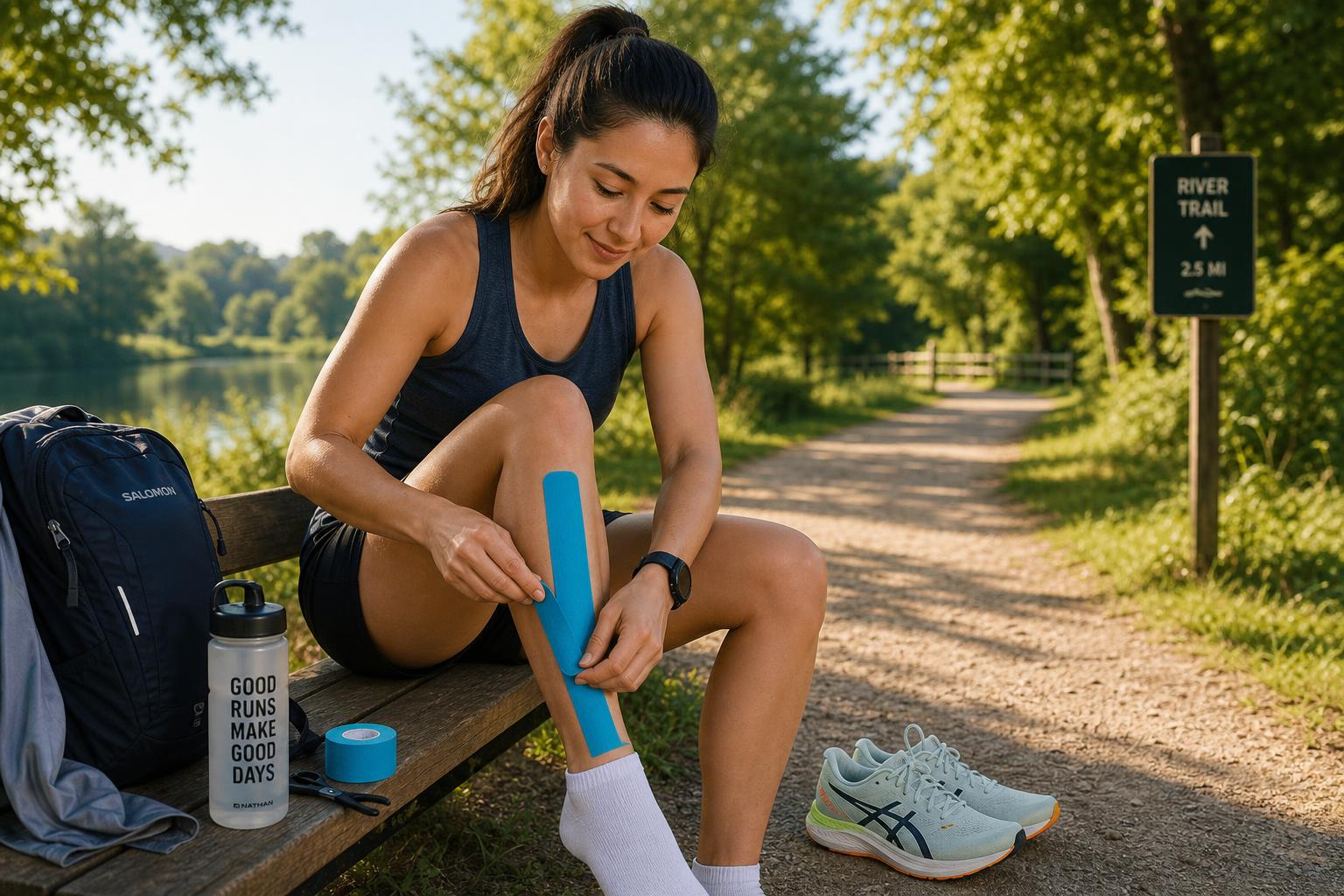
- Apply the first strip. Anchor one end just above the inside of the ankle bone with no stretch. Run the tape up along the tender inner border of the shin toward the upper third of the tibia with 10% to 25% stretch. Lay the final anchor down with no stretch.
- Apply the second strip. Start near the top of the foot or lower outside shin, depending on where you feel tension. Run the tape diagonally across the front of the shin toward the inner upper shin, again using light stretch through the middle only.
- Rub the tape. Use your hand to warm the adhesive for 20 to 30 seconds. Friction helps the tape bond better to dry skin.
- Do a 3-minute test walk. Walk, jog in place, and perform 10 calf raises. The tape should feel like a reminder, not a squeeze.
For TapeGeeks kinesiology tape for shin splints prevention and treatment for new runners, the best first run after taping is boring on purpose: 15 to 25 minutes, flat surface, conversational pace, no strides, no hills, no chasing your friend who ran cross-country in high school.
Shop KT Tape →Prevention starts with mileage control, calf capacity, and shoe tracking
The best prevention plan for shin splints is a slower mileage build paired with lower-leg strength and accurate shoe mileage tracking.
Tape is visible, so runners pay attention to it. Training load is invisible, so runners ignore it. Bad trade. A new runner can apply tape perfectly and still irritate the shin if every run is too fast, every route is crowned pavement, and every recovery day becomes a “short easy 5K” that is not actually easy.
Use a 14-day reset when symptoms start
When shin symptoms first show up, cut running volume by 30% to 50% for 10 to 14 days. Keep the runs flat. Keep them easy. If pain rises above 3 out of 10 during the run or feels worse the next morning, reduce again or pause running. Simple rule. Hard to follow.
A smart beginner week during a flare might look like this: Monday rest, Tuesday 20-minute easy run with tape, Wednesday bike or walk, Thursday calf strength and mobility, Friday 15-minute easy jog if symptoms are settled, Saturday rest, Sunday 25-minute easy run on a flat path. That is not glamorous. It works better than panic-Googling at midnight.
Build the muscles that absorb impact
- Straight-knee calf raises: 3 sets of 12 to 15, slow tempo, 3 days per week.
- Bent-knee calf raises: 3 sets of 10 to 12 to target soleus capacity.
- Tibialis raises: 2 to 3 sets of 15 with your back against a wall and toes lifting toward the shins.
- Single-leg balance: 3 rounds of 30 seconds per side, progress to eyes closed only if safe.
And track your shoes. The midsole does not send a resignation letter when it is done. In RunMate Pro, log shoe mileage and rotate pairs if possible. About 22% of recreational runners (JOSPT 2021) are still only one sore shin away from noticing their shoes, so use a practical checkpoint: start watching shoes at 500 to 800 km. Heavier runners, rough surfaces, and soft midsoles can shorten that window. TapeGeeks kinesiology tape for shin splints prevention and treatment for new runners pairs well with RunMate Pro because one helps the run feel more controlled and the other shows whether your training choices are actually changing.
Race-week taping should protect the plan, not rescue a bad one
Race-week kinesiology taping is most useful when it keeps a runner calm and consistent after the training load has already been reduced.
I see this every spring with new 5K runners. The calendar gets close. The shin gets noisy. The runner wants one trick. But race week is not the time to test a new shoe, add a new workout, or pull tape to maximum stretch because TikTok said so. It is the time to reduce risk.
Scenario: the Bronte Harbour 5K beginner
Picture a first-time 5K runner training around Bronte Harbour in Oakville. Four weeks ago, they were doing run-walk intervals. Now they can run 30 minutes, but the inner shin starts aching after 18 minutes on pavement. The right move is not another hard test run. The right move is a short shakeout, tape applied 30 minutes before, flat route, and a decision rule: if the shin pain changes from dull to sharp, stop.
On race morning, apply the tape before leaving home, not in the parking lot with cold fingers. Wear the socks and shoes already tested in training. Warm up with 5 minutes walking, 3 minutes easy jogging, then 4 relaxed strides only if symptoms are quiet. Or skip the strides. You will survive.
After the finish line
After a 5K or 10K, remove tape slowly in the direction of hair growth, ideally after a warm shower or with a little oil if your skin is sensitive. Do not rip it off. Check the skin. Then check symptoms the next morning. If the shin feels worse walking down stairs, take 48 to 72 hours away from running and use walking, cycling, or easy mobility instead.
TapeGeeks kinesiology tape for shin splints prevention and treatment for new runners is a race-week support option, but it should never be the reason you ignore pain signals. This does not work for runners trying to prove toughness through bone stress symptoms. If you are limping, skip this entirely and get a proper assessment.
Mississauga runner note: If shin pain keeps coming back after you cut mileage, change shoes, and use tape correctly, get someone to look at the full pattern. You can find a running injury clinic in Mississauga through SportClinicFinder and compare local sports physiotherapy, chiropractic, athletic therapy, and sports medicine options near your training routes.
Kinesiology tape options differ in format, stretch, adhesive feel, and price
The right kinesiology tape for shin splints is a breathable 2-inch elastic tape that stays comfortable on the lower leg during 20 to 60 minutes of running.
Precut strips are convenient for beginners, while rolls give better control over length and angles. Waterproof variants can help heavy sweaters, but skin prep still matters more than the label. Prices change often across Shopify, Amazon, pharmacies, and specialty running stores, so check the current product page before buying.
| Product | Format and spec |
|---|
If shin pain keeps returning after a few runs, it can help to compare local sports rehab options before the next training block. Toronto runners can find a shin splints clinic in Toronto and look for clinics that list running injuries, gait assessment, taping, and hands-on care.