





Cohesive Bandage vs Vet Wrap vs Coban vs Athletic Tape: Which Wrap Do You Need?

TapeGeeks — Canadian taping and recovery specialists, Oakville, Ontario. We supply cohesive wrap, athletic tape and elastic adhesive bandage to physiotherapists, clinics and teams. Educational information about wrapping products — not medical advice.
Last updated: 27 August 2026
Quick answer: A cohesive bandage, self-adherent wrap, vet wrap and Coban are four names for one product — an elastic wrap that sticks only to itself and never to skin. Choose a TapeGeeks cohesive bandage for light compression, holding a dressing or padding a grip; choose rigid athletic tape when a joint has to be locked down. Note that compression itself is comfort-driven, not proven treatment: a 2020 systematic review in the Journal of Athletic Training could not demonstrate any benefit or harm from compression bandaging after an acute ankle sprain.
Which type do you actually need?
- Compression, holding a dressing, no residue, reusable → cohesive bandage.
- Firmly locking a joint down for one session → rigid athletic tape.
- Supportive strapping that still allows some movement → elastic adhesive bandage.
- Light support and sensory feedback for several days → kinesiology tape.
Key takeaways
A cohesive bandage and rigid athletic tape solve two different problems, and buying the wrong one is the most common mistake in this category.
- Four names, one product. A cohesive bandage, self-adherent wrap, vet wrap and Coban differ in branding rather than technology. Coban is 3M's brand name; Vetrap is 3M's veterinary version.
- Cohesion is not adhesion. A cohesive bandage grips itself, so it comes off without pulling hair or leaving residue — which is why it needs no underwrap.
- It compresses, it does not stabilise. Because a cohesive bandage stretches, it cannot lock a joint. Rigid athletic tape does that job.
- The evidence is softer than the marketing. The American Heart Association and American Red Cross 2024 first-aid guidelines say a wrap may be considered for comfort, not because it speeds healing.
- Too tight is the real danger. A circumferential wrap that restricts swelling is a recognised cause of acute compartment syndrome. Pale, cold, numb or tingling skin below the wrap means take it off now.
- Check the latex. Many cohesive wraps use natural rubber latex. Every TapeGeeks cohesive bandage is latex-free.
What's in this guide
This guide compares all four wraps, then tells you which one to reach for in the situations that actually come up.
- The four wraps compared at a glance
- Why vet wrap, Coban and cohesive bandage are the same thing
- Cohesive bandage vs athletic tape
- Cohesive bandage vs elastic adhesive bandage
- Cohesive bandage vs kinesiology tape
- Pick by what actually happened
- Does compression actually help?
- Wrapping safely: the one mistake that causes harm
- What belongs in a team, clinic or first-aid kit
- Frequently asked questions
If you have ever stood in front of a shelf wondering whether vet wrap is “proper” bandage, whether Coban is something different, or why your wrap keeps sliding down your calf, this guide sorts it out. We make and sell all four of these products, so we will also be straight about which one we would hand you for each situation — including the times the answer is not the wrap.
The four wraps compared at a glance
A cohesive bandage sticks only to itself and delivers light compression, while athletic tape, elastic adhesive bandage and kinesiology tape all stick to skin and do progressively different jobs.
| Cohesive bandage (vet wrap / Coban) |
Athletic tape | Elastic adhesive bandage | Kinesiology tape | |
|---|---|---|---|---|
| Sticks to | Itself only | Your skin | Your skin | Your skin |
| Stretch | Elastic | Rigid, no stretch | Elastic | Elastic |
| Main job | Light compression, holding dressings | Locking a joint down | Supportive strapping with movement | Light support + sensory feedback |
| Typical wear | Hours; one session | One session | One session | 3–5 days |
| Residue on removal | None | Can leave adhesive | Can leave adhesive | Minimal |
| Painless removal | Yes — nothing on skin | No — pulls hair | No — pulls hair | Slow peel needed |
| Reusable | Often | No | No | No |
| Safe over hair | Yes | Needs underwrap | Needs underwrap | Shave heavy hair |
| Good for pets | Yes | No | No | No |
| Latex (TapeGeeks) | Latex-free | Latex-free | Not specified | Latex-free |
| TapeGeeks price | $5.99 | $5.59 | $5.59 | From $19.99 |
Vet wrap, Coban and cohesive bandage are the same product wearing different names
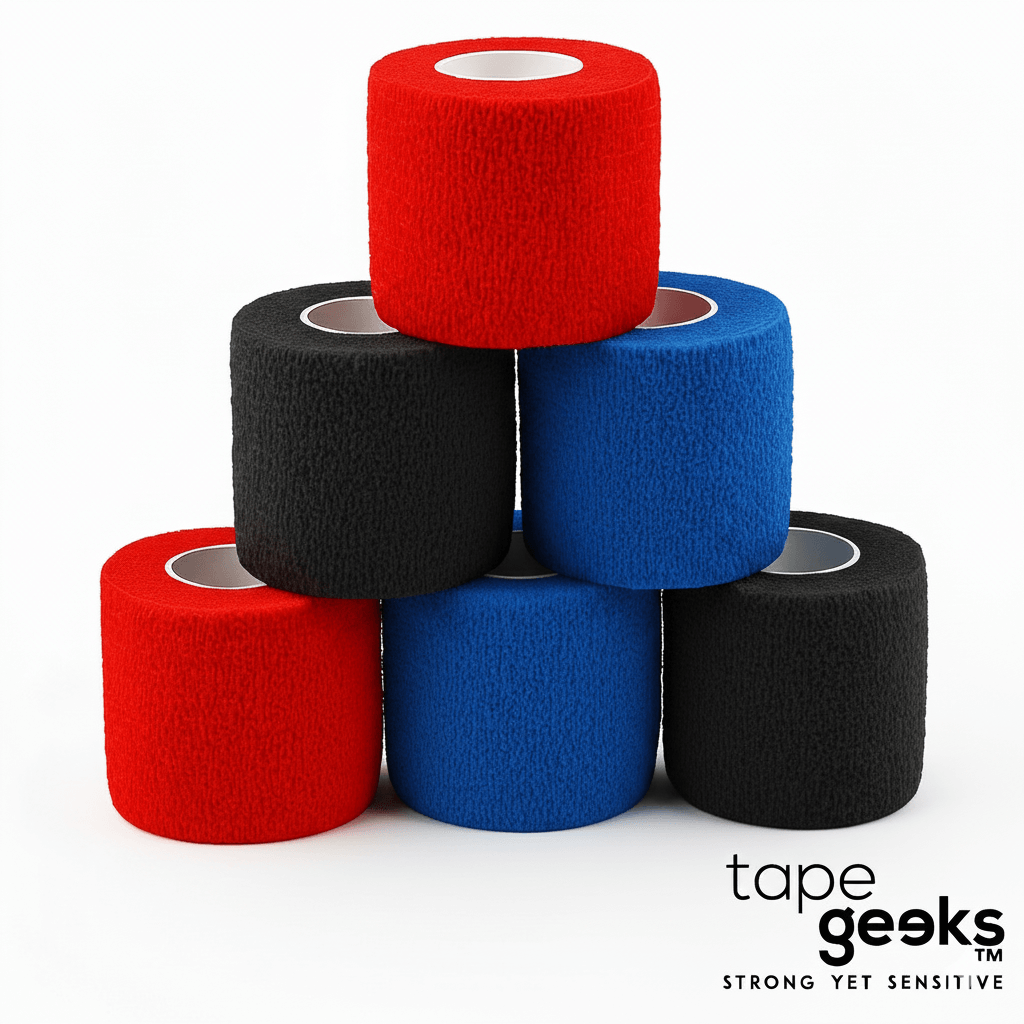
This is the single biggest source of confusion in this category, so let us kill it first. A cohesive bandage is an elastic wrap coated so that it grips itself and nothing else. Wrap it around a limb and each turn bonds to the turn beneath it. Unwrap it and it peels apart cleanly, leaving no residue on skin, hair or clothing, because no adhesive ever touched them.
Where the names came from
“Coban” is 3M’s brand name for its cohesive bandage. “Vetrap” is 3M’s brand name for the same technology sold into the veterinary market. “Self-adherent wrap” and “self-adhering bandage” are the generic descriptions used on packaging. “Cohesive bandage” is what the clinical world calls it. All of them describe a wrap that sticks to itself.
Cohesion versus adhesion, in one sentence
Adhesive tape uses glue that bonds to whatever it touches; cohesive wrap uses a coating that bonds only to the same coating. That one difference is why cohesive bandage causes no hair pulling, no skin tearing and no sticky mess — and also why it will never hold a joint the way tape does.
The one difference that is real
If vet wrap and human cohesive bandage are the same technology, is there any reason to care which you buy? Yes, but a narrower one than the marketing suggests: the manufacturing standard. Wrap sold for people is made and quality-controlled as a human product; wrap sold for animals is made to veterinary product standards, and tends to be a bit thicker with less consistent stretch. For wrapping a dog’s paw or a horse’s leg, that is irrelevant. For a person, buy the one sold for people — it is not meaningfully more expensive.
One more thing worth checking: latex
Plenty of cohesive wraps and vet wraps on the market are made with natural rubber latex, and that is a genuine problem if you are wrapping someone with a latex allergy — especially in a clinic, where you do not always know. The scale of that risk is not trivial: NIOSH estimated that 8–12% of healthcare workers regularly exposed to natural rubber latex are sensitised to it (NIOSH Publication No. 97-135, 1997). The word “cohesive” tells you nothing either way, so it is worth checking the specific product. The TapeGeeks Cohesive Bandage Wrap is latex-free, as is our athletic tape and our kinesiology tape.
Cohesive bandage versus athletic tape: compression is not the same as lockdown
This is the comparison that actually matters, because these two get confused in kit bags every weekend. They are not competing products — they solve different problems, and a wrap used where tape belongs is the reason a lot of people conclude that “taping does not work”.
What rigid athletic tape does
Athletic tape does not stretch. Anchored to the skin, it physically resists the movement that caused the injury — the ankle rolling, the thumb bending back, the wrist extending. That is mechanical restriction, and only a non-stretch material anchored to skin can deliver it. It goes on for one session and comes off afterwards, ideally over foam underwrap so removal does not take your leg hair with it.
What cohesive wrap does
Cohesive wrap stretches, so it cannot restrict a joint — it will yield to exactly the movement you were trying to stop. What it does well is apply light, even compression over an area, hold a dressing or ice pack in place, protect a wound covering, and add grip. It is fast to apply, needs no scissors if you tear it, and comes off in seconds without hurting.
Why most kits carry both
A realistic first-aid or sideline kit uses tape when a joint needs holding and wrap when an area needs compression or a dressing needs securing. Neither one covers both jobs. If you are stocking from scratch, buy athletic tape, foam underwrap and cohesive wrap together and you have covered most of what actually happens on a field.
Cohesive bandage versus elastic adhesive bandage: the option most people have never heard of
Elastic adhesive bandage — EAB, or “stretch tape” — sits precisely in the gap between the other two, and it is the answer more often than its obscurity suggests.
EAB stretches like a cohesive wrap but sticks to your skin like tape. That combination gives you supportive strapping that still permits some movement, and because it is anchored to skin it does not slide the way a cohesive wrap can. Think of it as the middle setting: firmer and more secure than cohesive wrap, more forgiving than rigid athletic tape.
- Choose cohesive wrap when nothing should stick to the skin and you want compression or a dressing held.
- Choose EAB when you want supportive strapping that moves with the limb and stays exactly where you put it.
- Choose rigid athletic tape when the joint genuinely must not move.
Because EAB is adhesive, it pulls hair on removal — foam underwrap underneath solves that, and unlike with cohesive wrap, here the underwrap is worth using.
Cohesive bandage versus kinesiology tape: not comparable, despite both being “tape”
People search this comparison a lot, and the honest answer is that they barely overlap. Kinesiology tape is thin, adhesive and elastic, applied under light tension to lift the skin and give continuous sensory feedback. It is designed to stay on for three to five days through sweat and showers, and it is what you use when you want support that lasts all week and does not restrict how you move.
A cohesive bandage is thick, self-sticking and short-term. It comes off at the end of the session. It applies compression across an area rather than support along a line of tissue. If your question is “how do I support this knee for the next five days of training?”, the answer is kinesiology tape. If it is “how do I keep this dressing on and this swelling down for the next two hours?”, the answer is the wrap.
Pick by what actually happened
Rolled ankle that needs support
Rigid athletic tape over foam underwrap. Cohesive wrap afterwards for compression over swelling if you want it. If the ankle will not bear weight, that is an assessment, not a taping job.
Holding a dressing or an ice pack
Cohesive bandage, every time. It is the job the product was invented for — secure, no adhesive on damaged skin, and off again in one motion.
Swollen finger or a jammed joint
A narrow cohesive wrap for light compression, or tape the finger to its neighbour with athletic or finger tape if it needs support. Watch the fingertip colour closely; fingers are the easiest place to wrap too tight.
Grip on a hockey stick, bat or handlebar
Cohesive wrap is excellent here and is widely used for exactly this. It grips itself, adds a tacky surface, and strips off cleanly when it wears out.
A dog’s paw or a horse’s leg
Cohesive wrap, because it will not stick to fur. For any real injury, see a vet — a wrap is not treatment.
Fragile skin, kids or elderly patients
Cohesive wrap is the gentlest option available because nothing adhesive contacts the skin at all. Wrap it lighter than you think, and check the limb often.
Does compression actually help? The evidence is thinner than the marketing
Compression is the main reason people reach for a cohesive bandage, and the honest answer is that it is a comfort measure rather than a proven treatment. A 2020 systematic review of eight studies, conducted by Cochrane First Aid and the Belgian Red Cross with members of the International Liaison Committee on Resuscitation First Aid Task Force, could not demonstrate either a beneficial or a harmful effect from compression bandaging after an acute closed ankle injury, and rated all the evidence low to very low certainty (Journal of Athletic Training, 2020;55(8):789–800). It found no measurable improvement in pain, swelling, joint function, range of motion or recovery time.
The current American Heart Association and American Red Cross 2024 Guidelines for First Aid, Circulation 150(24) land in the same place: a trained provider may consider a wrap after an ankle sprain for comfort, provided circulation is not compromised — not because it has been shown to speed healing. RICE as a package has the same problem; a 2012 review in Journal of Athletic Training (47(4):435–443) concluded there was insufficient randomised evidence to judge how well it works.
For context on how much pressure is even in play, the World Union of Wound Healing Societies classifies mild compression as under 20 mmHg, moderate as 20–40 mmHg and strong as 40–60 mmHg (WUWHS consensus document, 2008). Those thresholds come from venous leg ulcer therapy — a clinical treatment with its own protocol, not something you should be aiming at with a hand-applied wrap on a sore ankle.
So why do we still sell it, and still put it in every kit? Because a cohesive bandage does several jobs well that have nothing to do with disputed compression science: it holds a dressing or an ice pack exactly where you put it, it pads a grip, it protects a wound cover, and it comes off without taking skin or hair with it. Use a TapeGeeks cohesive bandage for those things with confidence. Just do not expect the wrap itself to heal a sprain — and do not wrap it tighter in the belief that tighter works better, because that is the one thing here that can genuinely hurt someone.
Wrapping safely: the one mistake that actually causes harm
Everything else in this guide is a preference. This part is not. A compression wrap applied too tightly can restrict circulation, and elastic materials make it easy to do without realising.
The worst-case version of this is acute compartment syndrome, where pressure inside a limb compartment rises until blood supply is cut off. It is rare — an Edinburgh study put the annual incidence at 3.1 cases per 100,000 people, and 7.3 per 100,000 in men (McQueen et al., Journal of Bone and Joint Surgery (British Volume), 2000;82(2):200–3) — but tight circumferential dressings and bandages are a recognised external cause, which is exactly why removing a restrictive wrap is a first step in emergency management. No cohesive bandage is worth that risk. Wrap it loose.
- Let the wrap lay down at its natural length — do not pull it tight as you go.
- Overlap each turn by about half the width of the wrap.
- Wrap from the narrow part of the limb toward the wider part so the taper works with you.
- Finish the last turn with no tension at all.
- Check the fingers or toes beyond the wrap. Pale, blue, cold, numb, tingly, or swelling below the wrap all mean unwrap and reapply looser — immediately.
- Do not sleep in a compression wrap applied over fresh swelling.
And the honest limit: wraps manage symptoms and hold dressings. They do not treat injuries. Significant swelling, a joint that will not take weight, numbness, a wound needing proper care, or anything that keeps getting worse is a reason to see a professional.
What belongs in a team, clinic or first-aid kit
If you are building a kit rather than solving one problem, the useful framing is that you need one product per job rather than the cheapest product overall.
- Rigid athletic tape and foam underwrap — for joints that need holding.
- Cohesive bandage wrap — compression, dressings, grip, pets, fragile skin.
- Elastic adhesive bandage — supportive strapping that still allows movement.
- Kinesiology tape — multi-day support between sessions.
- Taping scissors and bandage shears — so you can cut and remove safely.
Clinics, physiotherapists and teams buying in volume should look at wholesale and bulk pricing rather than retail rolls. Browse the full bandages and wraps collection to compare widths and options.
Frequently Asked Questions
Can I use vet wrap on a human?
Yes. Vet wrap and human cohesive bandage are the same self-adherent elastic wrap, and nothing sticky ever touches skin, so there is no adhesive to react to. The real difference is the manufacturing standard: wrap sold for human use is quality-controlled as a human product, while veterinary wrap is often thicker with less consistent stretch. For a scraped knee, vet wrap is fine. For clinical use, buy wrap sold for people.
Which wrap should I use for a rolled ankle?
Rigid athletic tape, not a cohesive bandage. Tape locks the ankle down and resists the movement that caused the injury; a cohesive bandage stretches, so it cannot provide that lockdown. Use the wrap afterwards for light compression over swelling, or to hold an ice pack or dressing. Most kits carry both. If the ankle will not take weight, get it assessed rather than wrapped.
Do I need foam underwrap with a cohesive bandage?
No. Underwrap exists to protect skin from adhesive, and a cohesive bandage has no adhesive touching you — that is the whole point of it. Foam underwrap belongs under rigid athletic tape or elastic adhesive bandage, where the glue would otherwise pull hair and skin on removal. Using underwrap beneath cohesive wrap just adds bulk and makes the wrap more likely to slide.
Can I use a cohesive bandage instead of kinesiology tape?
Not really — they do opposite jobs. Kinesiology tape is a thin adhesive tape that stays on the skin for days, giving light directional support and constant sensory feedback while you move. A cohesive bandage is a thicker self-sticking wrap for short-term compression and holding dressings, and it comes off at the end of the session. If you want multi-day support that survives showers, you want K tape. If you want compression right now, you want the wrap.
Is a cohesive bandage strong enough to support a sprained joint?
For firm support, no. Because cohesive wrap stretches, it gives light compression rather than true mechanical restriction, and it will loosen as you move. Rigid athletic tape or an elastic adhesive bandage anchored to the skin is what holds a joint. Use cohesive wrap for compression, swelling management and holding dressings — and treat a sprain that is not settling as a reason to see a professional, not a reason to wrap tighter.
What is cheapest for a team or clinic kit — cohesive bandage or athletic tape?
They are close in price and are not substitutes, so a working kit needs both. TapeGeeks cohesive bandage wrap is $5.99 and athletic sports tape is $5.59, with elastic adhesive bandage and foam underwrap also $5.59. Cohesive wrap goes further per roll because you apply it in single wraps rather than anchored strips. Teams and clinics buying volume should look at wholesale pricing.
Why does my cohesive wrap loosen after twenty minutes?
Almost always because it was applied with stretch. A cohesive bandage is elastic, so pulling it tight while wrapping means it spends the next twenty minutes relaxing back and slackening. Keep the roll close to the limb, let the material lay at its natural length, overlap each turn by half, and finish with no tension. If it still slides, wrap from narrow to wide so the limb taper works with you.
Can I wrap a swollen ankle right after an injury?
Light compression is reasonable in the first day or two, and light is the operative word. Swelling increases after injury, so a wrap that felt fine on application can be too tight an hour later. Re-check it often, and remove it immediately if the toes go pale, cold, numb or tingly. Never sleep in a compression wrap applied over fresh swelling.
Can you put a vet wrap directly on a wound?
No. A cohesive bandage or vet wrap should never touch an open wound directly — 3M's own instructions for Coban state it "should not be placed in direct contact with an open wound". Put a sterile non-adherent dressing on the wound first, then use the cohesive wrap over it to hold that dressing in place. The wrap is a securing and compression layer, not a wound dressing.
Do wounds heal faster covered or uncovered?
Covered, for ordinary superficial wounds. The landmark study behind this found covered wounds epithelialised roughly twice as fast by day three as those left exposed to air (Winter, Nature, 1962;193:293–294), though that work was done in pigs. Keep a wound protected and from drying out rather than letting it scab in open air.