


🏃 Back for Year 2 — Mercedes-Benz Oakville Bronte Harbour Classic 1K, 5K & 10K  •  June 20, 2027  •  Oakville  •  bronteharbourclassic.com 🚚 FREE shipping on orders CA$50+ (Canada)  •  US$40+ (USA) 👶 Kids Nasal Strips ship FREE in Canada — no minimum  •  Shop Breathe+ Kids

SHIPS FREE FOR ORDERS $50+  •  😴 FREE Better Sleep Guide

SHIPS FREE FOR ORDERS $50+  •  😴 FREE Better Sleep Guide

Search

Search

4.9★ rated
Kinesiology scissors, on-site
4.8★ · 255
Medical scissors, Amazon
Multi-Use
Tape, first aid & everyday
Stainless Steel
Sharp, durable, easy-clean
Canadian
Owned & operated

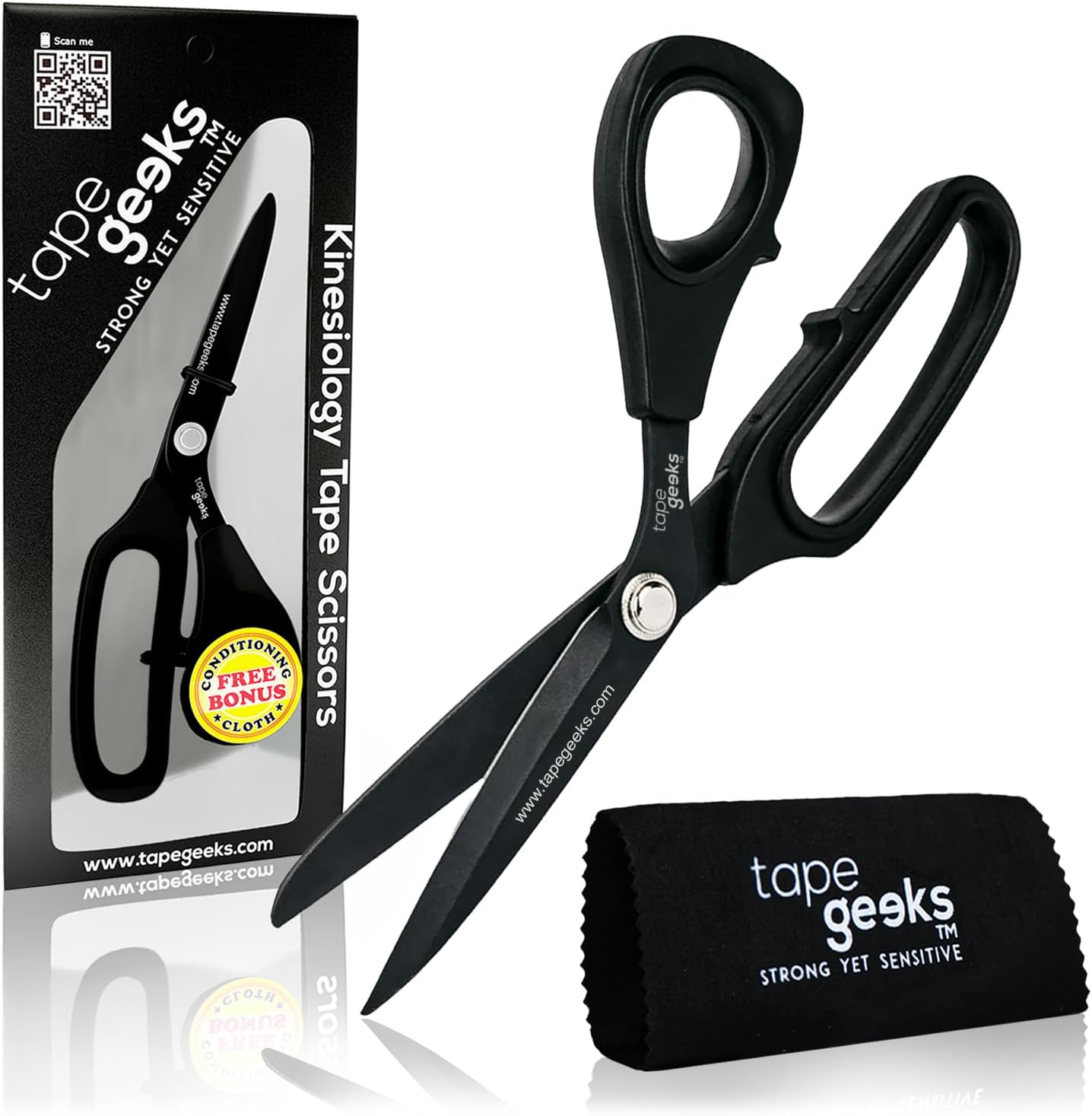
Precision scissors and medical shears that do far more than cut tape. TapeGeeks scissors are built with sharp, fine stainless-steel tips for clean, accurate cuts — whether you're rounding the corners of a kinesiology strip, trimming a dressing, or reaching for the one pair of scissors that lives in the kitchen drawer and does everything. Our kinesiology taping scissors are a customer favourite (rated 4.9★) precisely because they're so versatile, and our medical scissors for nurses, vets, and first responders are trusted across 255+ Amazon ratings at 4.8★.

Shop kinesiology taping scissors, medical scissors and trauma shears, and value bundles — the perfect add-on to your kinesiology tape and first-aid kit. The guide below explains what makes taping and medical scissors different, how to cut tape cleanly, the difference between bandage scissors and trauma shears, and how to keep them sharp.

Other Information  +

A complete guide to taping and medical scissors — what makes them special, how to cut kinesiology tape cleanly, the difference between bandage scissors and trauma shears, who uses them, and how to keep them sharp. This is educational information, not medical advice.

What makes kinesiology taping scissors special

Cutting stretchy, adhesive kinesiology tape with ordinary scissors is frustrating — the blades gum up, the tape drags, and the edges come out ragged. Purpose-made taping scissors solve that with sharp, fine tips and smooth stainless-steel blades that slice cleanly through adhesive tape and let you round the corners of a strip precisely (rounded corners are what stop tape peeling at the edges). A comfortable handle and a compact size make them easy to carry in a kit bag.

Why our kinesiology scissors are a multi-use favourite

Here's the thing customers keep telling us: once they own a good pair of taping scissors, they reach for them for everything. The same sharp, precise tips that round a tape corner are perfect for first-aid trims, cutting bandages and gauze, opening packaging, kitchen and craft tasks, gardening, and general household jobs. They're the “why don't all scissors work this well?” pair — which is exactly why they're one of our top-rated products at 4.9★. Buy them for taping; keep them for life.

Can you cut kinesiology tape with regular scissors?

You can, but you probably won't enjoy it. Regular scissors quickly get sticky with adhesive, which makes them drag and leave rough edges — and rough or square-cut edges are the number-one reason tape peels off early. Sharp, fine-tipped taping scissors cut cleanly and let you round every corner, which is why anyone who tapes regularly ends up with a dedicated pair.

How to cut kinesiology tape (and why round the corners)

Cut the tape to length, then round off each corner with a small curved snip. Rounded corners have no sharp point to catch on clothing, bedding, or movement, so the strip stays stuck far longer — square corners lift and peel. For shaped applications (a Y-strip or fan cut), fine-tipped scissors let you cut narrow tails accurately. If you'd rather skip cutting entirely, we also stock precut kinesiology tape.

Do you need scissors to cut KT tape?

Not always — some tape can be torn by hand or bought precut — but scissors give you clean edges, rounded corners, and custom shapes that hand-tearing can't. For anything beyond a straight strip, and for the best staying power, scissors are worth it.

What are bandage scissors?

Bandage scissors (often called Lister bandage scissors) have a distinctive angled blade with a blunt, flattened tip on the bottom blade. That blunt tip slides safely under a bandage, against the skin, so you can cut a dressing off without nicking the patient. The angle keeps your hand clear of the skin as you cut. It's a simple design that makes removing bandages fast and safe — a staple in every nurse's and first-aid kit.

What are trauma shears?

Trauma shears are heavy-duty medical scissors built to cut quickly through tough material — clothing, thick straps, even a seatbelt — to expose an injury in an emergency. They have a blunt safety tip (so they glide over skin without cutting it), a wide, strong blade, and leverage that lets them power through material scissors can't. They're the tool EMTs, paramedics, nurses, and first responders keep on their belt.

Bandage scissors vs trauma shears vs regular scissors

Tool Design Best for
Taping scissors Sharp, fine tips Clean tape cuts, rounding corners, precise trims, everyday use
Bandage (Lister) scissors Angled blade, blunt bottom tip Cutting dressings off safely against the skin
Trauma shears Heavy-duty, blunt tip, high leverage Cutting clothing/straps fast in an emergency
Regular scissors General purpose Everyday cutting; gum up on adhesive tape

Who uses medical scissors?

Nurses, doctors, vets, athletic trainers, physiotherapists, EMTs and paramedics, first-aid officers, and prepared households. Nurses use bandage scissors constantly for dressings; EMS crews rely on trauma shears; vets use them for animal dressings and grooming; and trainers use taping scissors on the sideline. A good pair is one of the most-used tools in any kit.

Are trauma shears legal to carry?

Yes. Trauma shears are a medical tool, not a weapon — they have blunt safety tips and are designed to cut material, not to stab. They're commonly carried by medical and first-aid personnel and kept in cars, homes, and go-bags. As always, follow any specific venue or travel rules (for example, airline carry-on limits on blade length), but there's nothing unusual about owning and carrying them.

Why do trauma shears cut so well?

Two reasons: leverage and blade design. The handle and pivot are engineered so a small squeeze delivers a lot of cutting force, and the wide, often micro-serrated blades grip and slice through tough, slippery material like fabric and straps instead of pushing it away. That's how a compact pair can cut through denim or a seatbelt.

Left- and right-handed use

Our medical scissors are designed to work comfortably for both left- and right-handed users, so the same pair suits everyone in a household or clinic. If you're left-handed and have struggled with standard scissors, an ambidextrous medical pair is a noticeably better experience.

Keeping your scissors sharp and clean

Adhesive tape residue is the main thing that dulls the feel of taping scissors — it's usually not the blade going blunt, just gunk on it. Wipe the blades with a little rubbing alcohol (or an adhesive remover) to dissolve residue, dry them, and they cut like new. Keep scissors dry to prevent rust, store them closed, and avoid cutting anything gritty. Quality stainless-steel scissors stay sharp for years with this simple care.

Choosing the right pair (and bundles)

For taping and everyday precision, choose the kinesiology taping scissors. For dressings and first aid, bandage/medical scissors with a blunt tip. For emergencies and cutting through material, trauma shears. If you want the lot, our bundles pair scissors together at a better value — a smart add-on to a tape or first-aid order.

Common myths, cleared up

  • “Any scissors cut tape fine.” Adhesive gums up ordinary blades; fine-tipped taping scissors cut clean and round corners.
  • “Trauma shears are weapons.” They have blunt safety tips and are a standard medical tool.
  • “Sticky scissors are worn out.” Usually just residue — wipe with alcohol and they're like new.
  • “Bandage and surgical scissors are the same.” Bandage scissors have a blunt tip to protect skin; surgical scissors are sharp-tipped for tissue.
  • “Taping scissors only cut tape.” They're one of the most versatile pairs you'll own.

A quick glossary

  • Taping / kinesiology scissors: sharp, fine-tipped scissors for clean tape cuts and rounding corners.
  • Lister bandage scissors: angled scissors with a blunt bottom tip for cutting dressings off safely.
  • Trauma shears: heavy-duty, blunt-tipped shears for cutting clothing and straps in emergencies.
  • Surgical scissors: sharp-tipped scissors for cutting tissue (not the same as bandage scissors).
  • Rounding corners: trimming a tape strip's corners so it doesn't catch and peel.

Safety

Scissors and shears are sharp tools — keep them away from young children, cut away from yourself, and use blunt-tipped bandage scissors or trauma shears (not sharp-pointed scissors) when cutting anything close to skin. For any real wound or emergency, get proper medical care.

Frequently Asked Questions

What are the best scissors for cutting kinesiology tape?
Sharp, fine-tipped scissors that slice cleanly through adhesive tape and let you round the corners of a strip. Ordinary scissors gum up on the adhesive and leave ragged, square edges that peel. Purpose-made taping scissors (like our kinesiology scissors, rated 4.9★) cut clean and double as a genuinely versatile everyday pair.
Can I cut KT tape with regular scissors?
You can, but the adhesive quickly makes ordinary blades sticky, so they drag and leave rough edges — and rough or square corners are the top reason tape peels early. Fine-tipped taping scissors cut cleanly and let you round every corner, which is why regular tapers keep a dedicated pair.
How do I cut kinesiology tape?
Cut it to length, then round off each corner with a small curved snip. Rounded corners have no sharp point to catch on clothing or movement, so the strip stays stuck much longer. For Y-strips or fan cuts, fine-tipped scissors let you cut narrow tails accurately. Or skip cutting with precut tape.
Why should I round the corners of kinesiology tape?
Square corners have a point that catches on clothing, bedding, and movement and starts to peel. Rounding each corner removes that catch point, so the strip stays adhered far longer — it's the single easiest trick for longer-lasting tape.
Do you need scissors to cut KT tape?
Not always — some tape tears by hand or comes precut — but scissors give clean edges, rounded corners, and custom shapes hand-tearing can't. For anything beyond a straight strip, and for the best staying power, scissors are worth it.
How do you rip KT tape without scissors?
For a straight cut you can pinch and snap some tapes by hand, or use precut strips. But you can't round corners or cut shapes by hand, so hand-torn strips tend to peel sooner. For clean, long-lasting applications, use taping scissors.
What are bandage scissors used for?
Cutting bandages and dressings off safely. Bandage scissors (Lister scissors) have an angled blade with a blunt, flattened bottom tip that slides under a bandage against the skin, so you can cut a dressing away without nicking the patient. They're a staple in nursing and first-aid kits.
What are bandage scissors called?
They're commonly called Lister bandage scissors, after the design with the angled blade and blunt safety tip. You'll also hear 'nurse scissors' or simply 'bandage scissors.'
What's the difference between bandage scissors and surgical scissors?
Bandage scissors have a blunt, flattened tip so they can slide against skin without cutting it — for removing dressings. Surgical scissors have sharp points for cutting tissue. They look similar but are designed for opposite jobs; you don't want sharp-tipped scissors sliding against a patient's skin.
Why are bandage scissors different from normal scissors?
The angled blade and blunt lower tip. The angle keeps your hand clear of the skin, and the blunt tip lets you slide the scissors safely under a bandage. Normal scissors have two sharp points and a straight blade, which isn't safe against skin.
What are trauma shears?
Heavy-duty medical scissors built to cut quickly through tough material — clothing, thick straps, even a seatbelt — to expose an injury in an emergency. They have a blunt safety tip so they glide over skin, a wide strong blade, and high leverage. EMTs, paramedics, and nurses keep them on hand.
What's the difference between trauma shears and scissors?
Trauma shears are far stronger and are engineered with leverage to power through fabric and straps, with a blunt tip to avoid cutting skin. Regular scissors are for lighter, precise cutting. Bandage scissors sit in between — blunt-tipped but not as heavy-duty as trauma shears.
Is it legal to carry trauma shears?
Yes. Trauma shears are a medical tool with blunt safety tips, not a weapon, and are commonly carried by medical and first-aid personnel and kept in cars and go-bags. Follow venue and travel rules (such as airline carry-on blade-length limits), but owning and carrying them is standard.
Why do trauma shears cut so well?
Leverage and blade design. The pivot and handles are engineered so a small squeeze delivers a lot of force, and the wide, often micro-serrated blades grip slippery material like fabric and straps instead of pushing it away — which is how a compact pair cuts through denim or a seatbelt.
What trauma shears or scissors do EMTs and nurses use?
EMTs and paramedics rely on heavy-duty trauma shears for cutting clothing fast; nurses use bandage (Lister) scissors constantly for dressings. Many carry both. Our medical scissors are designed for exactly these users, with a blunt safety tip and comfortable, durable build.
Are your kinesiology scissors good for more than tape?
Absolutely — that's why they're one of our top-rated products. The same sharp, fine tips that round a tape corner make them excellent for first-aid trims, cutting gauze and bandages, opening packaging, and kitchen, craft, and household tasks. Most customers buy them for taping and end up using them everywhere.
What are kinesiology scissors made of?
Durable stainless steel with sharp, fine tips, so they resist rust, hold an edge, and wipe clean easily. Stainless steel is ideal for tools that meet adhesive and moisture.
Why do my scissors get sticky when cutting tape?
Tape adhesive transfers onto the blades as you cut, which makes them drag. It's residue, not a dull blade. Wipe the blades with rubbing alcohol or adhesive remover, dry them, and they cut like new again.
How do I clean adhesive off my scissors?
Wipe the blades with a little rubbing alcohol or a dab of adhesive remover to dissolve the sticky residue, then dry them. Do this whenever they start to drag. Avoid soaking them; keep them dry to prevent rust.
How do I keep my scissors sharp?
Most 'dullness' in taping scissors is just adhesive residue — clean the blades with alcohol first. Beyond that, keep them dry, store them closed, don't cut gritty or very hard materials with your fine scissors, and quality stainless steel stays sharp for years.
Are your medical scissors suitable for left-handed users?
Yes — our medical scissors are designed to work comfortably for both left- and right-handed users, so one pair suits everyone. If standard scissors have never felt right in your left hand, an ambidextrous medical pair is a big improvement.
Can trauma shears really cut through a seatbelt or clothing?
Yes — that's their core purpose. The leverage and serrated blades let them cut through denim, leather, and seatbelt webbing quickly, which is exactly what's needed to expose an injury in an emergency.
Are these scissors safe to use near skin?
Bandage scissors and trauma shears have blunt safety tips specifically so they can be used against skin to cut dressings or clothing without cutting the person. Sharp-pointed scissors should not be used sliding against skin — use a blunt-tipped pair for that.
What's the difference between the scissors bundles?
The bundles pair complementary scissors together at better value — for example a kinesiology taping pair with a medical/bandage pair — so you're covered for tape, dressings, and first aid in one purchase. Check each bundle's contents on its product page.
Can I use these scissors in the kitchen or for crafts?
Yes — sharp, precise stainless-steel scissors are great for kitchen and craft tasks. Many customers keep their taping scissors as a general-purpose 'best scissors in the house.' Just clean them if you switch between food and adhesive tasks.
Are they safe for kids to use?
They're sharp precision tools, so keep them away from young children and supervise older kids. For household safety, store scissors closed and out of a small child's reach.
What's the best all-round pair to buy?
For most people, the kinesiology taping scissors — they cut tape beautifully and double as a superb everyday pair. Add bandage/medical scissors or trauma shears if you want a first-aid or emergency tool, or grab a bundle to cover everything at once.
Ask Tappy! 👋
Tappy
Tappy Tappy AI assistant