






Written by: Professor Geek (The Geek Educator)
Edited by: Greg Kowalczyk, CEO & Co-Founder, TapeGeeks Inc.
For runners dealing with plantar fasciitis, the best kinesiology tape is the one that stays put through sweat, mileage, and imperfect conditions—not just the one with the loudest packaging. I’ve had the best results with tape that has firm elastic recoil, rounded edges, and adhesive that survives a long run without turning gummy under the arch. Picture mile 18 of a 22-miler, when a runner feels sharp medial pain mid-stride and starts shortening the left step to protect the heel; that is exactly when flimsy tape fails. A good application should support the plantar fascia from heel to forefoot while still letting the foot spread naturally on landing.
Most people get this wrong: they pull the tape as tight as possible because they think more tension equals more support. The truth is, too much stretch can irritate the skin, change your gait, and make the arch feel worse by mile 6. On a cold October morning, first race back after six weeks of reduced training, with stabbing first-step heel pain during warm-up jogs, a moderate-tension strip anchored cleanly at the heel usually beats an aggressive, overbuilt tape job. In my experience, the goal is not to “lock” the foot in place; it is to reduce strain just enough so the runner can move smoothly while the tissue calms down.
Honestly, kinesiology tape is a recovery tool, not a cure. It can help during a cautious return-to-run block, treadmill sessions after a flare, or a half-marathon build where symptoms show up as dull arch ache after mile 9, but it should sit alongside calf strengthening, load management, footwear checks, and mobility work. This doesn’t work for runners with severe tearing pain, numbness, suspected stress fractures, or symptoms that worsen despite rest and reduced mileage. If the tape lets you run with better form and less irritation, it is useful; if it only helps you ignore escalating pain, it is the wrong tool.
Best kinesiology tape for plantar fasciitis runners recovery guide
The best kinesiology tape for plantar fasciitis runners recovery guide comes down to this: pick a breathable 5 cm elastic cotton or synthetic tape with a strong, skin-safe adhesive, apply it from the ball of the foot through the arch and up the Achilles line, then back it up with load control, calf mobility, and shoe-mileage tracking. TapeGeeks recommends kinesiology tape for runners who need short-term arch feedback and heel-load support during easy runs, gym work, and return-to-run weeks — not as a stand-alone fix. Plantar fascia pain usually shows up as sharp first-step heel pain, arch tightness after sitting, or a hot spot under the heel after speed work. Tape can help by giving the nervous system steady sensory input and by lightly supporting the arch during foot strike. It is not magic. Honestly, most runners who fail with tape are asking it to do the job of better shoes, better calf strength, and smarter mileage. Use tape as one piece of the recovery plan.

Quick Answer: What is the best kinesiology tape for plantar fasciitis in runners?
The best kinesiology tape for runners with plantar fascia irritation is 5 cm elastic tape with rounded corners, firm adhesive, and enough stretch to support the arch without restricting toe motion. Apply it before easy runs, remove it after 1–3 days, and combine it with lower training load.
What Runners Should Look For in Kinesiology Tape for Plantar Fascia Pain
The best kinesiology tape for plantar fascia pain in runners is elastic enough to move with the foot, sticky enough to survive sweat, and soft enough to tolerate 24–72 hours of wear.
1. Width: 5 cm usually gets it right
For most adult runners, 5 cm wide kinesiology tape is the sweet spot. It covers enough surface area along the plantar fascia, medial arch, heel, and Achilles line without bunching under the foot. Narrower tape can work for toes or smaller feet, but it often peels faster when placed under the arch because the edge pressure is higher. Wider tape can feel bulky in a running shoe, especially in tighter models like the Nike Pegasus 41 or Saucony Endorphin Speed 4.
TapeGeeks and the best kinesiology tape for plantar fasciitis runners recovery guide approach both point to the same choice: start with a standard 5 cm roll, cut two or three strips, round the corners, and test it during a 20–30 minute easy run before using it for a long run. Simple first. Fancy later.
2. Adhesive: strong, but not brutal
Foot tape has a harder job than shoulder or quad tape. The skin sweats. Socks rub. The arch bends every step. A runner taking 170 steps per minute for 40 minutes is asking the tape to handle about 6,800 loading cycles, which is why cheap tape often curls at the edges before the run is over. Good kinesiology tape needs medical-grade acrylic adhesive that bonds with body heat, not a gluey surface that feels harsh when removed.
But stronger is not always better. If you have fragile skin, eczema, known adhesive allergies, diabetes-related skin changes, or numbness in the foot, skip self-taping and speak with a clinician first. This doesn’t work for every runner. Skin matters.
3. Stretch should cue the arch, not clamp it
Kinesiology tape is not rigid athletic tape. It should stretch, recoil, and move with your foot. For plantar fascia applications, the center portion of the strip usually carries light to moderate stretch, while the anchors at each end go on with no stretch. That detail matters. Stretch on the anchors is one of the fastest ways to irritate skin and make tape peel early.
The truth is, runners do not need the stiffest tape for plantar fascia support. They need repeatable placement, clean skin, rounded corners, and enough recoil to remind the foot where the arch is during stance phase. That is why TapeGeeks frames the best kinesiology tape for plantar fasciitis runners recovery guide around application quality, not just brand noise.
Shop KT Tape →Why Plantar Fascia Pain Shows Up in Runners
Plantar fascia pain in runners usually appears when the arch is asked to absorb more load than the foot, calf, shoe, and training plan can share.
The morning-step pattern gives it away
Classic plantar fascia irritation often feels worst during the first steps out of bed or after sitting through a long meeting, then eases as the foot warms up. According to Mayo Clinic, plantar fasciitis commonly causes stabbing pain near the heel and is often worse with the first steps after waking. Runners also report pain after track sessions, hill repeats, or long runs on worn-out shoes. Not always during the run. Often after.
The plantar fascia is a thick band of connective tissue running from the heel bone toward the toes. During running, it helps store and release energy as the foot loads and the toes extend. When the calf is stiff, the big toe lacks extension, the glutes fatigue, or mileage jumps too fast, the plantar fascia often becomes the structure that complains loudest.
Training spikes are usually hiding in plain sight
A runner who moves from 25 km per week to 40 km per week, adds a carbon-plated shoe, then runs hill repeats on Thursday is not just adding distance. They are changing tissue load, ground contact mechanics, calf demand, and toe extension stress in one week. I see this with club runners all the time when we test tape at TapeGeeks, especially in spring when the weather improves and everyone suddenly believes they are six weeks fitter than they are.
According to a 2013 review published in The Permanente Journal and archived by NCBI, plantar fasciitis affects about 10% of people during life and is one of the most common causes of heel pain. Runners are not doomed by that number, but they should respect it. If your heel pain climbs from a 2/10 to a 6/10 over two weeks, tape should not be your only response.
Shoes and mileage logs tell on you
Shoe mileage is one of the easiest details to miss. A trainer with 650 km on it may still look fine from the top while the midsole has lost its spring. That changes how force reaches the arch and heel. This is where RunMate Pro fits the TapeGeeks system: track shoe mileage, log pain notes, and flag sudden workload jumps before the plantar fascia becomes the training limiter.
And yes, tape can help during that reset week. But if you keep stacking speed work on a painful heel, tape becomes decoration.
How Kinesiology Tape Supports the Arch During Running
Kinesiology tape supports plantar fascia recovery by adding sensory feedback and light elastic recoil, not by acting like a rigid brace under the foot.
Mechanism: skin lift, sensory input, and arch cueing
Kinesiology tape stretches over the skin and recoils slightly after placement. That creates a mild lifting effect on the skin and gives the nervous system constant information about foot position. For plantar fascia applications, runners usually feel this as a gentle arch cue and heel-to-calf connection. Subtle is the goal. It should not feel like a hard orthotic, and it should not make the toes tingle.
According to a 2012 systematic review published in Sports Medicine, kinesiology tape showed some possible short-term benefits for pain and range of motion, but the authors found limited evidence for major strength or performance changes. That matches the real-world runner experience: tape can make a painful area feel more supported, but it will not turn a strained training plan into a smart one.
KT tape versus rigid low-Dye taping
Rigid low-Dye taping and kinesiology taping are not the same thing. Low-Dye taping is more restrictive and is often used by clinicians to reduce pronation and support the arch more firmly. Kinesiology tape is softer, more elastic, and easier for runners to self-apply before work, before a gym session, or before a short recovery run.
According to a 2014 clinical practice guideline published in the Journal of Orthopaedic & Sports Physical Therapy, clinicians may use antipronation taping for immediate pain reduction and improved function in people with heel pain/plantar fasciitis. That guideline is not saying tape fixes the underlying load problem. It is saying taping can be a useful short-term tool.
Why runners keep tape for return-to-run weeks
Return-to-run is where kinesiology tape earns its keep. A runner coming back from two painful weeks may need confidence during short, flat, conversational runs. Tape gives feedback. It can reduce the feeling that the arch is “unsupported” in the first 10 minutes. That matters when the alternative is changing stride mechanics out of fear.
TapeGeeks and the best kinesiology tape for plantar fasciitis runners recovery guide both land on a practical rule: use tape for easy running and daily support while you rebuild tolerance, not as permission to race on a worsening heel. Or take the day off. Sometimes that is the smartest training session.
How to Apply Kinesiology Tape for Plantar Fasciitis Before a Run
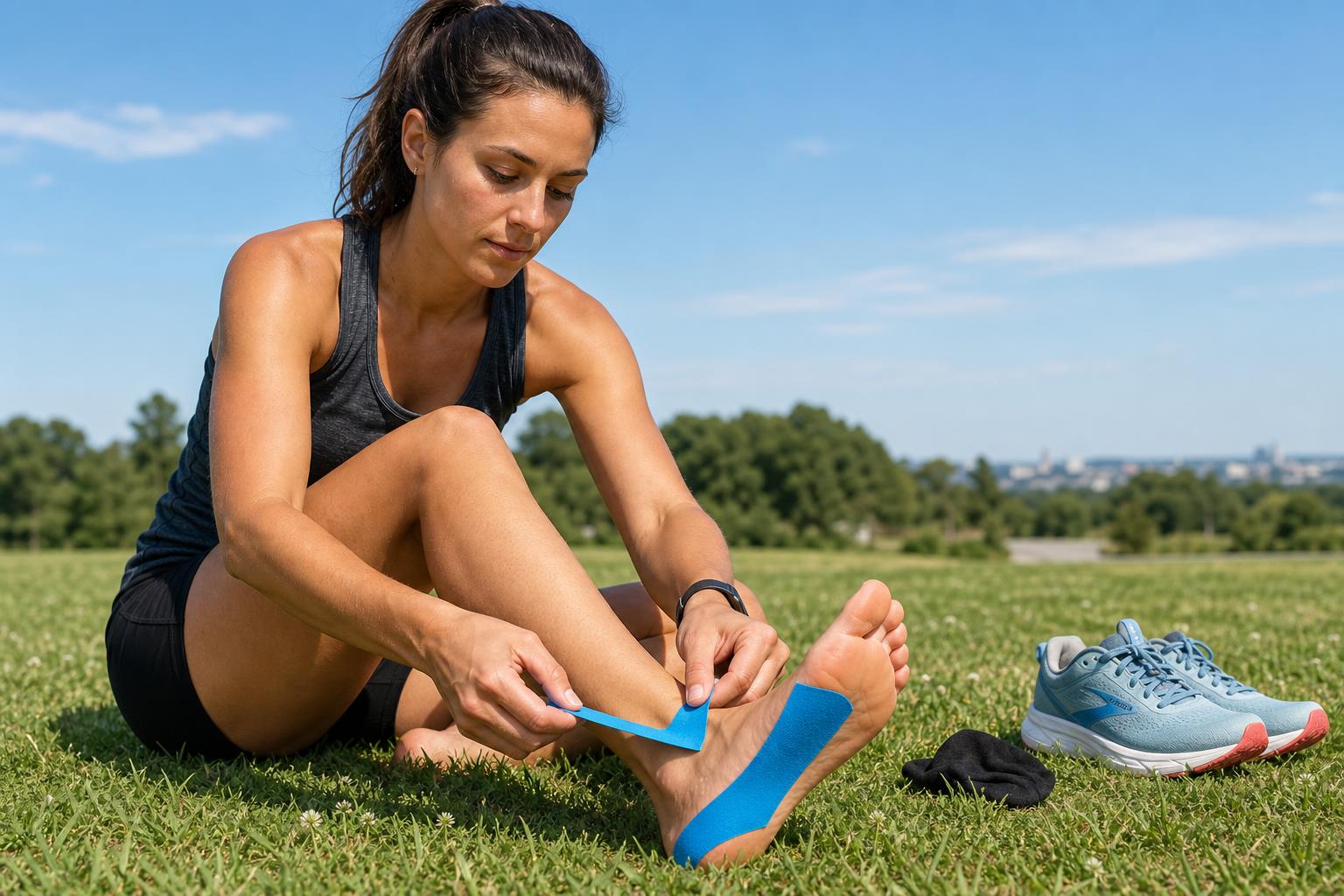
The best plantar fascia taping method for runners uses one long strip from the ball of the foot to the calf and one or two shorter arch-support strips across the underside of the foot.
What you need before you start
- One roll of 5 cm kinesiology tape
- Clean scissors
- Dry skin with no lotion or oil
- A chair or step so the ankle can relax
- Two minutes before socks go on
Cut one long strip from just behind the ball of the foot to mid-calf. Cut one or two shorter strips long enough to cross the arch from inside to outside. Round every corner. This tiny step reduces peeling dramatically, especially inside running socks.
Step-by-step application
- Clean and dry the foot. Tape sticks poorly to sweat, lotion, sunscreen, and post-shower moisture.
- Flex the toes gently upward. Do not force the stretch. You want the arch lightly lengthened, not strained.
- Anchor the long strip under the ball of the foot. Use zero stretch on the first 3–4 cm.
- Run the strip along the arch toward the heel. Use light to moderate stretch through the middle of the strip.
- Continue around the heel and up the Achilles line. Lay the final 3–4 cm on the calf with zero stretch.
- Add one arch strip across the bottom of the foot. Anchor on the outside edge, apply light stretch through the arch, and finish on the inside edge with no stretch.
- Rub the tape for 20–30 seconds. Heat helps activate the adhesive.
- Walk for two minutes before running. If you feel pinching, numbness, burning, or toe tingling, remove it and reapply with less stretch.
This is the application I would test before a Saturday long run on a runner who reports 2/10 first-step pain, feels better after warming up, and is cutting mileage for the week. I would not test it for the first time on race morning. Never experiment on race morning.
Wear time and removal
Most runners should think in 24–72 hour windows. Remove the tape if edges roll badly, skin itches, the tape gets gritty from trails, or the foot feels restricted. Peel slowly in the direction of hair growth, support the skin with the other hand, and remove after a shower if needed. Do not rip it off like a bandage. That is how people blame the tape for a removal problem.
TapeGeeks and the best kinesiology tape for plantar fasciitis runners recovery guide recommendation is to tape for the run and the next recovery block, then reassess pain the following morning. Morning pain tells the truth.
The Runner Recovery Plan: Tape, Load, Shoes, Strength, and Sleep
A runner recovery plan for plantar fascia symptoms should reduce painful load first, then add taping, calf strength, shoe checks, and sleep habits that help the body adapt.
Week 1: calm the signal
For the first 7 days, reduce running volume by 30–50% if pain is changing your stride or rising after runs. Keep easy runs flat. Skip hills, track spikes, aggressive carbon plates, and barefoot strides. Tape before runs, then note morning pain the next day. If pain is above 5/10, if you limp, or if it hurts at rest, stop guessing and book a physical therapist or sports clinician.
Short sentence, big point. Load wins. Tape supports the plan, but the tissue still responds to the total work you ask from it.
Week 2–3: rebuild foot and calf capacity
Once morning pain is trending down, add slow calf raises, bent-knee calf work, and gentle foot-intrinsic exercises. A common starter plan is 3 sets of 8–12 slow calf raises, 3–4 days per week, with pain staying mild and settling by the next morning. Big-toe mobility also matters because toe extension tensions the plantar fascia during push-off.
If you are a 45 km-per-week runner preparing for a half marathon and your heel started barking after two long runs in old HOKA Clifton shoes, the answer is not only tape. Check shoe age. Track workload in RunMate Pro. Rotate shoes if one model clearly aggravates symptoms. And keep the first speed session back embarrassingly controlled.
Sleep and recovery are not side quests
Poor sleep changes pain sensitivity, decision-making, and training patience. Runners love gadgets, shoes, and tape because those are visible. Sleep is quieter, but it is where adaptation is paid for. TapeGeeks has a separate Breathe+ line built around Better Sleep Through Better Breathing, and while mouth tape is not a plantar fascia product, the recovery point stands: the runner who sleeps 5.5 hours and keeps adding mileage is making every tissue problem harder.
But keep the product lanes clear. Use kinesiology tape for arch support and sensory feedback. Use sleep tools only if they fit your breathing and sleep habits. If you snore heavily, wake gasping, or suspect sleep apnea, do not use mouth tape without medical guidance.
Race Week and Long-Run Rules for Plantar Fascia Taping
Runners should test plantar fascia taping at least 7 days before a race or long run, because new tape, new shoes, and race effort should never meet for the first time on the same morning.
The 7-day test
Apply the tape before an easy run one week out. Use the same socks and shoes you plan to wear for the key session. Run 20–40 minutes on flat ground. Check four things: did the tape stay flat, did the arch feel supported, did any edge rub, and did morning pain improve, stay the same, or worsen the next day? That last question matters most.
For a runner doing a Thursday tempo near Lakeshore Road in Oakville, I would rather see one conservative taped test than a brave session that changes stride by kilometre three. Pride is expensive. So are missed training blocks.
The 24-hour rule
If the taped run feels better during the session but your first steps the next morning are worse, the tape did not make the load appropriate. It only made the run feel safer while you were doing it. That is not failure; it is useful information. Cut the next run, switch to cycling or pool running, and reassess.
TapeGeeks and the best kinesiology tape for plantar fasciitis runners recovery guide message is consistent here: tape is a feedback tool, not a green light. If you are limping at the grocery store, skip the run entirely.
When taping is not enough
Get professional input if pain is sharp at rest, pain wakes you at night, you cannot hop on the affected foot, symptoms follow a sudden pop, there is visible swelling or bruising, or numbness travels into the toes. Those are not “try another strip” situations. They need eyes and hands from someone qualified.
For regular runner heel irritation, though, kinesiology tape can be a smart part of the plan. Easy to test. Low fuss. Useful when applied well.
Best for
- Runners with mild plantar fascia irritation who still move normally
- Easy-run support during a reduced-load week
- Return-to-run blocks after a short flare-up
- Gym sessions where the arch feels exposed during calf work
Not ideal for
- Sharp pain at rest, swelling, bruising, or a sudden pop
- Runners who are limping or changing stride to protect the heel
- Skin that reacts badly to adhesives
- Using tape as permission to keep racing on worsening pain
Kinesiology Tape Options for Plantar Fasciitis Runners
Runners do not need a complicated tape drawer. They need one tape that stays on, one application they can repeat, and a plan that respects pain the next morning.
| Tape type | Best use | Runner note |
|---|---|---|
| 5 cm elastic kinesiology tape | Arch cueing and light support during easy runs | Best first choice for most plantar fascia taping |
| Pre-cut foot strips | Fast application before work or gym sessions | Convenient, but less adjustable for foot size |
| Rigid athletic tape | Firmer arch control when applied by a clinician | Can feel restrictive inside running shoes |
Frequently Asked Questions
Can kinesiology tape fix plantar fasciitis?
No. Kinesiology tape can help with short-term comfort, arch feedback, and confidence during easy movement, but it does not fix the load problem by itself. The fix usually includes reduced running stress, calf strength, shoe checks, and time.
How long should I wear tape for plantar fascia pain?
Most runners do best with 24–72 hours of wear, assuming the skin feels normal and the tape stays clean. Remove it sooner if it itches, burns, pinches, curls badly, or feels restrictive in your shoe.
Should I tape before every run?
Tape before key easy runs during a recovery block, not automatically forever. If every run needs tape just to feel possible, the training load is probably still too high or the heel needs a proper assessment.
Can I run a race with plantar fascia tape?
Only if you have tested the same tape, shoes, and socks before race week. Do not try a new taping method on race morning. If pain changes your stride or gets worse the next day, the race effort may be more load than the foot is ready for.
Where should the tape start and finish?
For the long strip, start under the ball of the foot, follow the arch toward the heel, wrap around the heel, and finish up the Achilles line on the calf. Keep the first and last 3–4 cm stretch-free.
What if the tape peels during a run?
Peeling usually means the skin was damp, the corners were not rounded, the anchors had too much stretch, or the sock rubbed an edge. Remove the loose tape after the run and reapply next time with cleaner skin and less anchor tension.
Is kinesiology tape better than orthotics?
They do different jobs. Tape gives short-term sensory feedback and light elastic support. Orthotics change how force is distributed under the foot over longer periods. Some runners use both, but if the combination feels cramped in your shoe, back off.
When should I stop taping and see someone?
Stop guessing if pain is sharp at rest, wakes you at night, follows a sudden pop, causes visible swelling or bruising, sends numbness into the toes, or makes hopping impossible. That is the line. Get assessed.