





How to Stop Mouth Breathing at Night: What Actually Works, According to the Research

Last updated: August 10, 2026
Quick answer: To stop mouth breathing at night, fix the nose first — treat congestion with saline rinses, nasal strips, or allergy care, since a blocked nose is the most common cause. Then retrain the habit with daily tongue-and-throat exercises, which cut apnea severity roughly in half in a 2015 meta-analysis, and sleep on your side. See a doctor if you snore loudly or wake up gasping.
Waking up with a bone-dry mouth, a scratchy throat, and breath that could wilt houseplants — if that's your morning routine, your mouth is falling open at night. You're not broken, and you're not lazy. Nighttime mouth breathing almost always has a mechanical cause, and most of those causes respond to treatment.
At TapeGeeks we spend our days on breathing products, and mouth breathing at night is the problem our customers ask about most. This guide walks through the fixes in the order the evidence supports: clear the nose, retrain the habit, adjust how you sleep, and — only in the right circumstances — consider mouth tape. Every number in this article comes from a named, published study. Where the research is thin, we say so.
Why You Breathe Through Your Mouth at Night
Most nighttime mouth breathing happens because the nose can't move enough air — the Cleveland Clinic puts it plainly: "Most people have mouth breathing because they can't get air in through their nose." The usual suspects are allergy congestion, a deviated septum, swollen turbinates, nasal polyps, or the six-month stuffiness season Canadians call winter.
Here's the striking part: when the nose works properly, the mouth barely gets used. A study of healthy sleepers with clear noses (Fitzpatrick et al., Journal of Applied Physiology, 2003) found they took only about 4% of their sleep breathing through the mouth. Your body strongly prefers the nasal route — it only abandons it when something forces the switch.
Two other forces matter. Age is one: an overnight study in the European Respiratory Journal (Madronio et al., 2004) found adults over 40 were roughly six times more likely than younger sleepers to spend most of the night breathing through both mouth and nose. Sleep-disordered breathing is the other — research on snorers with completely clear noses (Koutsourelakis et al., European Respiratory Journal, 2006) showed that mouth breathing tracks with apnea severity even when nothing is blocked. In other words: sometimes the mouth breathing is not the problem, it's the symptom.
What Mouth Breathing Does While You Sleep
Breathing through your mouth at night measurably degrades your airway mechanics, your hydration, and your dental environment. This is one of the better-documented areas in sleep physiology, and the numbers are not subtle.
- Your airway works harder and collapses more easily. In a crossover experiment where healthy adults were made to breathe only through the mouth during sleep (Fitzpatrick et al., European Respiratory Journal, 2003), upper-airway resistance more than doubled — 12.4 versus 5.2 cmH2O·L/s — and the apnea-hypopnea index jumped from 1.5 to 43 events per hour. Forced mouth breathing turned normal sleepers into severe-range apnea patients for a night.
- You dry out. A 2023 study in Biomedical Journal (Su et al.) estimated overnight plasma-volume loss at 5.5% in sleep apnea patients — who slept with the mouth open 96.7% of the night — versus 3.7% in controls. That's the dry mouth and 2 a.m. water-glass reach, quantified.
- Your teeth sit in acid. When researchers induced mouth breathing in sleeping adults (Choi et al., Journal of Oral Rehabilitation, 2016), intraoral pH dropped from 7.0 to 6.6 on average. A more acidic mouth overnight favours enamel erosion and cavity-forming bacteria — a mechanism finding, not proof of cavities, but not something to ignore either.
- You skip the nose's built-in chemistry. Your sinuses produce nitric oxide that travels with nasally inhaled air into the lungs; in a small study (Lundberg et al., Acta Physiologica Scandinavica, 1996), oxygen readings ran about 10% higher during nasal breathing. Mouth breathing bypasses this, along with the nose's filtering, warming, and humidifying.
The route matters more than most people assume: the same healthy sleepers went from essentially zero apnea events to severe-range numbers when restricted to mouth breathing for one night. Your nose is doing more work than it gets credit for.
Step 1: Clear Your Nose — the Highest-Return Fix
Treating nasal obstruction is the single most effective way to reduce mouth breathing at night, and one study measured exactly how much. When researchers treated adults who had severe nasal obstruction using a decongestant plus an external nasal dilator strip (McLean et al., European Respiratory Journal, 2005), the fraction of sleep spent mouth breathing collapsed from 39% to 8%. Open the road, and the body takes it.
Your nose-clearing toolkit, roughly in order of effort:
Saline rinse before bed
A 2018 Cochrane review of 407 patients found saline irrigation meaningfully reduced allergic-rhinitis symptoms. Cheap, drug-free, and safe nightly. Use sterile, distilled, or previously boiled water.
External nasal strips
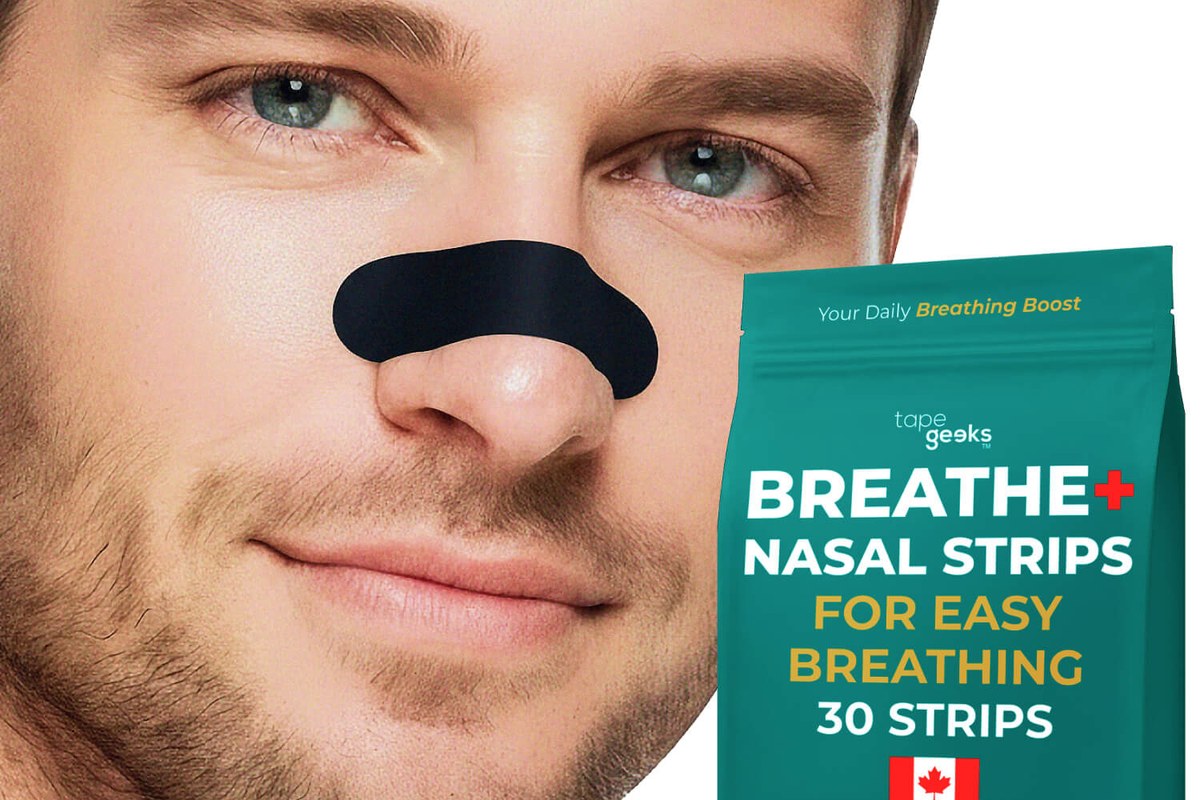
Strips mechanically widen the nasal valve. They help most when the nose is the bottleneck — congestion or valve narrowing — and were part of the treatment that cut sleep mouth breathing from 39% to 8% in the McLean study.
Treat the allergy itself
In snorers with rhinitis, a nightly steroid nasal spray roughly halved the apnea index versus placebo (Kiely 2004, Thorax: 11.9 vs 20). Talk to your pharmacist or doctor — these are for diagnosed rhinitis, not general use.
Humidify winter air
Dry Canadian winter air inflames nasal passages and breeds congestion. A bedroom humidifier from November to March keeps the nasal route comfortable enough to actually use.
One honesty note, because the marketing in this category gets ahead of the science: a 2016 systematic review (Camacho et al., Pulmonary Medicine) found nasal dilator strips do not meaningfully change apnea severity — AHI moved from 28.7 to just 27.4. Strips make nasal breathing easier; they do not treat sleep apnea. Anyone who tells you otherwise is selling something they shouldn't be.
TapeGeeks built the Breathe+ collection around this mouth breathing progression, and Breathe+ Nasal Strips are our contribution to Tool 2 — hypoallergenic, latex-free, and designed for exactly this job: keeping the nasal route open so your body stops defaulting to mouth breathing. There's a full comparison of strips versus mouth tape here if you're weighing both.
A 31-point drop from one intervention: opening the nasal route. This is why every credible protocol starts with the nose — no exercise program or tape can compete with simply making nasal breathing possible again.
Step 2: Retrain the Habit with Mouth and Throat Exercises
Daily tongue-and-throat exercises — the clinical term is myofunctional therapy — have the strongest trial evidence of any behavioural fix for mouth breathing's downstream problems. A meta-analysis in the journal Sleep (Camacho et al., 2015) pooled adult studies and found the exercises cut the apnea-hypopnea index roughly in half, from 24.5 to 12.3 events per hour. In a randomized trial (Guimarães et al., American Journal of Respiratory and Critical Care Medicine, 2009), three months of daily practice reduced AHI by 39% and dropped snoring intensity scores from 3 to 1. Another randomized trial (Ieto et al., Chest, 2015) cut the objective snore count roughly in half.
The catch: it only works if you actually do it, daily, for about three months. The core routine takes roughly ten minutes:
- Tongue posture: Rest the whole tongue against the roof of your mouth, tip behind the front teeth. Hold, release, repeat — and make it your default position during the day.
- Tongue push-ups: Press the entire tongue flat against the palate and hold for 10 seconds. Ten repetitions.
- Tongue slides: Run the tongue tip backwards along the roof of the mouth, 20 strokes.
- Cheek and lip resistance: Press lips firmly together for 30 seconds; use a finger to pull one cheek outward while the mouth muscles pull it back.
These come from the published trial protocols, but a speech-language pathologist or myofunctional therapist can tailor a program — worth it if snoring is the main complaint. Note what this is: an adjunct with real evidence, not a replacement for CPAP or medical treatment in diagnosed sleep apnea.
A halving of apnea events with no device and no drug is remarkable — but it came from people who practised every day for months. The exercises work on the muscles that keep your mouth closed and your airway toned; skip the practice and you keep the problem.
Step 3: Change How You Sleep
Sleeping on your side is the best-supported position change, though the evidence is indirect: positional therapy reduces apnea events by roughly half in people whose breathing problems concentrate in back-sleeping (Barnes et al., Sleep Medicine Reviews, 2017 — about 11 fewer events per hour). No trial has directly measured whether side-sleeping stops oral airflow, so treat this as a sensible supporting move rather than a cure: gravity pulls the jaw and tongue backward when you're on your back, and side-sleeping removes that force.
The practical tricks: a body pillow to block the roll onto your back, a slightly raised head of bed, and — as covered in our complete snoring guide — treating the bedroom environment (cool, humidified air) as part of the fix rather than an afterthought.
What About Mouth Tape?
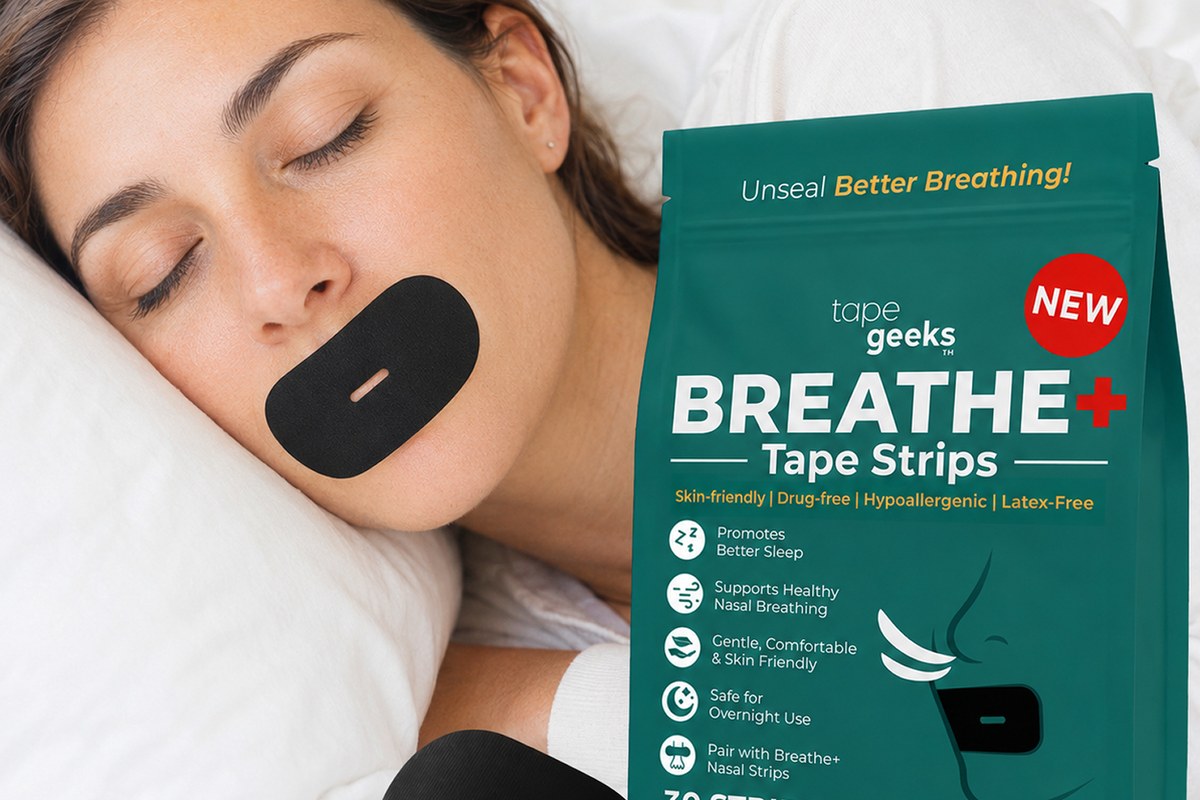
Mouth tape can help a narrow group — habitual mouth breathers with clear noses and, at most, mild sleep issues — and the evidence stops there. The one published study (Lee et al., Healthcare, 2022) found taping roughly halved snoring in mouth-breathers with mild sleep apnea, but it was small, short, and uncontrolled, and it excluded anyone who couldn't tolerate the tape. A 2025 systematic review in PLOS ONE was blunter: the evidence outside mild cases is minimal, and taping can be risky for people whose mouth breathing is compensating for a blocked nose.
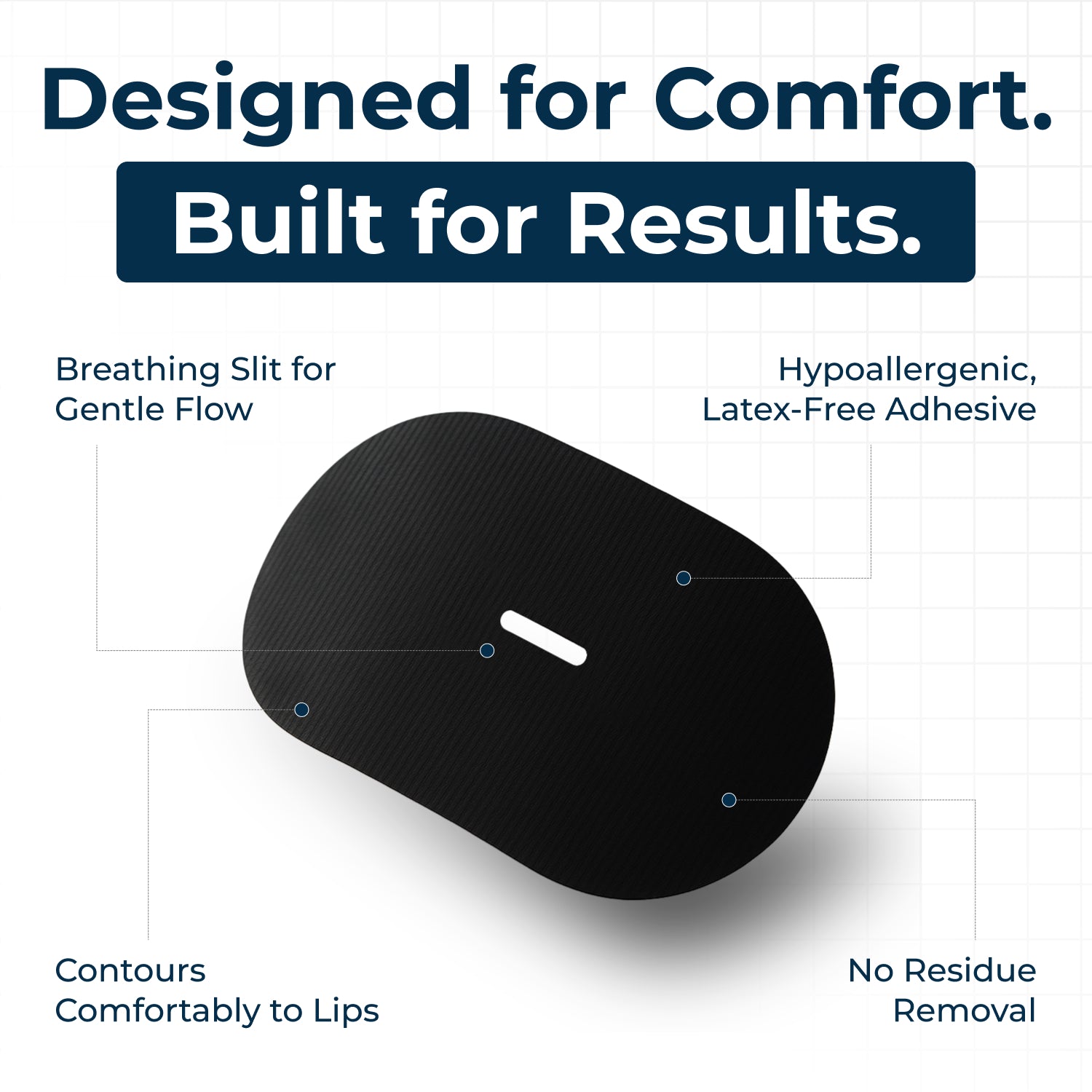
Here is the honest TapeGeeks position — and we literally sell mouth breathing products: tape belongs at the end of this list, not the beginning. Fix the nose first. If your nose is reliably clear and your mouth still falls open out of pure habit, tape is a reasonable, low-cost training aid. TapeGeeks Breathe+ mouth tape includes a built-in comfort slot precisely because a full seal is the wrong tool for beginners. Before trying it, read the safety section of our complete Canadian mouth taping guide — the contraindications list is not optional reading.
When to See a Doctor Instead
Some mouth breathing is a medical flag, not a habit to fix at home. Book an appointment — family doctor, ENT, or a sleep clinic — if any of these apply:
- You snore loudly and someone has seen you gasp, choke, or stop breathing during sleep
- You're exhausted during the day despite a full night in bed
- One nostril is always blocked, or congestion never resolves (possible deviated septum or polyps)
- A child in your house mouth-breathes constantly — pediatric mouth breathing has different causes (often enlarged adenoids) and different stakes
- Home fixes have changed nothing after a month of honest effort
Remember the research above: mouth breathing at night can be a symptom of sleep apnea, not the cause — and apnea is very treatable once diagnosed. In Ontario, sleep studies are OHIP-covered with a referral; SleepClinicFinder.com lists accredited clinics across the GTA.
Frequently Asked Questions
How can I stop mouth breathing naturally?
Start with the nose: a saline rinse before bed, a nasal strip to widen the nasal valve, and a bedroom humidifier in winter. Then add daily tongue-and-throat exercises — ten minutes of tongue posture holds, palate presses, and lip resistance work — which halved apnea severity in a 2015 meta-analysis. Side-sleeping helps too. All of these are drug-free and safe to start tonight.
What is the root cause of mouth breathing?
The most common root cause is a nose that can't move enough air — from allergies, congestion, a deviated septum, swollen turbinates, or polyps. The Cleveland Clinic notes most people mouth-breathe because nasal breathing isn't available. But it can also persist as pure habit after congestion resolves, or appear as a symptom of sleep apnea even when the nose is completely clear.
Can I train myself not to be a mouth breather?
Yes, if your nose is clear. Myofunctional therapy — daily tongue and throat exercises — has randomized-trial evidence: three months of practice cut apnea severity by 39% and dropped snoring intensity markedly in a 2009 trial. During the day, practise keeping your tongue on the roof of your mouth with lips closed. At night, some people add mouth tape once nasal breathing is comfortable.
Can I fix being a mouth breather?
Often, yes — but the fix depends on the cause. If congestion or allergies are the driver, treating them can cut sleep mouth breathing from 39% to 8% of the night, as one 2005 study showed. If it's habit, exercises retrain it over about three months. If it's driven by sleep apnea or a structural problem like a deviated septum, you need a diagnosis first — those don't resolve with home remedies.
Do nasal strips stop mouth breathing?
Nasal strips help when a congested or narrow nose is what's forcing your mouth open — they mechanically widen the nasal valve, and were part of a treatment combination that reduced sleep mouth breathing by 31 percentage points in one study. They are not a sleep apnea treatment: a 2016 systematic review found they don't meaningfully change apnea severity. Think of them as opening the door; your body still has to walk through it.
Is mouth taping a good way to stop mouth breathing?
Only in a narrow case: your nose is reliably clear, your sleep issues are mild at most, and your mouth opens out of habit. The supporting study was small and preliminary, and a 2025 systematic review found little evidence beyond mild cases — plus real risk if your nose is blocked. Fix nasal breathing first; treat tape as a training aid, never a first resort.
The Bottom Line
Mouth breathing at night is fixable, but the order of operations matters. Clear the nose first — that single step eliminated most sleep mouth breathing in the best study we have. Retrain the muscles with daily exercises if habit is the holdover. Sleep on your side. Save mouth tape for last, and only with a clear nose. And if snoring, gasping, or daytime exhaustion is part of the picture, skip the home remedies and get a sleep assessment — because sometimes the open mouth is the messenger, not the problem.
TapeGeeks builds tools for exactly this mouth breathing progression: Breathe+ Nasal Strips to keep the nasal route open, and mouth tape with a comfort slot for the retraining stage — because better sleep starts with better breathing.