






Written by: Professor Geek (The Geek Educator)
Edited by: Greg Kowalczyk, CEO & Co-Founder, TapeGeeks Inc.
Kinesiology tape vs compression sleeves for runners knee pain comparison guide
 kinesiology tape and a compression knee sleeve before a training run" style="width:100%; height:auto; border-radius:12px; margin:10px 0 22px 0; display:block;">
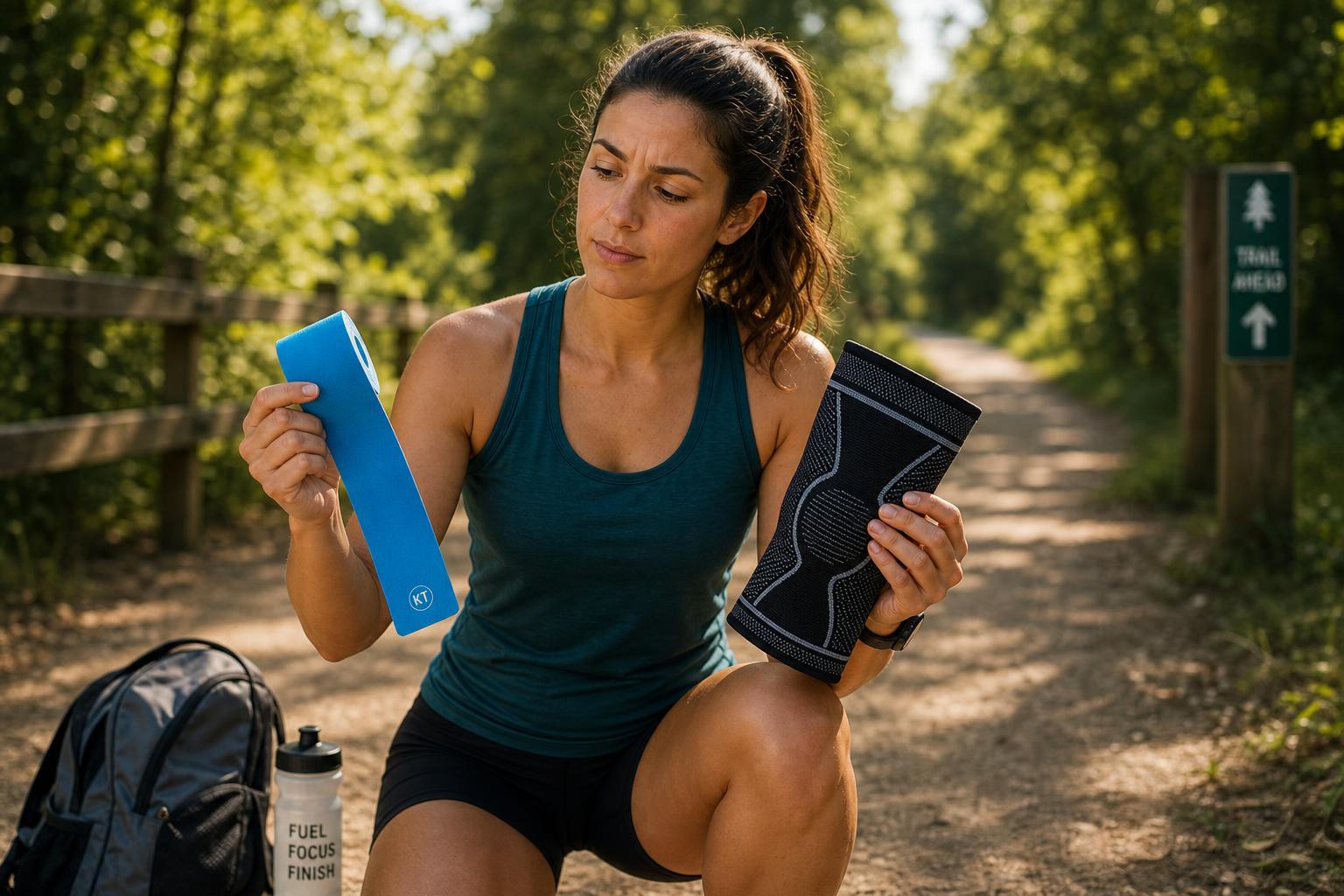
For runner’s knee pain, kinesiology tape is usually better when you want targeted support around the kneecap, IT band, or patellar tendon without changing your stride. A compression sleeve is better when you want general warmth, swelling control, and all-run comfort. The TapeGeeks kinesiology tape vs compression sleeves for runners knee pain comparison guide comes down to one question: do you need a precise mechanical cue, or do you need broad compression?
Honestly, most runners buy the wrong one first. They grab a thick sleeve because it feels supportive in the store, then realize it bunches behind the knee at kilometre 7. Or they slap tape across the kneecap with no anchor points and wonder why it peels before the warm-up is done. Not magic. Both tools can help you run with less irritation, but neither replaces strength work, load management, better pacing, or knowing when to stop. This guide is for real running situations: a 35 km-per-week recreational runner with kneecap ache, a half-marathon build with lateral knee pain, and the nervous week before a 10K when every niggle feels louder than it should.
Quick Answer: Tape or sleeve for runner’s knee?
Choose kinesiology tape for targeted kneecap tracking, IT band irritation, or patellar tendon load cues. Choose a compression sleeve for general warmth, mild swelling, and easy support during short runs. Use neither as your only plan if pain changes your stride or hurts at rest.
Kinesiology tape gives targeted feedback; compression sleeves give broad pressure
Kinesiology tape and compression sleeves work differently. Tape changes skin tension and sensory input in a specific line. A sleeve applies circumferential pressure around the whole knee.
What kinesiology tape actually does
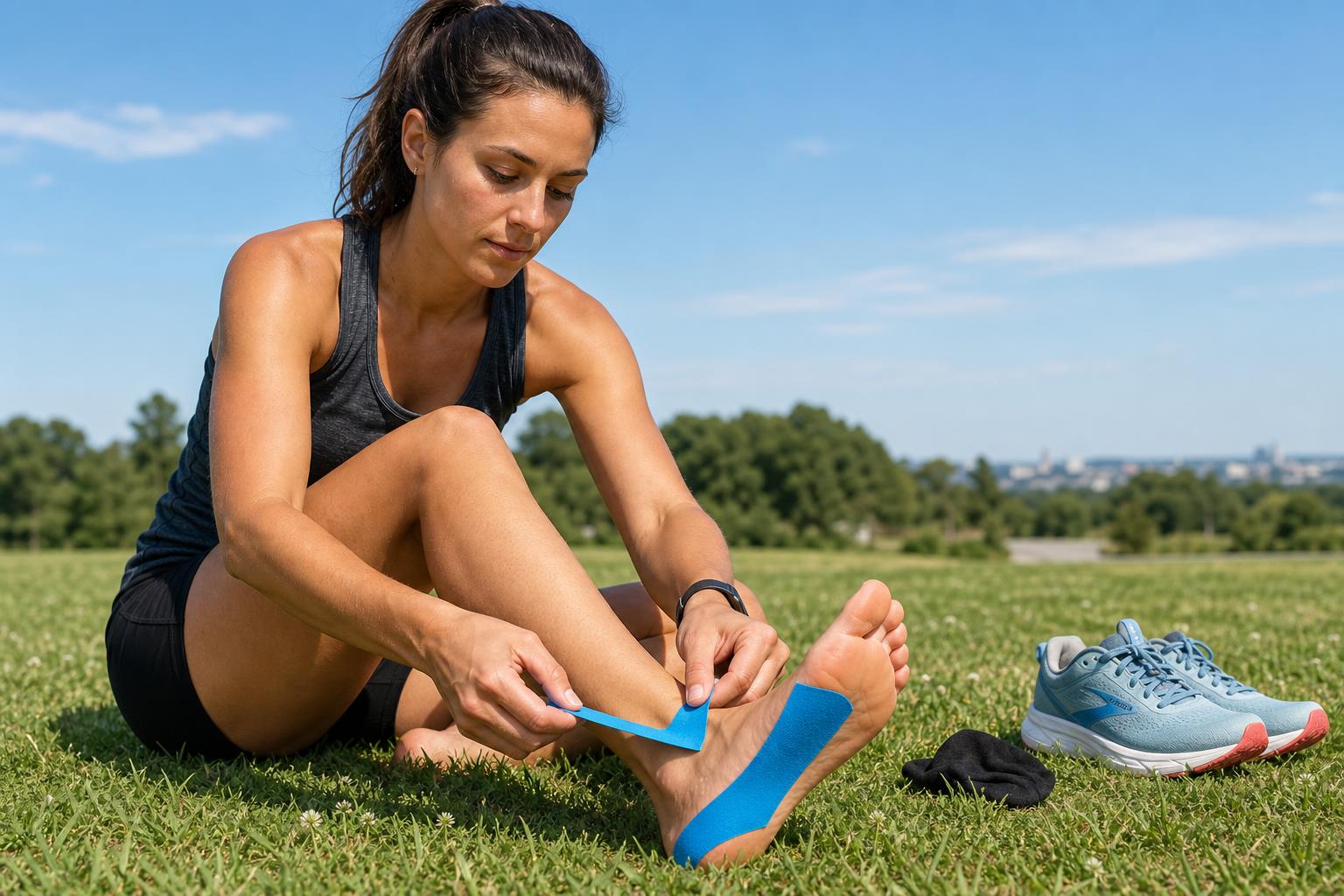
Kinesiology tape is elastic cotton or synthetic tape applied directly to the skin. For runners, that matters because the tape can be aimed along a specific structure: around the patella, across the patellar tendon, along the lateral thigh, or in a decompression strip over a sore point. The goal is not to “hold the knee together.” It does not do that. Instead, tape creates a light pull on the skin, which can alter proprioceptive feedback, reduce the feeling of strain during motion, and remind you to avoid the sloppy mechanics that show up when fatigue hits.
That is why the TapeGeeks kinesiology tape vs compression sleeves for runners knee pain comparison guide starts with symptom location. Pain under the kneecap is different from pain on the outside of the knee. A sleeve gives both areas the same squeeze. Tape can be cut, angled, stretched, and anchored to match the problem.
Where a compression sleeve helps
A knee compression sleeve wraps the joint in elastic fabric. Most sleeves add warmth, light joint awareness, and pressure. Some add silicone patellar rings or side stays, which move them closer to soft braces than plain sleeves. A sleeve is simple: pull it on, run, take it off. No trimming. No skin prep. No learning curve.
The trade-off is precision. A sleeve cannot bias the kneecap medially, unload a tender tendon strip, or cue a runner away from hip drop in the same way tape can. But if your knee feels stiff on cold morning runs, or if you like gentle pressure during easy 5K recovery runs, a sleeve may feel better than tape. Feel matters. So does fit.
The research picture is mixed, not useless
According to a 2023 study published in BMC Musculoskeletal Disorders, both Kinesio tape and compression sleeves were studied for delayed onset muscle soreness after exercise, and the authors reported changes in soreness and functional measures compared with control conditions. That does not prove either product fixes runner’s knee. It does show why athletes keep using both: sensory input, pressure, and comfort can change how a sore limb feels during movement.
The truth is, tape and sleeves are support tools. They are not the plan. Your plan is training load, strength, sleep, footwear timing, and knowing when pain is information instead of background noise. The TapeGeeks kinesiology tape vs compression sleeves for runners knee pain comparison guide is built around that reality.
Use kinesiology tape when knee pain is specific, repeatable, and tied to movement
Kinesiology tape is the better first choice when a runner can point to one painful area and reproduce the discomfort during squats, downhill running, stairs, or the first 10 minutes of a run.
Kneecap tracking irritation: tape’s best use case
If your discomfort sits behind or around the kneecap, especially on stairs or during downhill running, tape can be useful because it gives the patella a directional cue. A common runner setup uses two “I” strips around the kneecap with moderate stretch in the middle of each strip and no stretch on the anchors. The runner bends the knee to about 30 degrees, lays the first strip from the outside of the knee toward the inside edge of the patella, then mirrors it from the other side if needed. The anchors stay relaxed. Always.
According to the 2019 Patellofemoral Pain Clinical Practice Guideline published in the Journal of Orthopaedic & Sports Physical Therapy, exercise therapy is a primary intervention for patellofemoral pain, while taping may be used as an adjunct in selected patients. Translation for runners: tape can help your run feel more controlled, but your hips, quads, calves, and training volume still matter more over 6 to 12 weeks.
Lateral knee or IT band flare? Be precise
For lateral knee discomfort that shows up at the same distance every run, usually around the outside of the knee, tape can be used as a sensory cue along the lateral thigh or as a decompression strip over the sore point. It will not stretch the IT band. That band is dense connective tissue, not a shoelace. But tape can change the signal your brain gets from the area, which may reduce guarding and help you keep your cadence steady.
Specific example: a runner at Coronation Park in Oakville doing 6 x 800 m repeats feels outside-knee irritation on rep four every week. In that case, I would test a lateral thigh strip before the workout, shorten the session, and check cadence drop-off in the final reps. I would not just tape harder and run the full set. Bad trade.
Application steps for runner’s knee taping
- Clean and dry the skin; avoid lotion, sunscreen, or massage oil for at least 2 hours before taping.
- Cut two strips long enough to frame the kneecap, then round every corner to reduce peeling.
- Bend the knee slightly, about 20 to 30 degrees, so the tape is not applied over fully straight skin.
- Apply the first anchor with zero stretch, add 25% to 50% stretch through the middle, then finish with zero stretch.
- Rub the tape for 20 to 30 seconds to warm the adhesive before running.
- Test with 10 bodyweight squats and a 3-minute jog before starting the planned session.
For race week, keep it boring. If you have never taped your knee before, do not make race morning your first test. Use one easy run, one workout, and one post-run skin check before trusting any taping method on a long run.
Shop KT Tape →| Feature | KT Tape Pro kinesiology tape | Bauerfeind Sports Knee Support sleeve | Best for |
|---|---|---|---|
| Typical price | About $20–$25 per 20-strip roll; single-use strips | About $90–$110 each; reusable washable sleeve | Tape for low upfront cost; sleeve for long-term repeated use |
| Support style | Elastic cotton/synthetic tape with roughly 180% stretch; applied in patellar tracking or IT band patterns | Medical-grade knit compression with silicone patellar pad and side stays | Tape for targeted guidance; sleeve for all-around knee compression |
| Runner’s knee use case | Useful for mild patellofemoral pain, kneecap tracking cues, or short runs when taped correctly | Useful for achy knees, swelling control, proprioception, and longer runs or recovery walks | Tape for specific pain patterns; sleeve for diffuse soreness or mild swelling |
| Wear time | Typically 1–3 days; water-resistant but adhesive may loosen with sweat | Wear during runs and recovery periods; remove for sleep unless clinician advises otherwise | Tape for multi-day targeted support; sleeve for easy on/off daily use |
| Fit and sizing | One-size strips; requires clean skin, correct tension, and no wrinkles | Sized by thigh/calf circumference; snug fit is essential to avoid slipping or over-compression | Tape for customizable fit; sleeve for runners who can match size accurately |
| Main drawbacks | Can irritate skin, depends on application skill, and costs add up with frequent use | Higher upfront price, can feel warm, and may bunch behind the knee on some runners | Tape for occasional use; sleeve for runners tolerating compression and heat |
Use a compression sleeve when you want warmth, light swelling control, and simple support
Compression sleeves are the better choice when a runner wants easy, reusable support for general knee sensitivity rather than a precise taping pattern.
Sleeves work best for easy runs and cold starts
A sleeve shines when your knee feels stiff before it feels sore. Think early morning in March, an easy 30-minute run after a desk-heavy workday, or the first run back after a hard downhill trail session. The sleeve gives warmth and pressure immediately. No scissors. No mirror. No guessing about stretch percentages.
And some runners simply like the feeling. That is not a fake benefit. Comfort can reduce apprehension, and less apprehension often means smoother movement. The problem starts when a runner mistakes “feels secure” for “ready for speedwork.” A sleeve can make a grumpy knee quieter without changing the reason it became grumpy.
Fit decides whether a sleeve helps or annoys you
Measure your thigh and calf according to the brand’s chart, not your jeans size. If the sleeve rolls at the top, pinches behind the knee, or leaves deep marks after a 20-minute test walk, it is wrong for running. A sleeve that slips every kilometre will change your stride because you keep thinking about it. That defeats the point.
For runners with larger quads and smaller calves, common in cyclists and trail runners, some sleeves slide down because the taper is wrong. For runners with sensitive skin, silicone grip strips can irritate. If you are between sizes, the tighter option may feel supportive while standing and miserable while climbing hills. Test on movement, not on the couch.
When sleeves are not enough
This does not work for sharp pain, swelling after a twist, locking, buckling, or pain that changes how your foot lands. If you are limping, skip this entirely and get assessed. A sleeve may hide the warning signs long enough for you to make a small problem bigger.
According to Mayo Clinic guidance on knee pain, medical attention is recommended when a person cannot bear weight, has marked swelling, sees an obvious deformity, cannot fully extend the knee, or has fever with redness and pain. Runners should take that list seriously. Gear is for manageable training discomfort, not red flags.
The TapeGeeks kinesiology tape vs compression sleeves for runners knee pain comparison guide is not saying sleeves are weak. It is saying sleeves are broad. Broad support is useful when your symptoms are broad. It is less useful when the pain has an address.
For patellofemoral pain, tape usually wins on precision and sleeves usually win on convenience
For kneecap-area runner’s knee, kinesiology tape is usually more precise than a compression sleeve because it can cue patellar position and reduce irritation during specific movements.
Why kneecap pain needs a targeted plan
Patellofemoral pain often shows up as pain around or behind the kneecap during stairs, squats, sitting with bent knees, hills, or faster running. Runners usually describe it as vague at first, then annoyingly predictable. It may not hurt at kilometre 1. Then it appears at kilometre 4. Then it appears on the stairs after the run.
According to a 2015 systematic review indexed in PubMed on lower-extremity running injuries, knee injuries are among the most frequently reported running-related problems in long-distance runners. That broad finding matches what club coaches see every spring: mileage rises, downhill volume returns, shoes get older, and kneecaps start complaining.
Tape can be adjusted from run to run
One underrated advantage of tape is adjustability. If the irritation is more lateral, you can bias the strip slightly differently. If the patellar tendon is the touchy spot, you can use a short decompression strip over the tendon instead of framing the kneecap. If the skin reacts, you stop and change the method. A sleeve gives you one tool shape every time.
But tape has a learning curve. Bad taping can wrinkle, pull skin, irritate hair follicles, or peel in the first 15 minutes. A runner who hates prep will not suddenly become a careful taper during marathon training. That runner may do better with a sleeve, a shorter route, and a smarter strength plan.
A simple decision test before your next run
Before choosing tape or a sleeve, do three tests: 10 bodyweight squats, 10 step-downs from a low stair, and a 3-minute easy jog. If discomfort appears in one specific part of the movement, tape is more likely to give useful feedback. If the knee just feels generally stiff and better as it warms, a sleeve may be enough for that day.
Log it. Use RunMate Pro to track when the discomfort starts, what shoes you wore, your weekly mileage, and whether tape or a sleeve changed the run. Patterns beat guesses. If your pain appears every time one shoe passes 650 km, the best knee support may be a shoe rotation reminder.
For IT band and outside-knee pain, tape is a cue and load management is the fix
For outside-knee pain linked to IT band irritation, kinesiology tape can help as a sensory cue, but training load, downhill volume, hip control, and cadence usually decide whether the problem settles.
Why sleeves often miss the point with lateral knee pain
A compression sleeve squeezes the whole knee, which may feel good for a few kilometres, but lateral knee pain in runners often has a timing pattern. It shows up after a predictable distance, gets worse downhill, and may calm down when you stop. A sleeve does not tell your hip to stop collapsing inward at fatigue. It does not shorten an overreaching stride. It does not reduce the downhill set you added too quickly.
Tape can at least give a directional reminder. A long strip from the lateral hip toward the outside of the knee, plus a small decompression strip over the irritated area, can make a runner more aware of the lateral chain. Again, it is not holding the IT band in place. It is a cue. A useful one for some runners.
How to apply tape for outside-knee irritation
- Stand with the affected leg crossed slightly behind the other leg to place the outside thigh on gentle stretch.
- Anchor a long strip near the outside of the hip with zero stretch.
- Lay the strip down the lateral thigh with light stretch, about 15% to 25%, stopping just above the outside of the knee.
- Add a short cross strip over the sore point with 25% to 50% stretch in the middle and zero-stretch ends.
- Walk, squat, and jog before committing to the run.
If the tape makes symptoms worse, remove it. If symptoms appear earlier than usual, stop the workout. The TapeGeeks kinesiology tape vs compression sleeves for runners knee pain comparison guide is pro-tape, but not blindly pro-tape. Pain that escalates during the same run is your body voting no.
What to change beyond gear
For outside-knee issues, check three numbers before blaming your body: weekly mileage jump, downhill minutes, and shoe age. A jump from 28 km to 42 km in one week is a 50% increase, even if every run felt easy. A new hilly route can load the lateral knee more than your flat loop. A shoe at 750 km may still look fine and feel dead.
Shorten stride slightly. Raise cadence by 3% to 5% if you are overstriding. Reduce downhill intensity for 10 to 14 days. Add side planks, step-downs, and single-leg calf raises. Boring work. Very effective.
Race week choice should be based on testing, not panic
Race week is the wrong time to experiment, so runners should choose the support option they have already tested on at least two runs.
The 7-day rule
Seven days before a race, pick one support method and test it during a short run with a few strides. If tape stays on, feels comfortable, and leaves the skin calm afterward, it can stay in the plan. If a sleeve stays put, does not bunch, and does not make the knee feel hotter than expected, it can stay in the plan. No new gear after that. None.
I have seen runners change shoes, socks, gels, tape patterns, and pacing strategy in the same week because one knee felt off after a workout. Testing products with club runners has taught me the same lesson over and over: the calm option usually beats the clever one. That is how a small issue becomes a full-body mess. Use the support that has already worked.
When tape is better on race day
Tape is usually better on race day when you have a precise symptom that responds to a precise application. It also layers better under split shorts, tights, and race socks. If rain is possible, apply tape to clean dry skin at least 45 to 60 minutes before the start, and do not stretch the anchors. Waterproof tape can help, but sweat, sunscreen, body hair, and poor prep still matter.
But if you need to reapply tape in a parking lot at 6:35 a.m. with cold hands and nerves, you waited too long. Pre-cut your strips the night before. Round the corners. Pack one extra strip. Simple wins.
When a sleeve is better on race day
A sleeve is better on race day when you care more about warmth and confidence than directional correction. A 5K runner with mild stiffness may prefer a sleeve during warm-up and then remove it before the start. A half-marathoner who has tested the sleeve on a 16 km long run may keep it on
Best for
- Runners logging 10-35 miles per week with mild patellar tracking discomfort who want kinesiology tape for targeted kneecap support without covering the whole knee.
- Half-marathon or marathon trainees using compression sleeves on long runs of 8-18 miles to manage general knee achiness, warmth, and swelling after higher-volume weeks.
- Runners with occasional runner’s knee symptoms during downhill routes or speed workouts who need short-term support for a specific session, race, or return-to-run day.
- Beginners increasing from 2-3 runs to 4 runs per week who want a non-bulky option to improve comfort while they address strength, cadence, and training-load issues.
- Cold-weather runners who prefer compression sleeves for warmth and light joint feedback during easy runs under 60 minutes.
Not ideal for
- Runners with sharp pain, locking, giving way, or swelling that appears within 24 hours of a run, especially after a twist, fall, or sudden mileage jump.
- Anyone with skin allergy to adhesives, fragile skin, open cuts, eczema flare-ups, or tape-related blistering around the knee.
- Runners with numbness, tingling, calf swelling, color changes, or a sleeve that leaves deep marks, which may indicate excessive compression or circulation issues.
- High-mileage runners above 40 miles per week using tape or sleeves to push through worsening pain instead of reducing load and getting a gait or strength assessment.
- People with suspected meniscus tear, ligament injury, stress fracture, infection, or unexplained knee swelling who need medical evaluation rather than external support.
Frequently Asked Questions
Is kinesiology tape or a compression sleeve better for runner’s knee?
For most runner’s knee, or patellofemoral pain, neither tool is a cure. Kinesiology tape may help short-term pain by changing sensory input and kneecap tracking, while a compression sleeve may reduce swelling and add warmth and proprioception during runs. The 2019 JOSPT patellofemoral pain guideline emphasizes exercise therapy over passive supports (jospt.org, Willy et al., 2019). Choose the option that lowers pain during a 10-minute test run.
How long can runners wear kinesiology tape on the knee?
Most runners wear kinesiology tape for 1 to 3 days, depending on skin tolerance, sweating, and adhesive quality. Remove it sooner if itching, burning, blistering, or redness lasts more than 30 minutes after removal. Tape should not feel numb, tight, or painful. Apply it to clean, dry skin at least 30 minutes before running so the adhesive can bond properly and avoid lotions under the tape.
How tight should a knee compression sleeve be for running?
A running knee compression sleeve should feel snug but not restrictive. You should be able to slide 1 finger under the top edge, bend the knee fully, and run without tingling, foot coldness, or color change. Many brands size sleeves by measuring knee circumference at the kneecap or 4 inches above it. If the sleeve rolls down, leaves deep marks, or changes your stride, it is likely the wrong size.
Can I use kinesiology tape and a compression sleeve together?
Yes, some runners use kinesiology tape under a compression sleeve, especially for short workouts, but the combination can increase heat, friction, and skin irritation. Test it first on a 15- to 20-minute easy run, not during a race. The sleeve should not peel the tape, bunch behind the knee, or cause numbness. If pain relief only occurs with both supports, reduce mileage and address strength, cadence, and training load.
Does kinesiology tape actually work for knee pain in runners?
Kinesiology tape can help some runners feel less knee pain during activity, but research suggests effects are usually small and short term. A systematic review in the Journal of Physiotherapy concluded that current evidence did not support kinesio taping as a primary treatment for musculoskeletal conditions (Parreira et al., 2014, PubMed PMID: 24856938). For runner’s knee, tape is best viewed as a temporary aid while strengthening hips and quadriceps.
Do compression sleeves help runner’s knee pain or just hide symptoms?
Compression sleeves may help runner’s knee by improving comfort, warmth, and body awareness, but they do not fix the main causes, such as load spikes, weak hip muscles, or poor recovery. If a sleeve reduces pain from a 5 out of 10 to a 2 out of 10 during an easy run, it can be useful. If pain returns immediately after removing it, treat the sleeve as symptom support, not rehabilitation.
When should a runner stop using tape or sleeves and see a doctor?
A runner should seek medical advice if knee pain follows a fall, causes major swelling, prevents weight bearing, creates locking or instability, or is accompanied by fever or redness. Mayo Clinic lists inability to bear weight, obvious deformity, and marked swelling as reasons to get prompt care for knee pain (mayoclinic.org). Also get evaluated if symptoms persist longer than 2 to 3 weeks despite reduced mileage and basic rehab exercises.
What should I do besides tape or sleeves to fix runner’s knee?
The best-supported plan for runner’s knee is progressive exercise, load management, and gait adjustments when needed. The 2019 Journal of Orthopaedic & Sports Physical Therapy guideline recommends combined hip- and knee-targeted exercises for patellofemoral pain, with programs often lasting at least 6 weeks (jospt.org). Runners commonly start with pain-limited mileage, step-downs, squats, hip abduction work, calf strength, and a gradual return that keeps pain at 3 out of 10 or less.