





Common Dance Injuries: Where Dancers Get Hurt, What Tape Can and Can't Do, and When to See a Dance Physio

Quick answer: The most common dance injuries hit the foot and ankle first, then the hip, knee and lower back. In a 2008 JOSPT study of 204 pre-professional dancers aged 9 to 20, 53% of injuries were to the foot and ankle. Most build up from overuse. Kinesiology tape can make an achy area feel supported, but it does not treat an injury.
Dancers get hurt a lot, and mostly in the same places. This TapeGeeks guide to common dance injuries walks through each body area: what the injury is, the warning signs, what tape can honestly do, what it can't, and the point where you stop taping and book a dance physio. I'm Professor Geek, so the numbers come with their sources. Coach Geek chips in with the practical bits.
One rule runs through every section. Tape is for the achy, not the injured.
What are the most common dance injuries?
The most common dance injuries are foot and ankle problems (ankle sprains, Achilles and big-toe tendon pain, stress reactions), followed by hip, knee and lower-back pain. Boston Children's Hospital lists the same trouble spots for young dancers: feet and ankles, low back, hips and knees.
The clearest single breakdown comes from Gamboa et al. 2008 in JOSPT, which followed 204 pre-professional ballet dancers aged 9 to 20 over five years. Their injuries landed like this.
More than half of these young dancers' injuries were below the shin. That's why most of this guide sits in the foot and ankle. These are one school's numbers, though, so treat them as a pattern rather than a rule for every studio.
Why the injury numbers disagree
Dance injury studies report very different numbers because they count different things. A 2018 JOSPT study by Kenny and colleagues followed 145 pre-professional ballet and contemporary dancers and found that seasonal injury prevalence ranged from 9.4% to 82.4%, depending on how an "injury" was defined and who reported it. Count every self-reported complaint and nearly everyone is hurt. Count only time lost from dance, as recorded by staff, and the figure collapses.
So when a website says "up to 80% of dancers get injured", ask: injured how? Below are the main studies side by side, each with its own group of dancers. Don't add them together.
| Study | Who was studied | Main finding |
|---|---|---|
| Gamboa et al. 2008, JOSPT | 204 pre-professional ballet dancers, ages 9 to 20, over 5 years | Foot and ankle 53% of injuries; 32% to 51% of dancers injured each year |
| Ekegren et al. 2014, J Sci Med Sport | 266 full-time pre-professional ballet students, ages 15 to 19, one school year | 76% injured during the year |
| Smith et al. 2015, Orthop J Sports Med | Systematic review of ballet injury studies | Foot and ankle made up 14% to 57% of injuries, depending on the study |
| Kenny et al. 2018, JOSPT | 145 pre-professional ballet and contemporary dancers | 9.4% to 82.4% seasonal prevalence, depending on the injury definition |
| Honrado et al. 2021, Sports Health | 4,152 US emergency-department dance cases, 2014 to 2018 | Knee 22.5%, ankle 15.7%, foot 10.2% of ER cases |
Notice the emergency-room study puts the knee on top. That isn't a contradiction. ER data catches sudden injuries (falls, twisted knees), while school studies catch the slow-building overuse problems that never go near a hospital.
Overuse vs acute: most dance injuries build up slowly
Most dance injuries are overuse injuries, which means tissue gets loaded faster than it can recover, class after class, until it complains. Johns Hopkins performing-arts physical therapists say overuse injuries are the most common kind in dancers, and that ankle sprains are the number one sudden (traumatic) injury.
The difference matters for tape. An overuse ache that comes and goes is where tape can play a small supporting role. An acute injury (a pop, a fall, a rolled ankle that swells) is not a taping job. The IADMS paper First Aid for Dancers is blunt about it: stop dancing and get an acute injury evaluated.
Foot and ankle injuries in dancers
Foot and ankle injuries are the biggest group in nearly every dance study, because relevé, pointe work, jumps and barefoot turns load the lower leg harder than almost anything else dancers do.
Ankle sprains
A sprain happens when the ankle rolls and the ligaments on the outside stretch or tear, usually on a bad landing or late in a long rehearsal. Warning signs: fast swelling, bruising, pain putting weight on it. Johns Hopkins notes that once you've sprained an ankle, you're at risk of doing it again, which is why strength work matters more than any tape job.

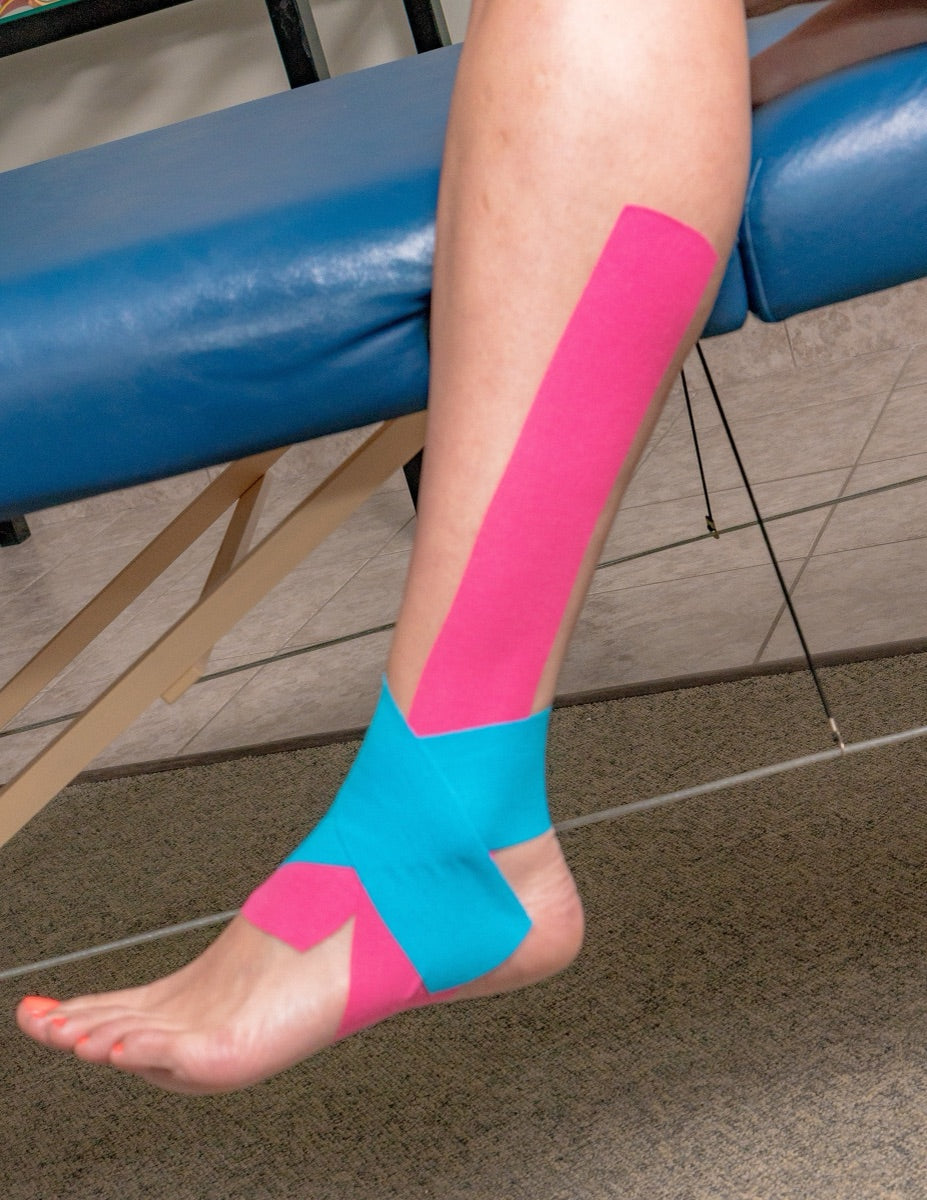
Ankle application from the Tape Like a Geek course: a compression strip loops around the back of the ankle (blue) and a no-stretch support strip runs up the lower leg (pink). For an old sprain that still aches. Dancers usually pick beige, light pink or black so it disappears on stage.
What tape can do: make an achy, previously sprained ankle feel more secure in class. What it can't do: lock the ankle like rigid athletic tape or a brace, or stop a re-sprain. The research on this exact question is humbling, and it's summarized in the evidence section further down.
A fresh sprain is different. Rest, ice, compression and elevation come first, then an assessment. Once it has been checked, some physios use a low-tension fanned "basket" pattern over the swelling, like the one below.

The fanned basket pattern used for swelling and bruising after a rolled ankle: two strips cut into fingers and laid across each other with minimal tension. It sits on top of first aid and an assessment, not in place of them. If you can't put weight on the foot, get it checked before anything else.
Achilles and big-toe tendon pain
Tendon pain is common in dancers, mostly at the Achilles and at the flexor hallucis longus, the big-toe tendon that works hard in relevé and pointe. A 2018 systematic review in the Journal of Dance Medicine & Science (Rietveld) calls FHL tendinopathy "dancers' tendinitis". Warning signs: stiffness first thing in the morning, pain behind the ankle or along the inside of the arch, a creaky or catching feeling when you point.

Calf and Achilles application: two no-stretch strips start under the heel and cross over the Achilles (black and blue), with a compression strip across the calf (pink). For calf tightness and Achilles aches from relevé and jumps.
Tape can take the edge off an aching calf or Achilles during class. Tape can't make a tendon stronger. Tendons get better with gradually loaded strength work, which is a physio's job to plan. Our Achilles taping guide and peroneal tendonitis guide go deeper.
Sesamoiditis (ball of the foot, under the big toe)
Sesamoiditis is irritation of the two tiny sesamoid bones under the big-toe joint and the tendons around them. Cleveland Clinic says overuse usually causes it, and both Cleveland Clinic and the American Academy of Orthopaedic Surgeons name ballet dancers among the people who get it. Warning signs: a pinpoint ache under the big toe that gets worse in relevé.
Coach Geek's honest take: this isn't a kinesiology tape job. The American Academy of Orthopaedic Surgeons lists a felt cushioning pad, taping the big toe slightly downward and soft, low-heeled shoes, so let a physio or doctor set that up. Pain that stays sharp and pinpoint, or keeps getting worse, needs a proper assessment to rule out a sesamoid stress fracture, which Johns Hopkins lists among dancers' stress fractures.
Stress fractures and shin pain
Stress fractures in dancers show up in the long bones of the foot (metatarsals), the shin (tibia), the sesamoids and the lower spine, according to Johns Hopkins. Boston Children's Hospital warns that shin splints and an early tibial stress injury can be hard to tell apart. Warning sign: pain on one small spot of bone that hurts more with every jump. Never tape over it and keep going. See our shin splints guide for the softer, spread-out kind of shin pain.
Dancers' knee pain
The most common cause of knee pain in dancers is patellofemoral pain, an ache around or behind the kneecap that gets worse with pliés, jumps, stairs and kneeling. Boston Children's Hospital says turnout, turning, twisting, jumping and landing can all lead to it. Forcing turnout from the knee instead of the hip is the classic culprit teachers watch for.

Knee application: a compression strip below the kneecap (black) and two support strips that frame it (blue). The kneecap itself stays untaped. For front-of-knee aches from pliés and landings.
Tape can help a sore knee feel supported through a class or a show. Tape can't fix turnout habits or weak hip muscles, and those are usually what a physio works on. A knee that gives way, locks, or swells after a twist needs an assessment, not tape. Full steps are in our knee taping guide.
Dancer hip pain: snapping hip, hip flexor and groin
Hip pain is the second biggest group in the Gamboa ballet data (21.6% of injuries), and most of it comes from the extreme range of motion dance asks for. Front-of-hip pain often starts at the hip flexor, and Boston Children's Hospital notes it can come with snapping.
Snapping hip
Snapping hip is a click or clunk at the hip during movements like développé. It's extremely common in ballet. In a 2007 American Journal of Sports Medicine study, 91% of 87 elite ballet dancers (Winston et al.) reported snapping hip, and 58% of those with snapping said it came with pain. A painless snap is usually just noise. A painful one, or one with a catching or giving-way feeling, is one for a dance physio.
Hip flexor aches
Hip flexor aches show up at the front of the hip after développés, kicks, grands battements and long rehearsals. We don't have a real photo of this application yet, so here's a diagram of the Tape Like a Geek Dance Edition method.
Lunge position with the sore side behind, rub all three strips, then lift the knee a few times: the tape should move with you. A painful click, a snap with catching, or pain at night means skip the tape and see a dance physio.
Inner-thigh (groin) strains
Groin strains come from splits, turnout and side extensions. A sudden sharp pull with bruising is a strain that needs rest and an assessment first.

Inner-thigh application: two no-stretch strips crossing on the inner thigh (black and blue). Slide the X up or down so it sits over the ache, and keep the top end a hand-width short of the groin crease.
Hamstring strains in dancers
Hamstring strains in dancers usually come from splits, high extensions and jumps, especially when the muscle is cold or tired. Warning signs: a sudden sharp pain at the back of the thigh mid-movement, sometimes with bruising a day later. That's an acute injury. Stop, get it assessed, and save tape for the later, achy stage of recovery.

Hamstring application: two no-stretch strips crossing in an X on the back of the thigh (blue and pink), anchored above the knee crease.
More detail, including the treatment side, is in our hamstring strain guide.
Lower back pain in dancers
Lower back pain in dancers usually comes from repeated arching (arabesques, backbends, lifts) combined with uneven strength and flexibility. In growing teenagers there's a bigger concern: Boston Children's Hospital warns that adolescent dancers can develop spondylolysis, a stress fracture in the lower spine.

Lower-back application: strips across the sore area and two strips running up either side of the spine (all black). For general aches from arabesques and lifts.
Tape can make a tired, achy lower back feel supported. Tape can't tell you whether a teenager's back pain is a muscle or a bone. Back pain in a dancer who's still growing, especially pain that bites when arching backward, needs a doctor or dance physio before any more backbends.
What kinesiology tape can and can't do: the research
Kinesiology tape has limited research behind it in dancers, and the two dance-specific studies we trust show small effects at best.
- Lai et al. 2026 (Asia-Pacific Journal of Sports Medicine, Arthroscopy, Rehabilitation and Technology) put kinesiology tape on the ankles of 85 dancers in a study of chronic ankle instability. Some static balance measures improved in subgroups, but there was no overall improvement in dynamic balance or hopping tests. Most dancers (72 of 85) still said the ankle felt better. The study did not test whether tape prevents re-injury.
- Botsis et al. 2019 (Journal of Functional Morphology and Kinesiology) tested 12 healthy female ballet dancers. The tape restricted side-to-side ankle motion, yet it did not shorten the time it took them to stabilize after a jump landing.
So the fair summary is this: tape changes how an area feels, and sometimes how it moves a little, but it hasn't been shown to make dancers land better or get hurt less. Alison Deleget, an athletic trainer at the Harkness Center for Dance Injuries, put it well in Dance Spirit: "It's just one tool in your recovery toolbox—in addition to rest, ice and physical therapy."
That's how TapeGeeks treats tape for common dance injuries too. We sell tape, and we'd still rather you see a physio than tape over something that needs one. Two more basics from Hospital for Special Surgery: kinesiology tape should never go on open wounds, and the colour comes down to personal preference. If tape makes your skin itchy, read our sensitive skin guide.
Achy or injured? A decision flow for dancers
The fastest way to decide between tape and a physio is to ask whether something happened suddenly, and then check for red flags. Johns Hopkins performing-arts physical therapists list four signs that pain is an injury rather than normal soreness: it wakes you at night, it's there at the start of class, it gets worse as you dance, or it makes you shift your weight or change how you move.
Most post-class soreness fades within a day or two. If the ache in the lime box keeps returning, the problem is load or technique, and tape only hides it. That's a physio conversation.
Finding a dance physio in Canada
A dance physio is a physiotherapist who has experience with dancers, so they understand turnout, pointe, relevé and why "just rest for six weeks" isn't a plan anyone will follow before a recital. The Johns Hopkins team recommends a physical therapist or physician with experience treating dancers, partly because a big part of rehab is fixing the technique that caused the injury.
For common dance injuries that need more than tape, TapeGeeks points Canadian dancers to two places:
- Healthy Dancer Canada's member directory, from a national non-profit for dancer health. You can search members by occupation and city. It only lists members, so it won't include every dance-savvy physio.
- SportClinicFinder, a sports-clinic directory run by TapeGeeks' founder, to find a sports physio near you.
When you call, ask one question: "Does a physio here regularly treat dancers?" If they ask you to show them the step that hurts, you're in the right place.
How to prevent dance injuries
Preventing dance injuries mostly comes down to managing hours, recovering properly and building strength outside class. The sources agree on five habits.
- Watch the hours. Dancing five hours a day or longer is linked to a higher risk of stress fractures and other injuries, according to Johns Hopkins.
- Take real rest days. Canada's Active & Safe programme recommends dancing no more than five days a week, with at least one day completely free of physical activity.
- Cross-train. Core and hip strengthening, Pilates and stability-based yoga help, per Johns Hopkins, and so does some cardio.
- Eat enough. Under-fuelling (relative energy deficiency in sport, RED-S) weakens bone, and Boston Children's Hospital flags it as a real risk in young dancers.
- Warm up, and sit one out when hurt. Masking pain with ice or painkillers to keep dancing is exactly what Boston Children's tells dancers not to do.
Dance-specific warm-up programmes exist too, such as 11+ Dance. The trials so far are small, so it's too early to say how much they cut injuries.
For dance teachers and studios
Dance teachers can prevent a lot of harm with one studio rule: tape is allowed for aches, never for dancing through a fresh injury. Pair it with a few habits. An adult applies and checks tape on young dancers. Nobody tapes over broken skin. A dancer who limps sits out and gets checked.
TapeGeeks built its free Tape Like a Geek taping guides around the common dance injuries in this article: ankle, calf, knee, hip flexor, hamstrings, groin and lower back. The Club & Studio Program gives a whole studio a 40% off code with no minimums and no expiry (it doesn't stack with other offers). New to taping dancers? Start with our kinesiology tape for dancers guide and, for pointe, how to tape toes for pointe shoes.
Frequently asked questions
What are the most common dance injuries?
Is tendonitis common in dancers?
How do you prevent dance injuries?
Can kinesiology tape help a dance injury?
When should a dancer see a physio instead of taping?
Why do dancers get knee pain?
What is snapping hip in dancers?
How do I find a dance physio in Canada?
The short version
Common dance injuries cluster in the foot and ankle, then the hip, knee and back, and most of them creep up from overuse. TapeGeeks' advice for common dance injuries comes down to one line: tape the ache, not the injury, and let a dance physio handle anything sudden, sharp or stubborn.
Get the free Tape Like a Geek guides →
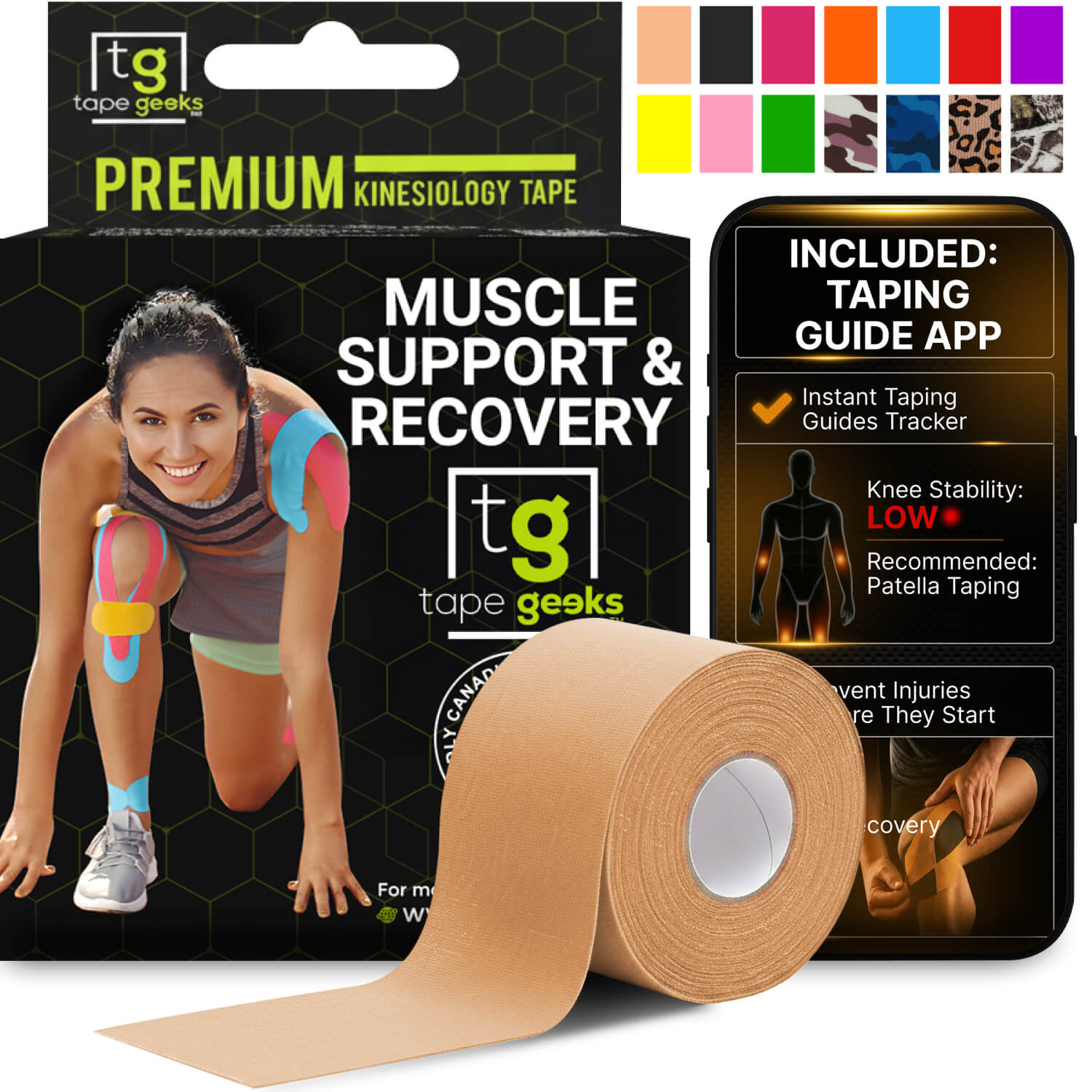
Taping an achy area for class? TapeGeeks kinesiology tape comes in beige, light pink and black, the three colours that disappear best on stage.
Educational content only, not medical advice.