





KT Tape for Achilles Tendonitis: How to Apply It — and What It Actually Does

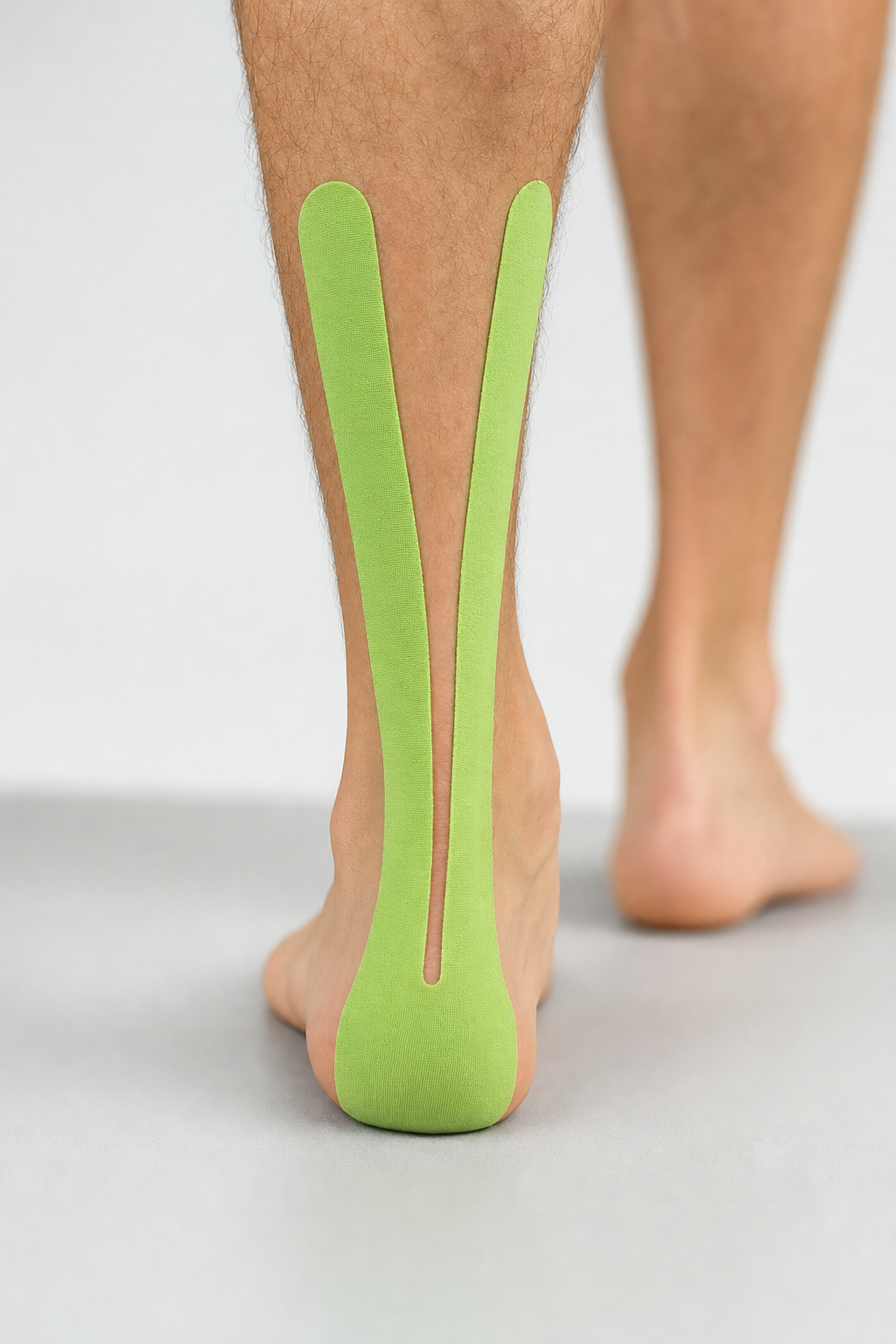
KT tape for Achilles tendonitis is applied as a Y-strip: anchor on the mid-calf, both arms laid down either side of the tendon with light 15–25% stretch, finishing at the heel with no stretch. Most people feel a supported, less "gripped" tendon while wearing it. What tape does not do is heal the tendon — a 12-week progressive calf-loading program does that. This TapeGeeks guide to Achilles tendonitis taping covers the application, the honest evidence, and the recovery plan around it.
Quick answer: Apply a Y-strip of kinesiology tape from mid-calf down both sides of the Achilles tendon with 15–25% stretch, anchoring at the heel with zero stretch, while the ankle sits at a natural angle. Expect comfort and body-awareness benefits during activity, not tissue healing — the 2024 JOSPT clinical practice guideline lists taping only as an optional add-on, with progressive calf loading as the treatment that carries Grade A evidence.
What Achilles Tendonitis Feels Like
Achilles tendonitis produces two signature signs: a localized ache 2–6 cm above the back of the heel, and morning stiffness that loosens once you start moving. The pain typically builds after running, jumping, or a sudden increase in training, then stiffens again after rest. Press the tendon between thumb and finger — a tender, sometimes thickened spot along the cord is the classic finding.
Location matters more than most people realize. Pain within 2 cm of the heel bone is insertional Achilles tendinopathy; pain higher up the cord is midportion. The research on taping and loading below applies to the midportion type, which is also the more common one. Insertional cases are managed differently (less ankle bend under load), so if your pain sits right at the heel bone, get it assessed before self-treating.
Does KT Tape Actually Help an Achilles Tendon?
No controlled study has shown that kinesiology tape reduces Achilles tendinopathy pain — and we sell tape, so that sentence cost us something to write. The one controlled trial to test it directly (Firth et al., Clinical Journal of Sport Medicine, 2010) taped 24 people with Achilles tendinopathy and 24 healthy controls, and found no change in pain during a single-leg hop test (p=0.74) and no change in hop distance. The 2024 Achilles tendinopathy clinical practice guideline in the Journal of Orthopaedic & Sports Physical Therapy lists elastic tape only as something clinicians "may use" — an optional adjunct, not a treatment.
So why tape at all? Three practical reasons hold up. Tape gives many athletes a sense of support and awareness of the tendon that makes movement feel safer, which matters during the anxious early weeks of rehab. It is a low-risk way to stay active while the real treatment — loading exercise — takes effect. And in our experience supplying physiotherapy and chiropody clinics across Canada, TapeGeeks kinesiology tape is most often used for Achilles tendonitis exactly this way: as a comfort and confidence layer on top of a structured program, never instead of one.
The hierarchy most tape brands won't show you: loading exercise carries the strongest evidence by a wide margin, rigid tape has a measurable mechanical effect, and kinesiology tape earns its place on comfort and confidence rather than proven pain reduction. Plan your recovery in that order.
How to Apply KT Tape for Achilles Tendonitis
The standard Achilles application is a single Y-strip laid over the tendon with light stretch, and it takes about three minutes once you have done it twice. You need one 20–25 cm strip of 5 cm kinesiology tape cut into a "Y" (leave 5 cm uncut as the base), scissors with rounded corners cut, and clean, dry skin — no lotion or sweat.
Position the ankle
Lie face down with your foot hanging off a bed or couch edge, ankle relaxed at its natural angle. A gentle calf stretch position also works.
Anchor at the heel
Stick the uncut base of the Y to the back of the heel with zero stretch. Rub it down for a few seconds so it bonds.
Lay the arms up the calf
Run one arm up each side of the Achilles tendon with 15–25% stretch, framing the cord rather than covering it. Finish both ends on the calf with zero stretch.
Activate the adhesive
Rub the full application firmly for 10–15 seconds. Friction heat sets the glue. Wear time: 1–3 days, sooner off if skin complains.

- Heel anchor: 0% stretch
- Y-arms beside the tendon: 15–25% stretch
- Finish on the calf: 0% stretch
- Pain within 2 cm of the heel bone = insertional — get assessed first
The arms frame the tendon instead of compressing it — the goal is skin-level sensory input, not squeezing an irritated cord. If the back of your ankle feels gripped or your calf feels restricted, peel it off and reapply with less stretch.
New to taping altogether? Start with our tips for applying kinesiology tape, and see how to make different tape cuts for the Y-cut used here.
Shop TapeGeeks Kinesiology Tape →
KT Tape vs Rigid Athletic Tape for the Achilles
Rigid athletic tape is the better choice when your goal is to mechanically unload the tendon for a specific session, and the comparison data is direct. A 2018 study in the Journal of Sport Rehabilitation tested both tape types on 15 kendo athletes and found rigid Achilles taping produced the lowest estimated peak tendon force during heel-down landings — lower than kinesiology tape, which preserved more ankle range of motion instead. A 2025 randomized crossover trial in Physical Therapy in Sport (30 recreational athletes with Achilles tendinopathy) confirmed rigid athletic taping measurably restricts ankle dorsiflexion, which is exactly what reduces tendon strain.
| Kinesiology tape | Rigid athletic tape | |
|---|---|---|
| Main effect | Sensory feedback, comfort, full motion | Restricts ankle bend, lowers tendon load |
| Evidence | No controlled pain benefit shown | Measured load and motion reduction |
| Wear time | 1–3 days, shower-tolerant | Hours — strap for the session, then remove |
| Best moment | Daily wear through rehab weeks | A flare-up day or an unavoidable hard session |
Bottom line: wear TapeGeeks kinesiology tape day to day for Achilles tendonitis comfort, and keep a roll of rigid athletic tape for the days the tendon needs genuine off-loading.
What Actually Heals It: The 12-Week Loading Plan
Progressive calf-loading exercise is the only Achilles tendonitis treatment with Grade A evidence, and it needs roughly 12 weeks to work. The original protocol (Alfredson et al., The American Journal of Sports Medicine, 1998) put 15 recreational athletes with chronic Achilles pain through 12 weeks of heavy eccentric calf drops — 3 sets of 15, knee straight and knee bent, twice daily — and all 15 returned to their pre-injury running level, while all 15 comparison patients treated conventionally ended up in surgery. Later reviews found other loading styles (heavy-slow resistance, isometrics) work comparably; what never changes is the load and the patience.
The Dutch multidisciplinary guideline in the British Journal of Sports Medicine (2021) recommends at least 12 weeks of education, load management, and calf strengthening before considering anything else, with surgery not even on the table before 6 months of active treatment. Taping, ice, and rest days are supporting cast around that program — useful, but none of them remodel a tendon.
Tape earns its keep in the left half of this chart — the weeks where pain management and staying mobile matter most. The right half belongs to the loading work. Expect meaningful improvement by 12 weeks, not 12 days: the 2024 JOSPT guideline reports typical symptom-score gains of 18–21 points (VISA-A) over that window.
When You Should Not Tape
Skip the tape entirely over open wounds, active skin infections, or a known adhesive allergy — the three contraindications clinicians name most. In a 2021 survey of 1,083 healthcare professionals in the International Journal of Sports Physical Therapy, adhesive or latex allergy (33.3%) and open wounds or skin lesions (32.9%) topped the contraindication list, with thin or fragile skin the leading precaution (25.5%). Remove any application at the first sign of itching, redness, or blistering. And a sudden sharp "snap" at the back of the ankle with immediate weakness is not tendonitis — that pattern suggests a rupture and needs same-day medical care.
Best for: runners and court-sport athletes with midportion Achilles ache who are working through a loading program and want comfortable support during daily activity.
Not ideal for: pain right at the heel bone (insertional — get assessed first), fragile or reactive skin, or anyone hoping tape alone will fix the tendon. It won't.
Can I Keep Walking and Training?
Walking with Achilles tendonitis is fine and usually helpful, provided pain stays mild and settles within a day. Complete rest weakens the tendon further; tendons adapt to the load they are given. The working rule most physiotherapists use: activity that keeps pain at or below about 3/10, and back to baseline by the next morning, is acceptable. Running through sharp or worsening pain is how a 6-week problem becomes a 6-month one. Tight calves feed the problem too — our calf strain guide covers the lower-leg side of the chain.
Milton runner note: Achilles pain that changes your stride or keeps returning after easy runs deserves a hands-on assessment. If you train in Milton or the west GTA, you can find an Achilles injury clinic in Milton and compare local physiotherapy, chiropractic, and sports medicine options before symptoms drag into your next training block.
Frequently Asked Questions
Will KT tape help Achilles tendonitis?
It can make the tendon feel supported and more comfortable during activity, but no controlled trial has shown it reduces Achilles pain — the one direct study (Clinical Journal of Sport Medicine, 2010) found no measurable benefit. Use kinesiology tape as a comfort layer while you complete a progressive calf-loading program, which is the treatment with Grade A evidence behind it.
Where do you put KT tape for Achilles tendonitis?
Anchor the base of a Y-strip at the back of the heel with zero stretch, then lay one arm up each side of the Achilles tendon with 15–25% stretch, finishing on the lower calf with zero stretch. The arms should frame the tendon, not cover or compress it. Apply with the ankle relaxed at its natural angle and rub firmly to set the adhesive.
Can KT tape heal Achilles tendonitis?
No. Tendons heal through progressive loading, not through anything applied to the skin. The landmark study in The American Journal of Sports Medicine (1998) returned all 15 athletes to full running with a 12-week eccentric calf program — that remains the backbone of treatment today. Tape is a short-term comfort and confidence aid worn alongside that program, never a replacement for it.
When should you not use KT tape?
Never tape over open wounds, active skin infections, or if you have a known adhesive or latex allergy — the contraindications clinicians cite most often in the 2021 IJSPT survey of 1,083 professionals. Use extra caution on thin, fragile, or neuropathic skin, and remove the tape at the first sign of itching, redness, or blistering rather than waiting out the wear time.
What are the first signs of Achilles tendonitis?
The two classic signs are a localized ache 2–6 cm above the back of the heel and morning stiffness that eases as you move. Pain typically flares after running or jumping and calms with rest. A tender or slightly thickened spot you can pinch on the tendon confirms the location. Sudden sharp pain with a snap sensation is different — that suggests a rupture and needs urgent care.
What is the quickest way to get rid of Achilles tendonitis?
Start a progressive calf-loading program this week and manage activity so pain stays mild — that combination has the strongest evidence and the fastest realistic timeline. Guidelines in the British Journal of Sports Medicine (2021) recommend at least 12 weeks of loading before judging results. Shortcuts that skip loading tend to produce relapses; there is no evidence-backed quick fix.
Should I still walk with Achilles tendonitis?
Yes — walking is usually beneficial as long as pain stays around 3/10 or below and returns to baseline by the next morning. Tendons weaken with complete rest and adapt to sensible load. Cut back on hills, speed work, and jumping until symptoms settle, and let the pain response over 24 hours guide each step up in activity.
Is kinesiology tape or athletic tape better for the Achilles?
They do different jobs. Rigid athletic tape restricts ankle bend and measurably lowers estimated tendon force (Journal of Sport Rehabilitation, 2018), making it the better choice for off-loading a cranky tendon during one hard session. Kinesiology tape keeps full motion and suits all-day comfort wear through rehab weeks. Many TapeGeeks clinic customers manage Achilles tendonitis with both: elastic daily, rigid on flare-up days.
The Bottom Line
Tape the Achilles for comfort, load the calf for the cure. The Y-strip application above takes three minutes and helps many athletes move with more confidence — and TapeGeeks kinesiology tape holds through sweat, showers, and multi-day wear while you work through Achilles tendonitis rehab. Just be clear-eyed about the division of labour: 12 weeks of progressive calf loading is what fixes an Achilles tendon. Everything else, our tape included, is there to make those 12 weeks more comfortable.
Related guides: kinesiology taping for heel pain · ankle sprain taping · taping for plantar fasciitis