







Neck pain is one of the most common complaints in modern life. The neck — or cervical spine — supports the full weight of your head (typically 5–6 kg) while allowing a remarkable range of motion. When any of the bones, joints, ligaments, muscles, or nerves in this area are irritated or inflamed, neck pain results.
In this article, we'll talk about the anatomy of the neck, its common causes of pain, symptoms, available treatments, and two kinesiology tape protocols that you can try at home to help alleviate discomfort.
[cta-kin-tape]
Table of Contents
Neck anatomy: why the cervical spine is vulnerable
The cervical spine consists of 7 vertebrae (C1–C7), stacked from the base of the skull to the top of the thoracic spine. Between each vertebra sits an intervertebral disc that absorbs shock and allows movement. A complex network of ligaments, tendons, and muscles holds everything in place and controls motion.
Key structures commonly involved in neck pain:
- Cervical facet joints — The small joints at the back of each vertebral pair. Facet joint irritation from poor posture or sudden impact is one of the most common causes of neck stiffness and restricted rotation.
- Cervical discs — Act as shock absorbers. Disc herniation (a bulging disc pressing on a nerve) causes radiculopathy — pain, numbness, or weakness that radiates into the arm.
- Upper trapezius and levator scapulae — The muscles most commonly tender to the touch in neck pain. Both are chronically overloaded in forward-head posture (the "tech neck" position).
- Suboccipital muscles — Four small muscles at the base of the skull that control head position and rotation. Tightness here is a common source of cervicogenic headaches (headaches caused by neck structures).
- Brachial plexus — The network of nerves that exits the cervical spine and supplies the arm and hand. Compression at any point can cause arm weakness, tingling, or "dead arm" sensations.
The neck's combination of extreme mobility and load-bearing responsibility makes it uniquely vulnerable to both acute trauma and chronic postural overuse.
What are the common causes of neck pain?
In neck pain, the neck's muscles and ligaments are typically irritated or inflamed.
With the modern lifestyle, neck pain is commonly caused by a forward head position — whether you're texting, driving, or working in front of a computer, these sustained postures all create the same excessive load on the cervical spine.
Neck pain often occurs after being in one position for too long or sleeping in an awkward position. It may also occur during pregnancy due to hormonal changes that loosen ligaments throughout the body.
"Tech neck" — the epidemic of smartphone-era cervical pain
For every inch the head moves forward from its neutral position over the shoulders, the effective weight it places on the cervical spine approximately doubles. At a 45-degree forward tilt (typical texting posture), the neck is bearing the equivalent of 22 kg — nearly four times the natural load.
The result is a predictable pain pattern:
- Chronic tightness and tenderness in the upper trapezius (the muscle between the neck and shoulder)
- Suboccipital tension headaches that begin at the base of the skull and radiate toward the forehead
- Restricted rotation — difficulty looking fully over one shoulder
- Mid-upper back pain as the thoracic spine compensates for the cervical imbalance
Tech neck is now being seen in teenagers at the same frequency as adults — a reflection of smartphone usage patterns rather than age-related degeneration.
Other common causes of neck pain
- Whiplash — Sudden acceleration-deceleration forces (car accidents, contact sports) strain the cervical ligaments and muscles. Symptoms can be delayed 12–24 hours and include stiffness, headache, and restricted rotation.
- Cervicogenic headaches — Headaches originating from the upper cervical facet joints or suboccipital muscles. Often confused with migraines but respond well to manual therapy, taping, and cervical exercises.
- Disc herniation — A bulging disc at C5/C6 or C6/C7 (the most common levels) can press on the exiting nerve root, causing arm pain, numbness, or weakness.
- Osteoarthritis — Wear and age-related degeneration of the cervical facet joints. Causes morning stiffness and a grinding sensation during movement.
- Sleeping position — Sleeping on your stomach rotates the neck to one side for hours, creating asymmetric muscle strain. A supportive cervical pillow in back or side-lying position significantly reduces morning neck pain.
How do you diagnose neck pain?
Some of the ways that can help diagnose neck pain include:
- X-ray
- MRI
- CT Scan
A physiotherapist or sports medicine doctor can perform a clinical assessment (range of motion testing, palpation, neurological screen) to identify the cause of neck pain without imaging in most cases. Imaging is reserved for suspected fracture, disc herniation with neurological symptoms, or pain that doesn't improve within 4–6 weeks.
When should you see a doctor for neck pain?
See a doctor promptly if neck pain is accompanied by:
- Arm weakness, numbness, or tingling — May indicate nerve root compression requiring prompt assessment
- Sudden, severe neck pain after trauma — Rule out fracture before moving the neck
- Neck pain with fever, night sweats, or unexplained weight loss — Red flags requiring investigation
- Difficulty swallowing or breathing — Immediate emergency care
- Pain that wakes you from sleep and doesn't improve with position change — May indicate inflammatory or systemic cause
How do you treat neck pain?

Treatments for neck pain vary depending on the underlying cause. Home remedies may include:
- Rest. A mild or moderate case of neck pain may be addressed by taking a few days off from activities that aggravate the symptoms.
- Heat or cold therapy. Apply ice for the first 48–72 hours to reduce acute inflammation. Then switch to heat (heating pad or hot compress) to relax tight muscles.
- Kinesiology tape. By lifting the skin, kinesiology tape increases circulation and helps reduce pressure while providing support to the cervical muscles.
- Over-the-counter pain medication. Ibuprofen or acetaminophen can help manage acute pain and inflammation.
- Exercise. Regular neck exercises reduce stiffness and improve range of motion — essential for long-term recovery and prevention.
- Immobilization. A neck brace or collar may be prescribed for specific conditions. Avoid using one unless prescribed — unnecessary immobilization can worsen outcomes by reducing muscle strength.
- Physical therapy. A physiotherapist can correct posture, alignment, and weakness patterns that are driving the pain.
- Surgery. Rarely required. Reserved for disc herniation with significant neurological compromise, or cervical myelopathy.
Neck exercises and stretches for pain relief
Targeted cervical exercises are the most evidence-based intervention for chronic neck pain. A 2012 randomized controlled trial found that specific neck strengthening exercises reduced chronic neck pain by 69% over 12 weeks — significantly more than general activity alone.
Mobility stretches (hold 20–30 seconds, 3 times each):
- Chin tuck (cervical retraction) — The single most important exercise for forward-head posture. Gently draw your chin straight back (as if making a "double chin") without looking down. You should feel a stretch at the base of the skull. This strengthens the deep cervical flexors and directly counteracts tech neck.
- Lateral neck flexion stretch — Tilt your right ear toward your right shoulder while keeping your left shoulder down. Hold for 30 seconds. Repeat on the other side. Targets the upper trapezius and scalene muscles.
- Neck rotation stretch — Slowly turn your head to the right until you feel a gentle stretch. Hold for 20 seconds. Return to center and repeat to the left. Never force rotation past comfort.
- Upper trapezius stretch — Reach your right hand over and rest it gently on top of your head. Apply no pressure — just the weight of the hand. Let the stretch happen passively for 30 seconds. This releases the most chronically tight muscle in desk workers.
Strengthening exercises (2 sets of 10–12 reps):
- Chin tuck with resistance band — Loop a resistance band around a fixed point at head height. Anchor it against your forehead. Stand facing the band and perform chin tucks against the band's resistance. Directly strengthens the deep cervical flexors.
- Neck isometrics — Place your palm against your forehead and push your head forward while resisting with your hand (no movement). Hold for 5 seconds. Repeat on the sides and back. Safe for acute pain when movement is limited.
- Scapular squeeze — Sit or stand tall, then pinch your shoulder blades together and down (as if putting them in your back pockets). Hold for 5 seconds. This counters the rounded shoulder posture that drives forward head position.
- Band pull-aparts — Hold a resistance band at chest height with hands shoulder-width apart. Pull the band apart until your arms are fully extended, keeping elbows straight. Targets the rhomboids and lower trapezius that are chronically weak in neck pain patients.
Prevention protocol for desk workers:
- ✅ Perform chin tucks (10 reps) every hour at your desk
- ✅ Set your monitor at eye level so you look straight ahead, not down
- ✅ Check your ear position — it should be directly above your shoulder, not in front of it
- ✅ Use a headset for phone calls — never cradle a phone between ear and shoulder
- ✅ Do 5 scapular squeezes before any extended typing session
How does kinesiology tape help with neck pain?
If you're new to kinesiology tape, itsbenefits are worth knowing, especially if you're prone to neck aches and stiffness. Kinesiology tape lifts the skin away from the underlying tissues, which helps increase local circulation and reduce pressure on pain receptors in the soft tissue.
For neck pain specifically, kinesiology tape provides:
- Proprioceptive feedback — The tape's gentle tension on the skin makes you more aware of your head position. This unconsciously reduces forward-head posture throughout the day.
- Upper trapezius inhibition — Applied along the upper trapezius with light tension, kinesiology tape can help "turn down" an overactive, chronically tight muscle.
- Pain gate modulation — The sensory input from the tape to the skin's mechanoreceptors can help reduce pain signal transmission through a neurological mechanism known as the "gate control theory."
- Postural cueing — Used as a tactile reminder during rehab, the tape helps patients maintain correct alignment between taping sessions.

How to apply kinesiology tape for neck pain
Before your neck application, here are sometips on how to prepare beforehand. And, since you'll beapplying different kinesiology tape tensions, learn more about it here.
Here are the two main ways that you can apply kinesiology tape on the neck:
Protocol A: Unilateral neck (one-sided pain)
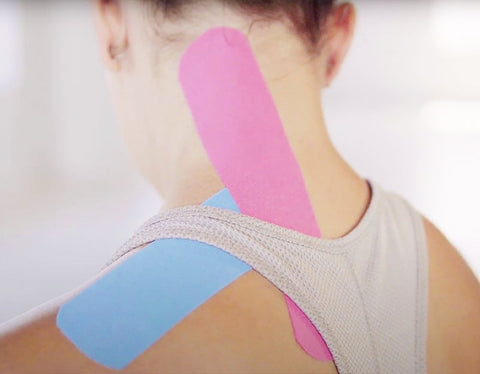
*This protocol requires assistance — the neck is a hard-to-reach area to self-tape accurately.
Step 1: Start seated with the head and neck turned toward the opposite shoulder.
Step 2: Have an assisting partner measure a compression strip spanning the area of complaint.
Step 3: Measure the security strip starting at the base of the skull to finish in the mid-back.
Step 4: Round the tape ends.
Step 5: Apply the compression strip with 50% tension spanning the area of complaint.
Step 6: Apply the security strip from the base of the skull to the mid-back with 0% tension.
Step 7: Rub in the tape to activate the adhesive.
Protocol B: Bilateral neck (both-sided pain or general stiffness)

*This protocol also requires assistance for best results.
Step 1: Start in a comfortable seated position.
Step 2: Have the assisting partner measure a compression strip to span the area of complaint.
Step 3: Measure two security strips from the base of the skull toward the mid-back (one for each side).
Step 4: Bring your chin toward your chest to elongate the posterior cervical muscles.
Step 5: Apply the compression strip across the area of complaint with 50% tension.
Step 6: Apply the first security strip from the base of the skull to the mid-back with 0% tension.
Step 7: Apply the second security strip symmetrically to the first with 0% tension.
Step 8: Rub in the tape firmly to activate the adhesive. Check that all edges are flat.
Postural taping for tech neck (self-applicable)
For forward-head posture and upper trapezius tension — a common daily-use protocol that can be self-applied:
- Cut two I-strips, each approximately 20–25 cm long.
- Sit or stand in good posture (ears over shoulders, chin tucked slightly).
- Apply the first strip with 10–15% tension along the upper trapezius (from the base of the skull, across the top of the shoulder, toward the tip of the shoulder). Anchor both ends with zero tension.
- Repeat on the opposite side.
- The light tension of both strips provides ongoing proprioceptive feedback, gently reminding you to maintain upright posture throughout the day.
This postural protocol is ideal for desk workers, students, and anyone who spends extended time looking at screens.
Tape Geeks: The one-stop-shop for your kinesiology taping needs!
[cta-all]Enjoy a great stick without making your skin sick with Tape Geeks kinesiology tape! TG tapes are hypoallergenic, zinc-free, and latex-free — manufactured in an ISO-certified and dermatologist-approved factory in South Korea, known for their consistent and reliable adhesives.
Get the best deals for Tape Geeks' products by visiting our Amazon store today!
How do you prevent neck pain?
Here are some things that you can do to prevent neck pain from developing in the future:
- Practice good posture. Practicing good posture develops strength, balance, and flexibility that help reduce muscle pain and cervical load.
- Take breaks. Do not stay in one position for too long. Set a timer for every 45–60 minutes and perform a few chin tucks and scapular squeezes.
- Set up an ergonomic workstation. Here's ahelpful video for ergonomic setup.
- Optimize your sleeping position. Sleep with your neck aligned with your body. Use a cervical support pillow on your back or side — never sleep on your stomach.
- Quit smoking. Smoking reduces disc hydration and accelerates cervical spine degeneration.
Neck pain prevention checklist for athletes and desk workers
- ✅ Do chin tucks daily — 10 reps, 3 times per day, takes under 2 minutes
- ✅ Monitor at eye level — Top of screen should be at or slightly below eye level
- ✅ Phone at eye level — Bring the phone up, not your head down
- ✅ Use a cervical pillow — Maintains neutral neck position during sleep
- ✅ Strengthen upper back — Band pull-aparts and rows counteract chronic forward posture
- ✅ Apply kinesiology tape on heavy screen days — Postural taping protocol reduces cumulative load on the cervical spine
- ✅ Check your running posture — Runners often develop forward head from looking down. Focus on a horizon gaze.
Conclusion
Now that you understand the anatomy of the cervical spine, the common causes and symptoms of neck pain, available treatments, and two kinesiology taping protocols, you're better equipped to address neck pain effectively — and prevent it from returning.
For more information on other aches and pains likeknee pain andback pain, make sure to read our blog for helpful articles and tips!
[cta-more]
[cta-email]Frequently Asked Questions About Neck Pain and Kinesiology Taping
How long does neck pain usually last?
Most acute neck pain from muscle strain resolves within 1–2 weeks with rest and gentle movement. Subacute pain (4–12 weeks) responds well to physiotherapy and targeted exercises. Chronic pain (12+ weeks) requires a comprehensive rehabilitation program. See a doctor if pain involves arm symptoms or doesn't improve after 4 weeks.
Does kinesiology tape help neck pain?
Yes — kinesiology tape helps neck pain by lifting the skin to improve circulation and reduce pressure on pain receptors, and by providing proprioceptive feedback that reduces forward-head posture. Studies show it significantly reduces pain and improves range of motion when combined with exercise and manual therapy.
What causes neck pain on one side only?
One-sided neck pain is most commonly caused by sleeping awkwardly, a cervical facet joint irritation from sudden head movement, upper trapezius strain from poor workstation setup, or unilateral nerve root compression. The unilateral kinesiology tape protocol shown in this article — applying a compression strip to the painful side with 50% tension — is designed specifically for this pattern.
Can neck exercises make pain worse?
Gentle exercises like chin tucks and lateral stretches rarely worsen neck pain. Avoid forceful rotation or any movement causing sharp pain or arm symptoms. If any exercise causes pain radiating into the arm, stop immediately. For acute pain, start with isometric exercises (no movement, just gentle resistance) before progressing to mobility work.
Is heat or ice better for neck pain?
Use ice for the first 48–72 hours after acute neck strain (15–20 minutes at a time). After 72 hours, switch to heat to relax tight muscles. For chronic neck pain with no recent trauma, most people find heat more effective. Kinesiology tape can be worn alongside heat therapy for around-the-clock support.
How do I apply kinesiology tape to my own neck?
The most self-applicable protocol is the postural taping technique: cut two I-strips (20–25 cm), sit in good posture, and apply each along the upper trapezius (from the base of the skull across the top of the shoulder) with 10–15% tension. This provides excellent proprioceptive feedback without needing to reach the back of the neck. For the bilateral and unilateral protocols, ask a partner or physiotherapist to help.


