




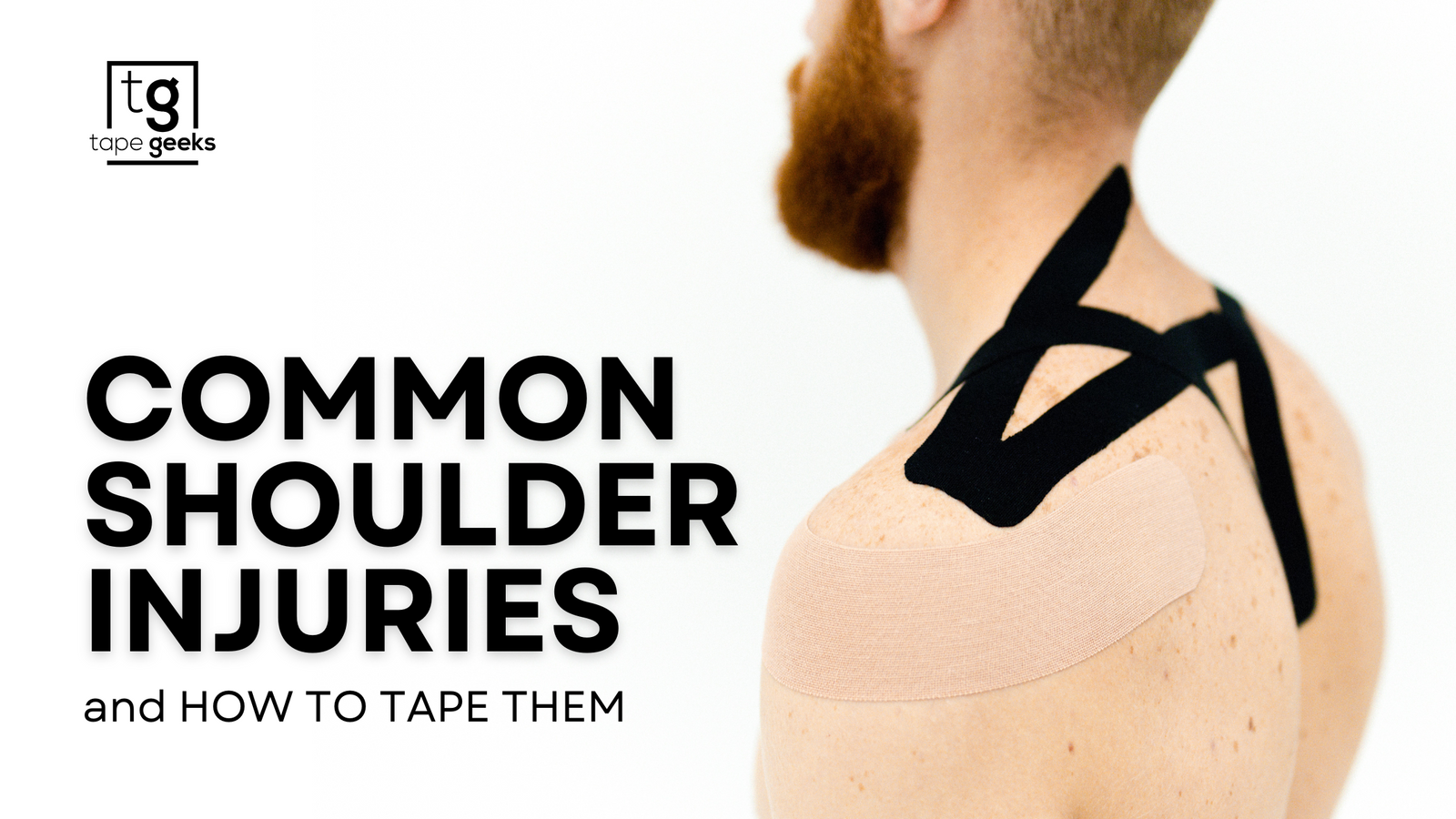
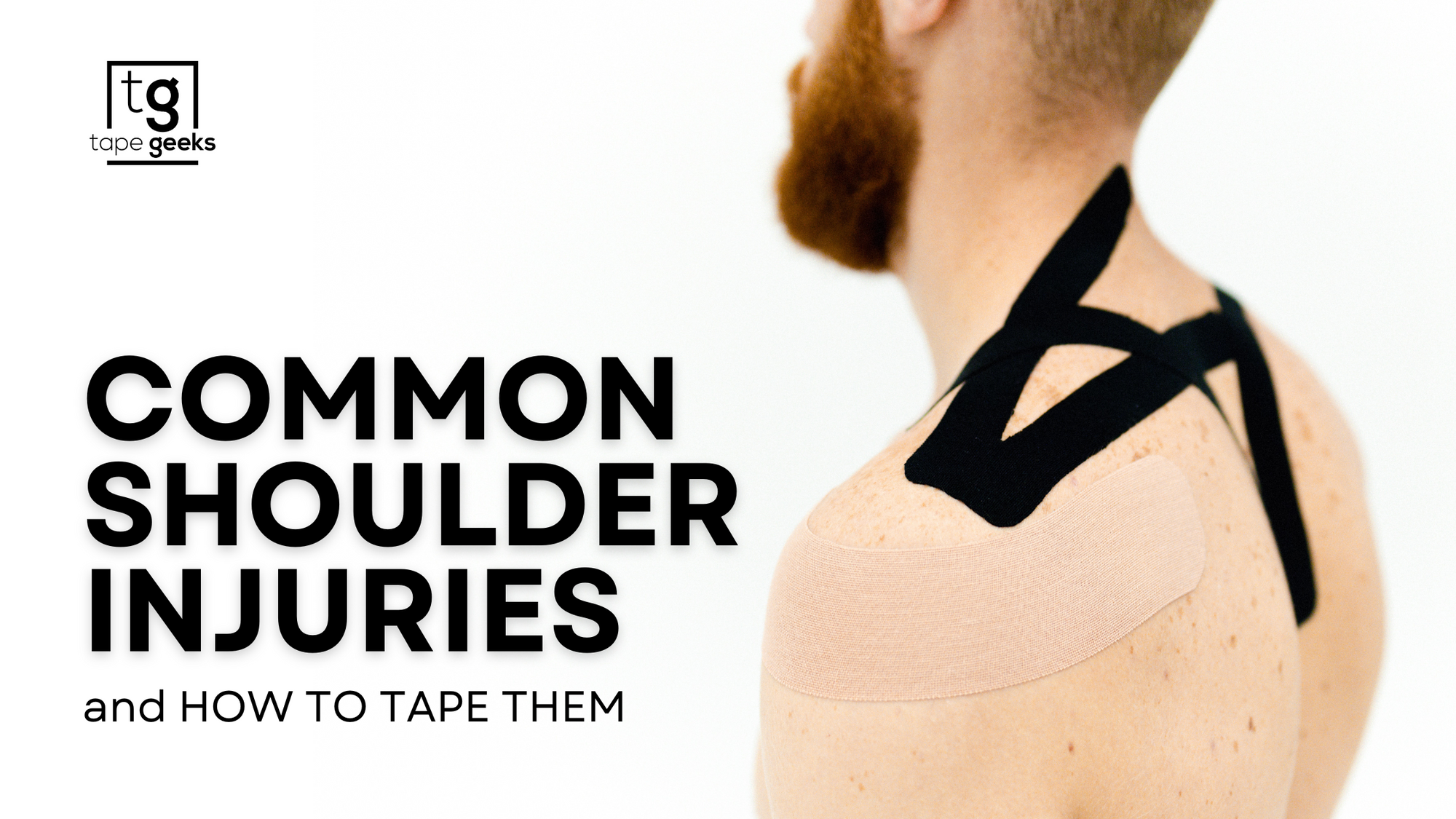
The 5 Most Common Shoulder Injuries: What They Are, Who Gets Them, and How Kinesiology Tape Helps

Written by: Professor Geek (The Geek Educator)
Edited by: Greg Kowalczyk, CEO & Co-Founder, TapeGeeks Inc.
Your shoulder is the most mobile joint in your body — and that mobility comes at a cost. With four muscles and their tendons working as a team to keep a golf-ball-sized humeral head seated in a shallow socket, the margin for error is thin. A single overhead throw, a hard fall onto an outstretched arm, or a thousand repetitive press-ups can tip that balance and land you on the injured list.
Shoulder injuries account for roughly 20% of all musculoskeletal complaints seen in primary care, and for overhead athletes — swimmers, baseball pitchers, volleyball players, and CrossFitters — that number climbs even higher. The frustrating part is that many shoulder injuries are slow to announce themselves. By the time pain becomes impossible to ignore, the underlying damage has often been building for months.
This guide breaks down the five most common shoulder injuries in athletes and active adults: what each one actually is, who is at risk, how to recognize it, and what conservative treatment looks like — including how kinesiology tape fits into the recovery toolkit.
Quick Answer: The 5 Most Common Shoulder Injuries
- Rotator Cuff Strain or Tear — the most common overall; supraspinatus is the usual culprit
- Shoulder Impingement Syndrome — soft-tissue pinching under the acromion
- AC Joint Sprain — the bump on top of the shoulder from a fall or collision
- Biceps Tendonitis — often a companion to impingement; front-of-shoulder ache
- SLAP Tear — labral damage at the top of the socket; common in throwers and lifters
A Quick Shoulder Anatomy Primer
You do not need a medical degree to understand shoulder injuries, but a 60-second anatomy recap makes everything else click.
The glenohumeral joint is the main ball-and-socket: the head of the humerus (upper arm bone) sits in the glenoid fossa of the scapula (shoulder blade). Because the socket is shallow — think of a golf ball on a tee — stability comes almost entirely from soft tissue rather than bony architecture.
The rotator cuff is four muscles that wrap around the joint: supraspinatus (lifts the arm), infraspinatus and teres minor (externally rotate), and subscapularis (internally rotates). Their tendons merge into a cuff that both moves and stabilizes the joint simultaneously.
Above the rotator cuff sits the subacromial space — a narrow gap between the cuff tendons and the acromion bone of the scapula. This space is occupied by the supraspinatus tendon and the subacromial bursa. When posture, mechanics, or swelling reduces that space, you get impingement.
The acromioclavicular (AC) joint connects the clavicle (collarbone) to the acromion at the top of the shoulder. It is held together by strong ligaments and is the first casualty in direct falls onto the shoulder point. The labrum is a ring of fibrocartilage that deepens the glenoid socket and serves as the anchor point for the biceps tendon — which is where SLAP tears originate.
The 5 Most Common Shoulder Injuries
1. Rotator Cuff Strain or Tear
What it is: Damage to one or more of the rotator cuff tendons, ranging from microscopic fibre tearing (strain) to a full-thickness rupture. The supraspinatus tendon is involved in roughly 90% of cases because it passes through the tightest part of the subacromial space. Partial tears are far more common than full tears and respond well to conservative management.
Who gets it: Anyone, but incidence rises sharply with age — cadaveric studies show full-thickness rotator cuff tears in approximately 25% of individuals in their 60s and over 50% in those over 80. In younger athletes, rotator cuff injuries are typically acute (a single violent event) rather than degenerative. Overhead athletes — swimmers, pitchers, tennis players, and weight-lifters — are at elevated risk at any age.
Symptoms: Deep aching pain in the shoulder that often radiates to the outer upper arm; weakness when lifting the arm sideways or reaching overhead; pain at night, especially lying on the affected shoulder; a painful arc between roughly 60–120 degrees of arm elevation.
Conservative treatment: Activity modification, NSAIDs for acute flare-ups, targeted physical therapy (rotator cuff strengthening, scapular stabilisation, posterior capsule stretching). Most partial tears and strains respond well to 8–12 weeks of structured rehab. Corticosteroid injection can be useful for short-term pain control. Surgery is typically reserved for full-thickness tears with persistent weakness that fail 3–6 months of conservative care.
2. Shoulder Impingement Syndrome
What it is: Subacromial impingement occurs when the soft tissues in the subacromial space — primarily the supraspinatus tendon and bursa — are compressed between the humeral head and the acromion during arm elevation. Over time, this repeated mechanical irritation leads to tendinopathy, bursitis, and pain. It is the most common diagnosis given for shoulder pain in primary care, accounting for 44–65% of all shoulder pain presentations.
Who gets it: Overhead athletes, swimmers, painters, carpenters, and anyone with rounded-shoulder posture or weak rotator cuff muscles. Poor scapular control — sometimes called "scapular dyskinesis" — is a major contributor because the scapula fails to rotate upward correctly during arm elevation, narrowing the subacromial space.
Symptoms: A painful arc during arm elevation (typically 60–120 degrees), aching in the front and outer shoulder, pain reaching behind the back or across the body, and worsening symptoms after overhead activity. The Neer and Hawkins-Kennedy clinical tests are positive.
Conservative treatment: Physical therapy is first-line and highly effective — randomised trials show outcomes equivalent to surgery for most patients. Treatment focuses on rotator cuff strengthening (especially infraspinatus and lower trapezius), postural correction, and manual therapy. Kinesiology tape for scapular repositioning is widely used as an adjunct. Most patients improve significantly within 6–12 weeks.
3. AC Joint Sprain
What it is: A sprain or separation of the acromioclavicular joint, graded I–VI based on severity. Grade I and II (ligament stretch or partial tear) are the most common and respond well to conservative management. Grade III separations — where the clavicle visibly rides up — are controversial; most orthopaedic guidelines now favour non-operative treatment even for Grade III injuries in non-throwing athletes. Grades IV–VI involve severe displacement and almost always require surgery.
Who gets it: Contact sport athletes are disproportionately affected — AC joint sprains account for roughly 40–50% of all shoulder injuries in rugby and American football. A direct fall onto the tip of the shoulder (the "point-down" mechanism) or a FOOSH (fall onto an outstretched hand) are the classic mechanisms. Cyclists, mountain bikers, and skiers are also frequent victims.
Symptoms: Immediate sharp pain directly over the AC joint (the bony bump on top of the shoulder), tenderness to direct palpation, a visible step deformity in higher-grade injuries, and pain with cross-body movements or lying on the shoulder. Reaching across the body to touch the opposite shoulder reproduces pain reliably.
Conservative treatment: Ice, a sling for comfort in the first week, progressive range-of-motion and strengthening exercises. Grade I typically resolves in 1–2 weeks; Grade II takes 3–6 weeks. Kinesiology tape provides compression and proprioceptive support during the return-to-sport phase and is commonly used to offload the joint during training.
4. Biceps Tendonitis
What it is: Inflammation of the long head of the biceps tendon, which runs through the bicipital groove on the front of the humerus and attaches to the superior labrum. Biceps tendonitis rarely occurs in isolation — it is most often a secondary consequence of shoulder impingement or rotator cuff pathology, because the biceps tendon travels through the same compromised subacromial space. Some clinicians argue it is underdiagnosed precisely because the pain presentation overlaps so heavily with impingement.
Who gets it: Overhead athletes, weightlifters, rowers, and swimmers. Repetitive supination (turning the palm up) against resistance — as in pulling and rowing movements — loads the biceps tendon heavily. Age-related degeneration can also cause tendinopathy in the 40–60 age group without any single precipitating event.
Symptoms: Aching pain in the front of the shoulder that may radiate down the biceps muscle belly; pain with resisted elbow flexion or forearm supination; point tenderness in the bicipital groove; Speed's test and Yergason's test are typically positive on clinical examination.
Conservative treatment: Relative rest from aggravating movements, eccentric loading protocols (effective for most tendinopathies), and addressing the underlying impingement if present. Ultrasound-guided corticosteroid injection into the tendon sheath can reduce acute pain. Biceps tenodesis surgery is occasionally required for persistent cases unresponsive to 3–6 months of conservative care.
5. SLAP Tear (Superior Labral Tear from Anterior to Posterior)
What it is: A tear of the superior (top) portion of the glenoid labrum — the rim of fibrocartilage that deepens the shoulder socket. SLAP stands for Superior Labral tear from Anterior to Posterior, describing the direction of the tear. Type II SLAP tears, where the biceps anchor is detached from the glenoid, are the most common and most clinically significant. SLAP lesions are notoriously difficult to diagnose clinically and are frequently missed on initial assessment.
Who gets it: Throwing athletes (baseball pitchers, quarterbacks, javelin throwers) are at highest risk because the late-cocking phase of throwing generates massive traction forces on the biceps anchor. SLAP tears also occur in weight-lifters from compressive loading and in anyone who falls onto an outstretched arm. They account for approximately 6% of all shoulder arthroscopies but may represent up to 26% of shoulder injuries in overhead athletes.
Symptoms: Deep, vague pain inside the shoulder joint; a painful click or catching sensation during overhead movements; loss of velocity or endurance in throwing; symptoms that worsen with overhead activities but may be absent at rest. Diagnosis is confirmed by MRI arthrogram or diagnostic arthroscopy — clinical tests have poor sensitivity.
Conservative treatment: Physical therapy for 3–6 months is appropriate for most Type I SLAP tears (simple fraying without detachment) and for older patients where degenerative change is expected. For younger throwing athletes with Type II tears, surgical repair (arthroscopic SLAP repair or biceps tenodesis in patients over 35) is often required to restore full throwing function. Return-to-throwing timelines are typically 6–9 months post-surgery.
My honest take: The most underdiagnosed shoulder injury
In my experience working with athletes, biceps tendonitis is the most consistently missed shoulder diagnosis — not because it is rare, but because it rarely shows up cleanly on imaging and its pain pattern mimics so many other conditions. If you have been told you have "shoulder impingement" but haven't responded fully to treatment, ask your clinician to specifically assess the bicipital groove. The two conditions frequently coexist and must be treated together for full recovery.
How Kinesiology Tape Helps Shoulder Injuries
Kinesiology tape is a thin, elastic therapeutic tape that mimics skin's elasticity (roughly 130–140% stretch capacity). Unlike rigid athletic tape, which restricts movement, kinesiology tape works with movement — and this is critical for the shoulder, where immobilisation is almost never the goal.
The proposed mechanisms are well-supported by a growing body of research:
- Pain inhibition: The gentle lifting effect of kinesiology tape on the skin stimulates cutaneous mechanoreceptors, which activate the gate control mechanism and reduce pain signal transmission. Multiple randomised controlled trials have demonstrated statistically significant short-term pain reduction for shoulder impingement patients taped with kinesiology tape versus sham tape or no tape.
- Proprioceptive enhancement: The tape provides constant sensory feedback about shoulder position. For athletes returning from injury, this enhanced proprioception helps re-establish normal movement patterns and neuromuscular timing.
- Scapular repositioning: Scapular kinesiology tape techniques have been shown in multiple studies to improve scapular upward rotation and reduce scapular anterior tilt — directly addressing the mechanical cause of impingement. A 2008 randomized trial in the Journal of Orthopaedic & Sports Physical Therapy (Thelen et al., n=42) tested kinesiology tape against sham tape in rotator cuff tendinitis and impingement. Taping produced an immediate gain of roughly 17 degrees in pain-free abduction, but no improvement in pain intensity or disability over sham.
- Postural cueing: Applied across the posterior shoulder and scapula, kinesiology tape acts as a constant postural reminder — nudging rounded shoulders back into a more neutral position throughout the day without restricting the range of motion needed for athletic performance.
One honest limitation: Kinesiology tape is a support tool, not a treatment in isolation. The research is clear that tape alone, without addressing the underlying muscular imbalances and movement faults, produces only temporary relief. Think of tape as scaffolding — useful while you rebuild, but not a substitute for the structural work.
For best results, use kinesiology tape as part of a structured rehabilitation programme. If you are new to taping, our guide on kinesiology taping for heel pain covers the application fundamentals that apply across all body regions.
How to Tape for Shoulder Impingement: Step-by-Step
This two-strip technique addresses both the supraspinatus tendon decompression and scapular repositioning — the two most important mechanical targets for impingement.
What you need: One Y-strip (approx. 30 cm / 12 inches), one I-strip (approx. 25 cm / 10 inches), scissors, clean dry skin.
Strip 1: Y-Strip for Deltoid and Supraspinatus Support
- Position: Sit or stand with the arm at your side. Bring the hand of the affected arm across the body toward the opposite hip, creating mild shoulder depression and exposing the supraspinatus region.
- Anchor: Place the base (tail end) of the Y-strip at the deltoid insertion on the outer mid-upper arm with zero stretch — just the natural recoil of the tape.
- Upper tail: Route the upper tail of the Y up and over the top of the shoulder (over the AC joint and supraspinatus), applying 15–25% stretch and ending at the base of the neck near C7.
- Lower tail: Route the lower tail of the Y over the anterior deltoid (front of the shoulder), applying 15–25% stretch and ending at the front of the shoulder near the bicipital groove.
- Finish: Rub the entire strip briskly with your palm for 30 seconds to activate the heat-sensitive adhesive.
Strip 2: I-Strip for Scapular Stabilisation
- Position: Slightly protract (round forward) the shoulder blade by reaching the arm across the body. This pre-stretches the application area.
- Anchor: Place the base of the I-strip at the inferior angle of the scapula (the lowest point of the shoulder blade) with zero stretch.
- Direction: Apply the tape upward and medially along the medial border of the scapula toward the spine of the scapula, using 25–35% stretch. The increased tension here creates a retraction cue that pulls the scapula into a more neutral, upwardly rotated position.
- End anchor: Lay the last 3–4 cm of the strip down with zero stretch to secure the end.
- Rub to activate: Same 30-second friction activation as strip 1.
Pro tip: Tape can be worn for 3–5 days including during showering. If the skin underneath becomes irritated or itchy, remove the tape and allow the skin to rest for 24 hours before reapplying. Never apply tape to broken, sunburned, or recently shaved skin.
How to Tape for AC Joint Support
AC joint taping aims to reduce the vertical separation force between the clavicle and acromion, providing compression and proprioceptive support during the return-to-training phase. This technique works best for Grade I–II sprains once acute swelling has subsided (typically 48–72 hours post-injury).
What you need: Two I-strips (approx. 15 cm / 6 inches each), clean dry skin.
- Position: Arm relaxed at the side. Depress the shoulder slightly (shrug down gently) to reduce the step deformity as much as comfortable.
- First I-strip: Place the anchor over the top of the AC joint with the tape running vertically over the joint from the top of the clavicle to the acromion. Apply 50–75% stretch across the joint itself — this is higher tension than standard applications because you want genuine compression. Lay both ends (2–3 cm) down with zero stretch.
- Second I-strip: Apply diagonally across the first, from the front of the clavicle to the posterior acromion, again with 50–75% stretch over the joint and zero stretch at both ends.
- Rub to activate: 30 seconds of palm friction over both strips.
For an additional offloading effect in higher-grade separations, your physiotherapist may add a shoulder sling or a more elaborate taping construction — this basic two-strip technique is appropriate for training support once you are cleared for return to activity.
Local Newmarket note: If shoulder pain is still affecting your training after a couple of weeks, a hands-on assessment can help separate a simple overload issue from something that needs a more specific plan. Newmarket athletes can use SportClinicFinder to find a shoulder injury clinic in Newmarket and compare local options before pushing the next block.
When to See a Specialist: Red Flags
Most shoulder injuries respond well to self-managed conservative care in the first 48–72 hours. Seek medical assessment promptly if you experience any of the following:
- Significant loss of strength — inability to lift the arm or hold objects with the affected side. This can indicate a full-thickness rotator cuff tear or nerve injury.
- Visible deformity — a prominent step or bump at the AC joint, or a visible dislocation of the glenohumeral joint (the entire shoulder appears squared off or the arm hangs differently).
- Acute trauma with severe, immediate pain — especially after a direct fall, collision, or violent force. This warrants X-ray to rule out fracture.
- Locking, catching, or grinding inside the joint — not to be confused with the harmless "shoulder pops" many people experience. A true mechanical catch that stops movement is a red flag for loose bodies or significant labral pathology.
- Pain radiating down the arm below the elbow, particularly with numbness or tingling — this suggests cervical nerve root involvement or thoracic outlet syndrome rather than a primary shoulder problem.
- No improvement after 2–3 weeks of sensible conservative management. Do not let a shoulder injury linger — the sooner accurate diagnosis guides treatment, the better the long-term outcome.
Important
Kinesiology tape is a support and rehabilitation adjunct — it is not a substitute for medical evaluation. If you are unsure whether your shoulder injury requires imaging or specialist care, err on the side of getting it assessed. A missed rotator cuff tear or undiagnosed fracture can significantly worsen with continued loading.
Shoulder Injury Prevention: What Actually Works
Prevention is not glamorous, but it pays off compounding returns over an athletic career. The evidence consistently points to three priorities:
1. Rotator Cuff Strengthening
External rotation and scapular retraction exercises are the highest-value investments. The "thrower's ten" programme — which includes side-lying external rotation, prone Y and T raises, and diagonal PNF patterns — has strong evidence for both prevention and rehab. Use light resistance and high volume: 3 sets of 15–20 repetitions, 3–4 days per week. The goal is endurance, not maximum strength.
2. Posterior Capsule Flexibility
Tightness in the posterior capsule forces the humeral head to ride anteriorly and superiorly — directly into the subacromial space. The "sleeper stretch" (lying on the affected side with the shoulder at 90 degrees and gently rotating the forearm toward the floor) held for 30–60 seconds, performed 3–4 times daily, is the most effective intervention for correcting this imbalance.
3. Load Management
Most shoulder overuse injuries develop when training volume increases faster than the tissue can adapt. Apply the 10% rule for overhead volume (do not increase weekly throwing distance, swim yardage, or overhead pressing load by more than 10% per week), and build in one complete rest day per week from upper-body loading. Monitoring the ratio of acute to chronic workload — popularised by Tim Gabbet's research in sports science — is particularly valuable for throwing athletes managing high seasonal volumes.
Vaughan shoulder injury note: Tape can help some athletes manage mild shoulder discomfort during activity, but pain after a fall, repeated overhead work, or suspected rotator cuff irritation deserves a proper clinical check; if you are north of Toronto, use SportsClinicFinder to find a shoulder injury clinic in Vaughan.
Frequently Asked Questions
What is the most common shoulder injury in athletes?
Rotator cuff injuries — specifically strains and partial tears of the supraspinatus tendon — are the most common shoulder injuries across athletic populations. In older athletes (40+), degenerative rotator cuff changes are almost universal, even without a specific injury event. In younger athletes, impingement syndrome (which often involves early rotator cuff irritation) is the most frequent presenting complaint in sports medicine clinics.
How long does a shoulder injury take to heal?
Timelines vary by injury type and severity. Grade I AC joint sprains and mild impingement episodes can resolve in 1–3 weeks with appropriate care. Rotator cuff strains typically require 6–12 weeks of structured rehabilitation. Full-thickness rotator cuff tears treated conservatively may take 3–6 months. Surgically repaired SLAP tears have the longest timelines — expect 6–9 months before return to full overhead sport. Starting rehabilitation early with a physiotherapist dramatically improves outcomes across all types.
Can I still train with a shoulder injury?
In most cases, yes — but training needs to be modified, not stopped. Complete rest is rarely optimal for soft-tissue shoulder injuries. Work with a physiotherapist to identify which movements are pain-free, maintain loading through those patterns, and use them as the foundation for progressive return. Lower body and core work can almost always continue uninterrupted. The key is avoiding the specific loading directions that reproduce your shoulder symptoms.
Does kinesiology tape actually work for shoulder pain?
The evidence supports short-term pain reduction and improved function when kinesiology tape is applied correctly for shoulder impingement and rotator cuff conditions. Multiple randomised controlled trials show statistically significant improvements in pain scores and range of motion compared to no-tape controls, particularly for impingement patients. The effect size is moderate — tape is not a cure, but it meaningfully supports recovery when used alongside targeted exercise.
How do I know if I've torn my rotator cuff?
The hallmark symptoms of a significant rotator cuff tear are weakness (not just pain — actual inability to lift the arm or hold resistance), a painful arc between 60–120 degrees of elevation, and night pain that wakes you from sleep. However, small partial tears can be surprisingly subtle. The only way to confirm a tear and determine its size is through MRI or diagnostic ultrasound. If you suspect a tear, particularly if you have had acute trauma or persistent weakness, get imaging.
What is the difference between shoulder impingement and a rotator cuff tear?
Impingement is a mechanical problem — the tendon is being compressed but not necessarily torn. A rotator cuff tear is structural damage to the tendon tissue itself. The two conditions exist on a continuum: chronic, untreated impingement is one of the leading causes of rotator cuff tears over time. Symptoms overlap significantly, which is why imaging is important for accurate diagnosis. Impingement generally responds faster to conservative treatment than a true tear.
Can shoulder injuries be prevented entirely?
Not entirely — acute injuries from falls and collisions are largely unpredictable. But overuse injuries (impingement, rotator cuff tendinopathy, biceps tendonitis) are highly preventable. Consistent rotator cuff and scapular stabiliser strengthening, managing training load sensibly, and addressing posture and posterior capsule tightness will significantly reduce your injury risk across a career. Athletes who invest in prehab rarely face the extended absences that follow preventable injuries.
Is swimming good for shoulder injury rehabilitation?
It depends entirely on the injury. Swimming is often recommended as low-impact cross-training — but for shoulder impingement and rotator cuff injuries, freestyle and butterfly strokes are among the most provocative movements possible. Backstroke is generally less aggravating. If you want to use swimming for general fitness during shoulder rehab, discuss the specific stroke mechanics with your physiotherapist first. Many shoulder-injured swimmers find that kicking drills with a pool buoy are the safest interim option.
The Bottom Line
The shoulder's extraordinary range of motion is both its greatest asset and its greatest vulnerability. Rotator cuff tears, impingement syndrome, AC joint sprains, biceps tendonitis, and SLAP tears are the five most common injuries athletes face — and all of them share a common thread: they respond far better to early, targeted intervention than to rest and hope.
Kinesiology tape is a legitimate part of the treatment toolkit. It reduces pain, enhances proprioception, and helps retrain scapular mechanics — but it works best as scaffolding while you do the structural work of rehabilitation. Apply the correct technique, stay consistent with your exercise programme, and do not hesitate to seek specialist input if your shoulder is not progressing.
If you are dealing with a shoulder injury and want a tape that moves with you, holds through training, and actually stays put, explore our full kinesiology tape range. Our 5cm therapeutic tape is designed specifically for joint applications where durability and skin-friendliness both matter.
This guide is part of TapeGeeks' commitment to providing athletes with practical, evidence-based tools for recovery and performance.